Recruiting the Fighting Forces, 1790-1918 (Edexcel A Level History: Paper 3 Options): Revision Note
Exam code: 9HI0

Summary
The Royal Navy, Britain's Senior Service, filled many of its ranks by pressing men into service
Around half of the men serving in the Royal Navy had been pressed or forced into joining in 1805
The rest were volunteers, although they were often convicted criminals who had been given the choice between prison and the Navy
The Army relied on volunteers, supported by part-time forces such as the militia
The outbreak of the First World War led to the introduction of formal conscription in Britain for the first time
This was due to the Military Service Act, which was passed in 1916
Impressment and the manning of the forces
Britain had no conscription for the regular army, though the militia ballot compelled some men into home-defence service
However, once war with France began in 1793, the Navy had to grow from about 17,000 men to 45,000, and by 1810 it needed over 140,000
The number of men who volunteered to serve in the Navy was insufficient
As a result, the Navy relied on impressment and the quota system to man the ranks
The Impressment Service
The role and responsibility of the Impressment Service was to round up men in and around ports and force them to join the Royal Navy
Captains of Royal Navy ships could also press (or force) merchant seamen to join their ships
Around half of the men in the Royal Navy had been pressed into service by 1805
The quota system
In addition to pressed men, the Quota Acts (1795–96) required each county to provide a set number of men
The number of volunteers required depended on each county's population and number of ports
These volunteers were often criminals who were given the choice of volunteering for the Navy or being sent to prison
Volunteers and the volunteer tradition
Unlike the Navy, Britain's Senior Service, the Army, did not press men to join
With any threat of invasion of Britain coming by sea and with a large and growing global Empire, Britain's Royal Navy was the 'Senior Service'
Therefore, Britain did not feel the need to maintain an enormous standing army of conscripts like those in France, Prussia and Russia
Instead, it maintained a relatively small Army made up of volunteers
At different times, this was supported by different organisations, including:
The militia
The Army Reserve
The Volunteer Force
The Yeomanry
These part-time organisations represented Britain's volunteer tradition
They enabled Britain to maintain a small professional Army whilst also being able to draw on much larger numbers in times of emergency
Volunteers in the French Wars
Part-time volunteer units were recruited to defend against French invasion from 1793
Napoleon's plans to invade Britain led these numbers to increase from 1803
By 1804, there were approximately 380,000 volunteers
These volunteers were for home defence rather than service overseas
The regular Army relied on bounties and militia transfers to find enough men
A bounty was a cash payment offered to encourage men to join
From 1799, militiamen were allowed to transfer into the regular Army
From 1808, about 10,000 militiamen a year transferred
Reforming recruitment 1815–1899
Impressment was not used after 1815
The Continuous Service Act 1853 gave sailors long-term careers and pensions
The McNeill-Tulloch Report (1855) exposed poor conditions that deterred recruits
The Volunteer Force (1859) grew out of an invasion scare
Flogging abolished in peacetime (1868)
Short service of six years with the colours and six in the reserve (1870), which helped to build a trained reserve
Local regiments linked to recruiting districts (1872) to attract better recruits
In 1881, Childers linked infantry regiments to counties
Recruitment also rose and fell with the economy
When jobs were scarce, as in the 1840s, more men enlisted
Examiner Tips and Tricks
Fighting forces include the Royal Navy: examiners reward answers that track naval recruitment from impressment to the Continuous Service Act 1853. Don't focus only on the French Wars and the First World War
The Boer War
The Boer War of 1899–1902 tested Britain's volunteer system severely
Britain initially struggled against the Boers and required sizeable numbers of reinforcements
Over 30,000 men volunteered to serve in the Imperial Yeomanry, which was specifically created to fight against the Boers
The creation of this force exposed problems and weaknesses in Britain's volunteer system
These problems included volunteers having poor physical health and fitness, a lack of training and difficulty integrating with the wider Army
Haldane created the Territorial Force (1908), merging the Volunteers and Yeomanry into a part-time army for home defence
The introduction of conscription, 1916
The British volunteer tradition proved inadequate to cope with the demands of the First World War
It became clear in 1914 that Britain was going to need huge armies to fight in France and Belgium
However, Lord Kitchener, the Secretary of State for War, believed that conscription would be too unpopular
Instead, he planned to create these 'New Armies' out of volunteers
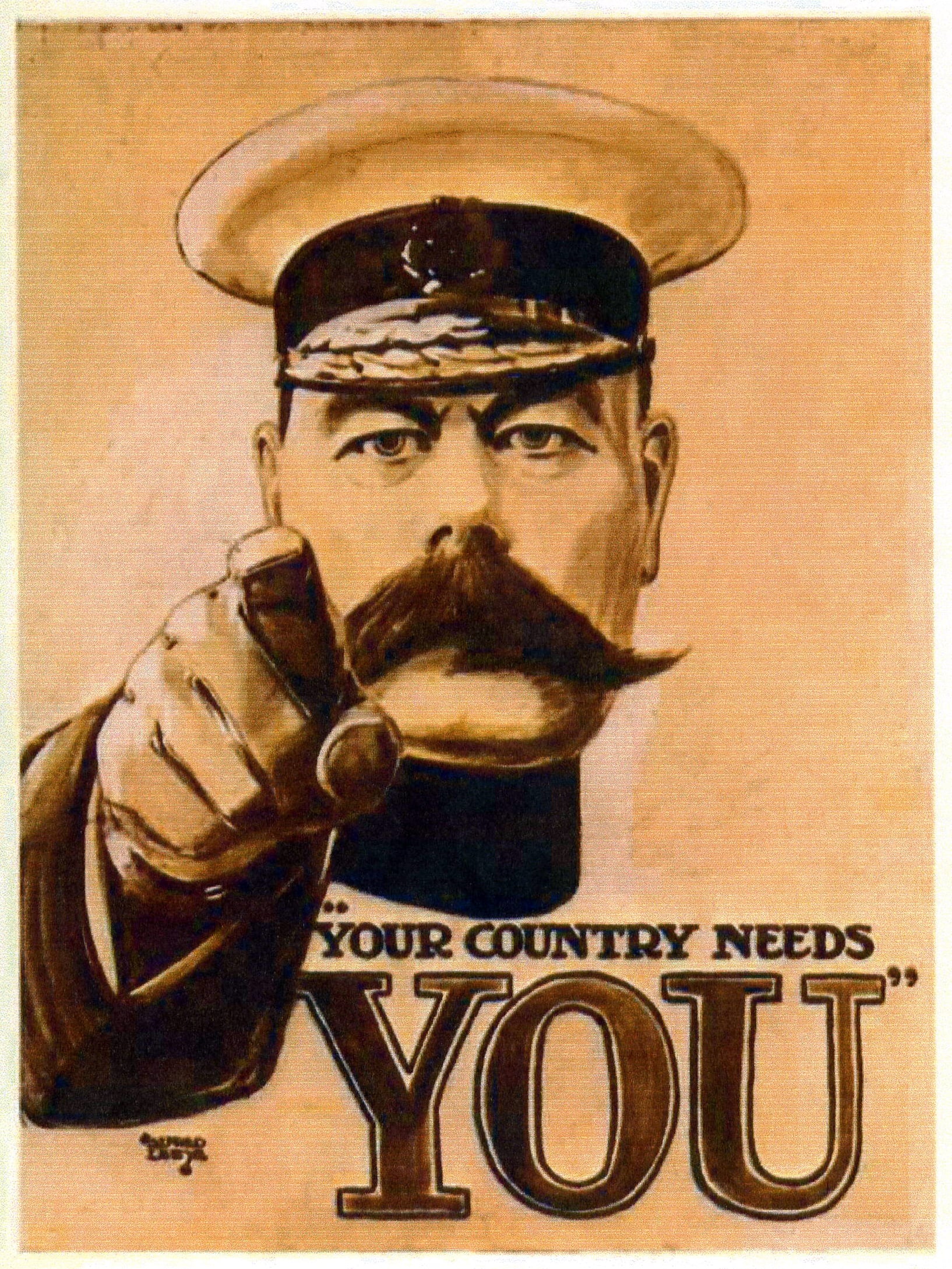
"Your Country Needs You" recruitment poster, Alfred Leete, 1914. Public domain, via Wikimedia Commons
When war broke out in 1914, enormous numbers rushed to volunteer
In August and September alone, 761,000 joined the Armed Forces
High numbers continued to volunteer until the middle of 1915, with propaganda posters and developments such as the 'Pals Battalions' encouraging people to 'join up'
Pals Battalions assured men who volunteered that they would serve alongside people from their town or workplace
However, by December 1915, the number of men volunteering had declined
The Derby Scheme (October–December 1915) asked men to attest they would serve if called
Too few single men came forward
Demands for conscription began to grow, and the Prime Minister, Herbert Asquith, faced a revolt from his own cabinet over the issue
The Military Service Act became law in January 1916
It conscripted unmarried men and widowers without dependent children aged between 18 and 41
Exemptions covered the unfit, sole supporters of dependants, conscientious objectors and those engaged in essential war work
The course we are going to ask Parliament to adopt—is to provide that, if, after due opportunity of inquiry, it is found that there are single men of military age who have no ground whatever for exemption or excuse, they shall be deemed to have done what everyone agrees it is their duty to the State in times like these to do, and be treated as though they had attested or enlisted. That is the course we propose to adopt in this Bill.
An extract from a speech by the Prime Minister, Herbert Asquith, to the House of Commons during a debate over the passing of the Military Service Act on 5 January 1916
Approach
Asquith's speech provides valuable evidence of the fundamental change in British recruitment represented by the Military Service Act of 1916. As Prime Minister introducing the legislation, he clearly explains that eligible single men without valid grounds for exemption would be compelled to serve rather than relying upon voluntary enlistment. However, because Asquith was attempting to persuade Parliament to accept a controversial measure, his description of military service as a duty that “everyone agrees” upon exaggerates the degree of consensus surrounding conscription. This demonstrates the government's desire to portray compulsion as a limited extension of the voluntary tradition rather than a complete rejection of it.
A second Military Service Act was passed in May 1916
This conscripted all men aged between 18 and 41, regardless of marital status
Conscription raised large numbers overall, about 2.5 million men by the end of the war, but fell short of what was hoped for
By mid-1916, about 750,000 men had submitted a claim for exemption
The average monthly enlistment number was lower under conscription than under the voluntary system
Local tribunals heard men's claims for exemption, including those of conscientious objectors
How far did the methods of recruitment change, 1790–1918?
In some ways, it can be argued that the methods of recruiting changed dramatically between 1790 and 1918
Britain was proud of its 'volunteer tradition ', and conscription was viewed as incompatible with the idea of British liberties
The First World War and the passing of the Military Service Act in 1916 ended this tradition
The British Armed Forces now conscripted large numbers of people to serve, a break with centuries of tradition
However, it is important to remember that Britain had been compelling people to join its Navy for many years
It could be argued that impressment was a form of conscription
It was less centralised and formalised, but it still resulted in thousands of men being compelled by their government to join the Armed Forces
To conclude, although there were many changes in recruitment between 1790 and 1918, those of 1916 were the most significant
These saw a formal shift away from the voluntary principle

Unlock more, it's free!
Join the 100,000+ Students that ❤️ Save My Exams
the (exam) results speak for themselves:

Was this revision note helpful?
