The Reform of the Royal Navy, 1790-1918 (Edexcel A Level History: Paper 3 Options): Revision Note
Exam code: 9HI0

Summary
The Royal Navy was significantly reduced after the defeat of Napoleon in 1815
From the 1830s onwards, the Royal Navy began to transform from ships made of wood and powered by sails to those made of metal and powered by steam engines
Sir James Graham's reforms also took place in the 1830s
They led to officers gaining more experience and made the Navy a fairer organisation
Admiral Fisher's reforms (1904–10) modernised the Navy before the First World War
They improved the training of officers
He also championed the expansion of submarines and introduced the Dreadnought class of battleships
Both were to revolutionise war at sea
The reduction of the Navy after 1815: decommissioning and size
After the defeat of Napoleon at the Battle of Waterloo in 1815, the threat of an invasion of Britain was removed in both the short and medium term
As a result, the Royal Navy was dramatically reduced in size
It went from having 713 warships in 1814 to just 121 four years later
Despite the enormous number of warships that had been decommissioned, this reduction still left Britain with a Navy big enough to control the world's trade routes
Many of the ships removed were smaller frigates and gunboats rather than ships of the line
The smaller Navy protected trade, suppressed piracy and worked against the slave trade
The shift from sail to steam
All of the ships that had been decommissioned after 1815 had been made of wood and powered by sails
Steam-powered paddle ships helped Britain to win the First Opium War (1839–42)
However, the paddles took up large areas of both sides of the ships
This prevented guns from being positioned along the hulls and meant they could not fire 'broadsides'
This meant most ships in the Royal Navy were powered by wind throughout the 1840s
The invention of the screw propeller in the late 1830s was the key development in changing this
The screw propeller was located at the stern of the ship, meaning guns could still be fitted all along both sides
HMS Ajax (launched 1809) was among the first ships of the line converted to screw propulsion, in 1846
HMS Duke of Wellington was launched in 1852 and was the most powerful battleship in the world
Its steam-powered screw propeller meant it could travel rapidly at 10 knots
It carried 131 guns
Its launching marked a new era in naval warfare
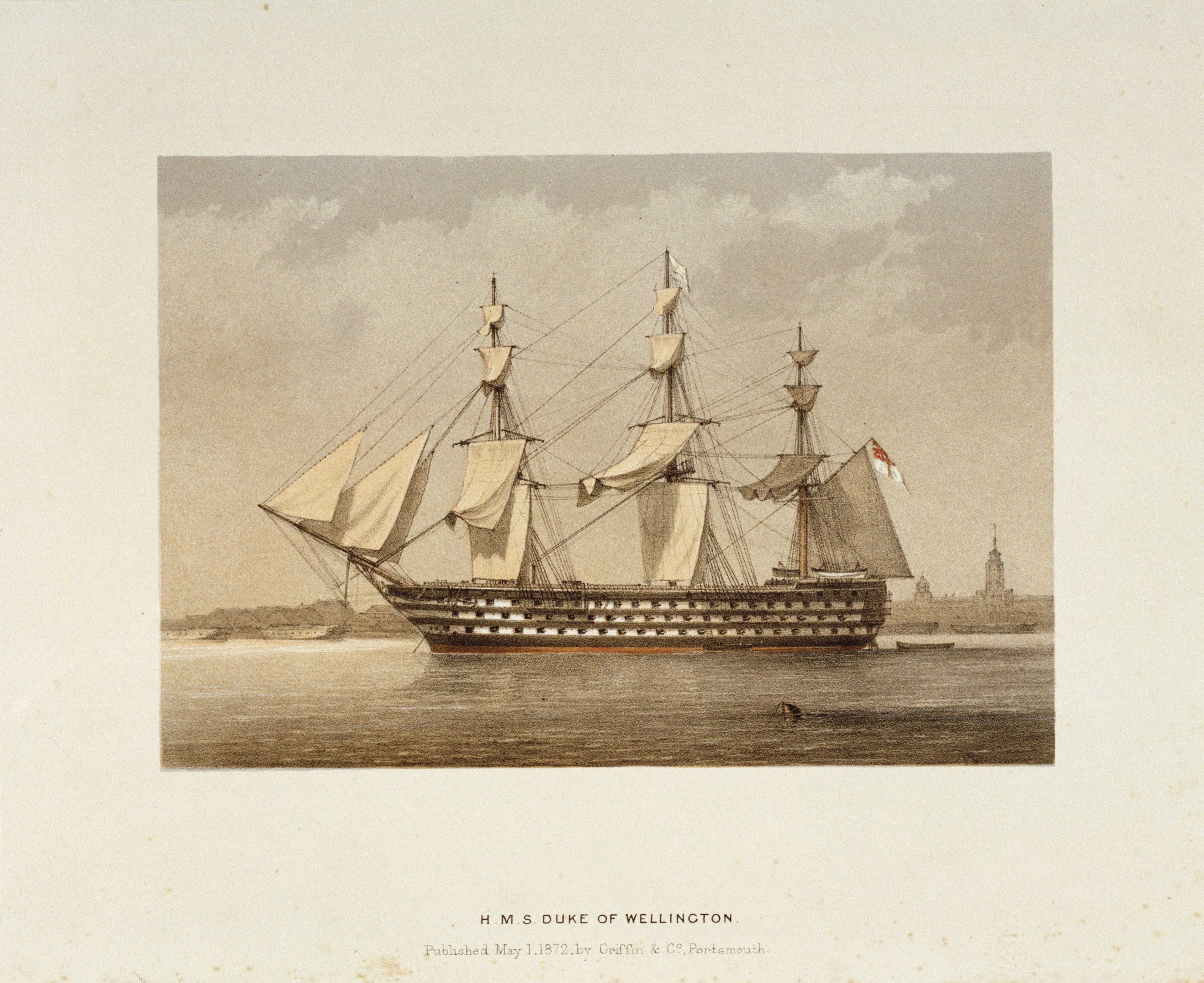
HMS Duke of Wellington, print by Griffin and Co, 1872. © National Maritime Museum, Greenwich, London (PU6198), public domain, via Wikimedia Commons
Graham's naval reforms, 1832
Sir James Graham was the First Lord of the Admiralty between 1830 and 1834
In 1832, he merged the Admiralty and the Navy Board
This made the organisation and administration of the Navy more efficient
It also helped to end the corruption and nepotism that had been common in the Navy
The gunnery school HMS Excellent, set up in 1830 and led by Thomas Hastings from 1832, gave sailors systematic gunnery training
Automatic promotions were stopped
All officers had to have at least two years' experience at sea before they could be promoted
Examiner Tips and Tricks
Don't write a Graham versus Fisher answer. Examiners reward answers that also use the Middleton reforms and HMS Excellent (from 1830, led by Thomas Hastings from 1832). Use HMS Excellent as evidence of improved gunnery training.
Fisher's reforms at the Admiralty, 1904–10
Admiral Fisher held the positions of Second Sea Lord, 1902–03, and First Sea Lord, 1904–10
Fisher's reforms responded to the growing threat from the German navy
He scrapped large numbers of old ships and concentrated the fleet in home waters
He introduced the Selborne Scheme
This required all officers to undergo a common training scheme before they specialised in different disciplines such as gunnery or navigation
It also meant that all officers, regardless of their specialism, would be eligible for promotion to the highest positions in the Navy
It was intended to lead to the best people getting the roles rather than those with the best connections
The Navy's first submarines entered service in 1901–02
As First Sea Lord, Fisher championed their expansion
He saw these as having a deterrent effect on any potential invaders
It was also a cost-saving move, as a submarine was 25 times cheaper to build than a battleship
It was under Fisher that the powerful Dreadnought class of battleships was introduced, with HMS Dreadnought launched in 1906
These were so heavily armed and armoured that they made all other ships virtually obsolete
Although this gave Britain a major advantage in the short term, it intensified the arms race with Germany, which started building its own fleet of Dreadnoughts
It is probably no exaggeration to say the Dreadnought could fight a couple of our latest King Edward VII type and come out best. Incidentally, she could probably tackle the entire German battle fleet single-handed and so is a guarantee of peace. It should be remembered, however, that Germany is preparing to build similar ships, that Japan has two in hand, that the United States contemplates a couple, and France has plans for three. When these ships are all afloat, existing battleships will hardly count.
An extract from the New Zealand newspaper The Press, published on 28 February 1906
Approach
The source is useful for demonstrating the revolutionary impact of HMS Dreadnought. Published only weeks after its launch, it mentions both its superiority over existing battleships and the likelihood that other naval powers would imitate the design, making older battleships increasingly obsolete. However, its claim that Dreadnought could defeat the entire German battle fleet is probably exaggerated and reflects contemporary enthusiasm rather than combat performance. It is a more reliable source of information about perceptions of technological change and understanding of the emerging naval arms race, but less reliable for measuring Dreadnought's fighting effectiveness.
How significant was the shift from sail to steam for the Royal Navy?
In some ways, the shift from sail to steam was highly significant
Ships were much faster and were no longer dependent on the wind
They could travel at a constant speed in any direction
This gave commanders much greater flexibility in terms of their tactics
The development of the screw propeller also allowed guns to be carried along both sides of the ship, and screw-driven ships worked well in rough seas
Britain's industrial strength let it build steam warships faster and in greater numbers than its rivals, which increased the power of the Royal Navy
It could respond to events all over the world much more quickly
It could patrol the trade routes more effectively
It allowed Britain to remain the major naval power in the world
However, the development of steam power may not be as significant as it first appears, and other developments may have been more important
Ships continued to use both sail and steam into the 1900s
The dependency on coal supplies required the building of secure coaling stations across the world
The coal supply chain was vulnerable, and steamships were useless without coal
Other developments were arguably just as important as steam
Iron armour, first used in the Royal Navy on HMS Warrior (1860), made ships far more resistant to enemy fire
Rifled guns were much more accurate and could fire much farther
Explosive shells could do much more damage when they struck a target
Wireless telegraphy meant ships could communicate with London and with each other over much greater distances
Organisational reforms also affected how well the Navy could use its new ships
Graham’s reforms (1832) merged the Admiralty and the Navy Board, which made the Navy’s administration more efficient
These reforms came before the screw propeller, so not all improvement in the Navy depended on steam
Graham's reforms made the Navy's administration more efficient and HMS Excellent improved gunnery
HMS Excellent (from 1830) gave sailors systematic gunnery training
A fast ship was of limited use if its crew could not fire its guns accurately
Percy Scott further improved gunnery accuracy in the late 19th century
Fisher’s reforms (1904–10) gave all officers common training and opened the highest positions to every specialism
With the Dreadnoughts, these reforms prepared the Navy’s officers and ships for war with Germany
Fisher's reforms prepared officers and ships for war with Germany, so steam alone did not make the Navy effective
Overall, steam was the most significant change because it altered both ship design and naval strategy
Screw propellers allowed guns along both sides of the ship, and steam freed commanders from relying on the wind
Steam turbines, first on a battleship in HMS Dreadnought, and later oil fuel gave greater speed than earlier coal-fired engines
Britain also needed secure coaling stations across the world
However, steam depended on organisational reform to be used effectively, as ships needed well-trained crews and efficient administration
Examiner Tips and Tricks
Weigh steam against organisational reforms, not just other technologies, and cover 1790–1918.

Unlock more, it's free!
Join the 100,000+ Students that ❤️ Save My Exams
the (exam) results speak for themselves:

Was this revision note helpful?