The Human Nervous System (Edexcel GCSE Biology): Revision Note
Exam code: 1BI0

The Human Nervous System: Structure
The human nervous system consists of:
Central nervous system (CNS) – the brain and spinal cord
Peripheral nervous system (PNS) – all of the nerves in the body
Information is sent through the nervous system as electrical impulses – these are electrical signals that pass along nerve cells known as neurones
A bundle of neurones is known as a nerve
The nerves spread out from the central nervous system to all other regions of the body and importantly, to all of the sense organs
The CNS, therefore, acts as a central coordinating centre for the impulses that come in from (or are sent out to) any part of the body

The human nervous system is comprised of the CNS and the PNS
Adaptations of neurones
Neurones have a cell body (where the nucleus and main organelles are found) and cytoplasmic extensions from this body called axons and dendrites
The axon is the main long fibre of the neurone
Some human neurones have axons over a metre in length (but only 1 - 4 micrometres wide)
This is far more efficient than having multiple neurones to convey information from the CNS to effectors – less time is wasted transferring electrical impulses from one cell to another
The axon is insulated by a fatty myelin sheath with small uninsulated sections along its length (called nodes)
This means that the electrical impulse does not travel down the whole axon, but jumps from one node to the next
Many extensions called dendrites extend out from the cell body of the neurone and at the far end of the axon
This means neurones can connect to many other neurones and receive impulses from them, forming a network for easy communication
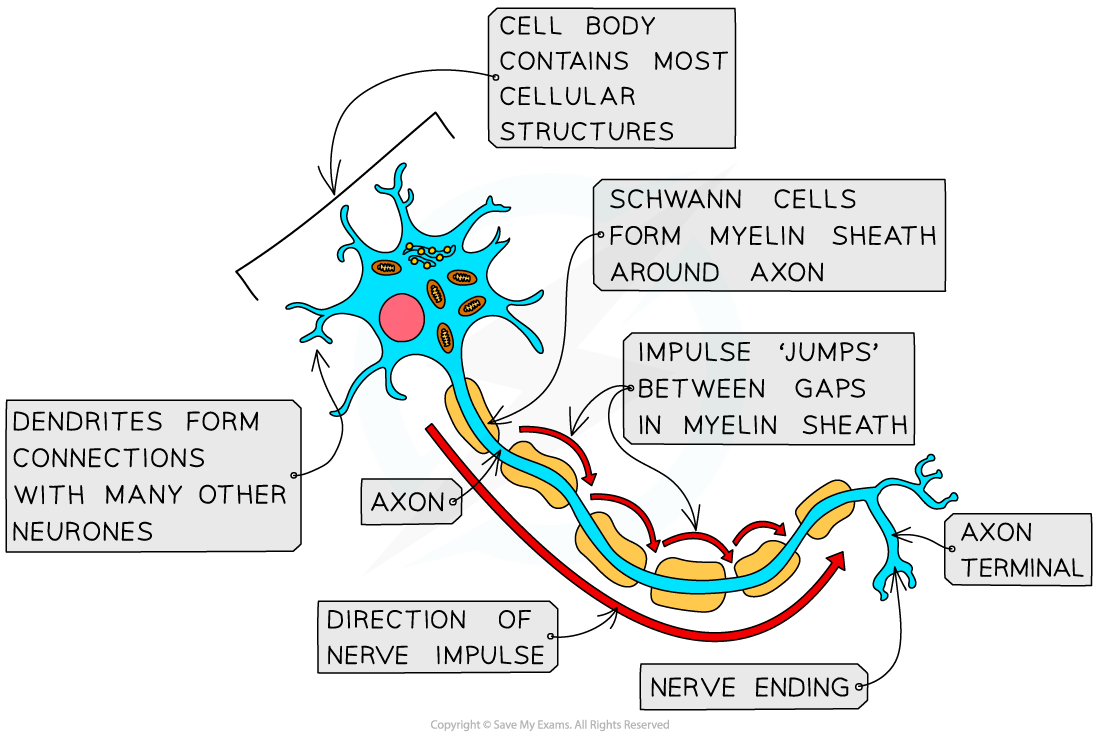
The structure of a myelinated neurone.
Types of neurones
There are three main types of neurones: sensory neurones, relay neurones and motor neurones
Sensory neurones carry impulses from sense organs to the CNS (brain or spinal cord)
Relay neurones are found inside the CNS and connect sensory and motor neurones
Motor neurones carry impulses from the CNS to effectors (muscles or glands)
Identifying the three types of neurones
Sensory neurones are long and have a cell body branching off the middle of the axon
Relay neurones are short and have a small cell body at one end with many dendrites branching off it
Motor neurones are long and have a large cell body at one end with long dendrites branching off it

The three types of neurones
The Human Nervous System: Function
The pathway through the nervous system can be summarised as follows:
stimulus → sensory neurone → relay neurone → motor neurone → effector → response
First, a stimulus is received by a sensory (receptor) neurone
Most receptors are specialised to detect particular stimuli
When a receptor is stimulated, it produces electrical impulses
These impulses then travel along a sensory neurone to the central nervous system (the coordinator is either the brain or the spinal cord)
In the CNS, the impulses are passed on to a relay neurone
The relay neurone links to a motor neurone, along which the impulses travel until they reach the effector
The effector is what carries out the response (the effector may be a muscle or gland)

From stimulus to response: an example of a nerve pathway showing how an electrical impulse travels through sensory, relay and motor neurones

Unlock more, it's free!
Join the 100,000+ Students that ❤️ Save My Exams
the (exam) results speak for themselves:

Was this revision note helpful?
Build on this topic