Completing the Square (Cambridge (CIE) O Level Additional Maths): Revision Note

Exam code: 4037

Dan Finlay

Written by: Dan Finlay

Reviewed by: Lucy Kirkham

Updated on

Completing the square

What is completing the square?

  • Completing the square is another way of writing a quadratic function

  • It means rewriting y space equals a x squared plus b x plus c in the form y space equals space a left parenthesis x plus p right parenthesis squared plus q

    • The key point is that x now only occurs once in the equation

  • It can be used to solve quadratic equations, sketch their graphs and to find the coordinates of the turning point

How do I complete the square?

The method used will depend on the value of the coefficient of the bold italic x to the power of bold 2 term in y space equals a x squared plus b x plus c

  • When bold italic a bold equals bold 1

    • p is half of b

    • q is c minus p squared

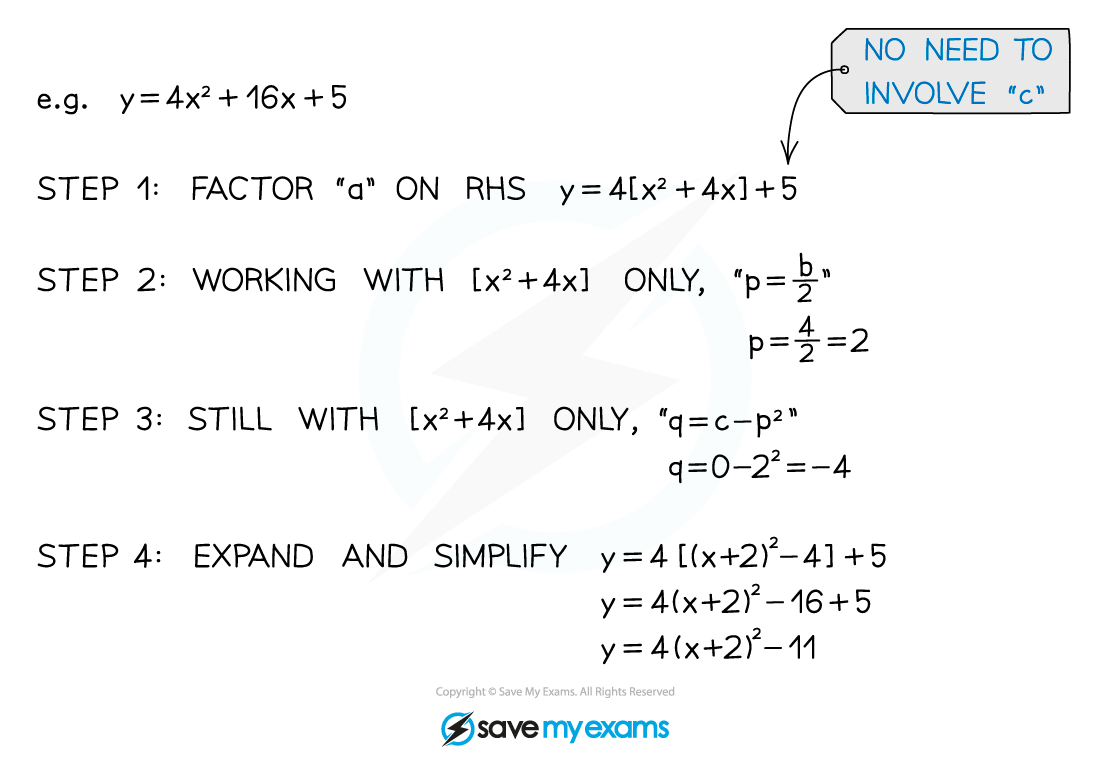
Example of completing the square


  • When a ≠ 1 

    • First take a factor of a out of the bold italic x to the power of bold 2 and bold italic x terms

    • Then continue as above

Harder example of completing the square

Examiner Tips and Tricks

  • Sometimes a question will explicitly use the phrase complete the square

  • Sometimes a question will use the form a open parentheses x plus p close parentheses squared plus q without using the phrase completing the square

Worked Example

Write 3 x squared minus 12 x plus k in the form a open parentheses x plus p close parentheses squared plus k plus q, where a comma space p and q are constants to be found, and k is an unknown constant.

The form required is 'completing the square' (do not be put off by the k, it is just a constant!).

STEP 1 - Take a factor of 3 out of the x squared and x terms - leaving k avoids awkward fractions.

3 x squared minus 12 x plus k equals 3 open parentheses x squared minus 4 x close parentheses plus k

STEPS 2 and 3 - Complete the square on the open parentheses x squared minus 4 x close parentheses part only. "p equals negative 4 over 2 equals negative 2" and "q equals 0 minus open parentheses negative 2 close parentheses squared equals 4".

3 open square brackets open parentheses x minus 2 close parentheses squared minus 4 close square brackets plus k

STEP 4 - Expand and simplify.

3 open parentheses x minus 2 close parentheses squared minus 12 plus k

i.e. a equals 3 comma space p equals negative 2 comma space q equals negative 12

Solving by completing the square

How do I solve a quadratic equation by completing the square?

  • To solve x2 + bx + c = 0 

    • replace the first two terms, x2 + bx, with (x + p)2 - p2 where p is half of b

    • this is called completing the square

      • x2 + bx + c = 0 becomes

        • (x + p)2 - p2 + c = 0 where p is half of b

    • rearrange this equation to make x the subject (using ±√)

  • For example, solve x2 + 10x + 9 = 0 by completing the square

    • x2 + 10x becomes (x + 5)2 - 52

    • so x2 + 10x + 9 = 0 becomes (x + 5)2 - 52 + 9 = 0

    • make x the subject (using ±√)

      • (x + 5)2 - 25 + 9 = 0

      • (x + 5)2 = 16

      • x + 5 = ±√16

      • x  = ±4 - 5

      • x  = -1 or x  = -9

  • If the equation is ax2 + bx + c = 0 with a number in front of x2, then divide both sides by a first, before completing the square 

Examiner Tips and Tricks

  • When making x the subject to find the solutions at the end, don't expand the squared brackets back out again!

    •  Remember to use ±√ to get two solutions

Worked Example

Solve 2 x squared minus 8 x minus 24 equals 0 by completing the square.

Divide both sides by 2 to make the quadratic start with x2   

x squared minus 4 x minus 12 equals 0  

Halve the middle number, -4, to get -2
Replace the first two terms, x2 - 4x, with (x - 2)2 - (-2)2  

open parentheses x minus 2 close parentheses squared minus open parentheses negative 2 close parentheses squared minus 12 equals 0  

Simplify the numbers  

table attributes columnalign right center left columnspacing 0px end attributes row cell open parentheses x minus 2 close parentheses squared minus 4 minus 12 end cell equals 0 row cell open parentheses x minus 2 close parentheses squared minus 16 end cell equals 0 end table  

Add 16 to both sides  

open parentheses x minus 2 close parentheses squared equals 16  

Square root both sides
Include the ± sign to get two solutions  

x minus 2 equals plus-or-minus square root of 16 equals plus-or-minus 4  

Add 2 to both sides  

x equals plus-or-minus 4 plus 2  

Work out each solution separately

x = 6 or x = -2

Unlock more, it's free!

Join the 100,000+ Students that ❤️ Save My Exams

the (exam) results speak for themselves:

Build on this topic

Dan Finlay

Author: Dan Finlay

Expertise: Portfolio Lead

Dan graduated from the University of Oxford with a First class degree in mathematics. As well as teaching maths for over 8 years, Dan has marked a range of exams for Edexcel, tutored students and taught A Level Accounting. Dan has a keen interest in statistics and probability and their real-life applications.

Lucy Kirkham

Reviewer: Lucy Kirkham

Expertise: Content Creator

Lucy has been a passionate Maths teacher for over 12 years, teaching maths across the UK and abroad helping to engage, interest and develop confidence in the subject at all levels.Working as a Head of Department and then Director of Maths, Lucy has advised schools and academy trusts in both Scotland and the East Midlands, where her role was to support and coach teachers to improve Maths teaching for all.