Factor & Remainder Theorem (Cambridge (CIE) O Level Additional Maths): Revision Note
Exam code: 4037

Factor theorem
What is the factor theorem?
The factor theorem is a useful result concerning the roots and factors of polynomials
In the example below, the polynomial has three (linear) factors
and
and so it has the three roots and
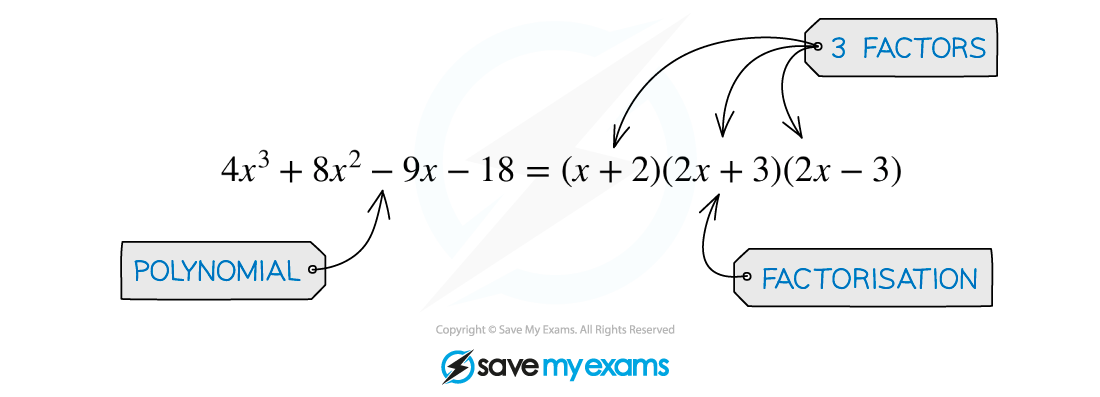
For a polynomial the factor theorem states that:
i) if , then is a factor of
( is a root of )
and
ii) if is a factor of , then
Examiner Tips and Tricks
In an exam, the values of you'll need to find that make are going to be integers close to zero
Try and first, then 2 and -2, then 3 and -3
It is unlikely that you'll have to go beyond that
Worked Example
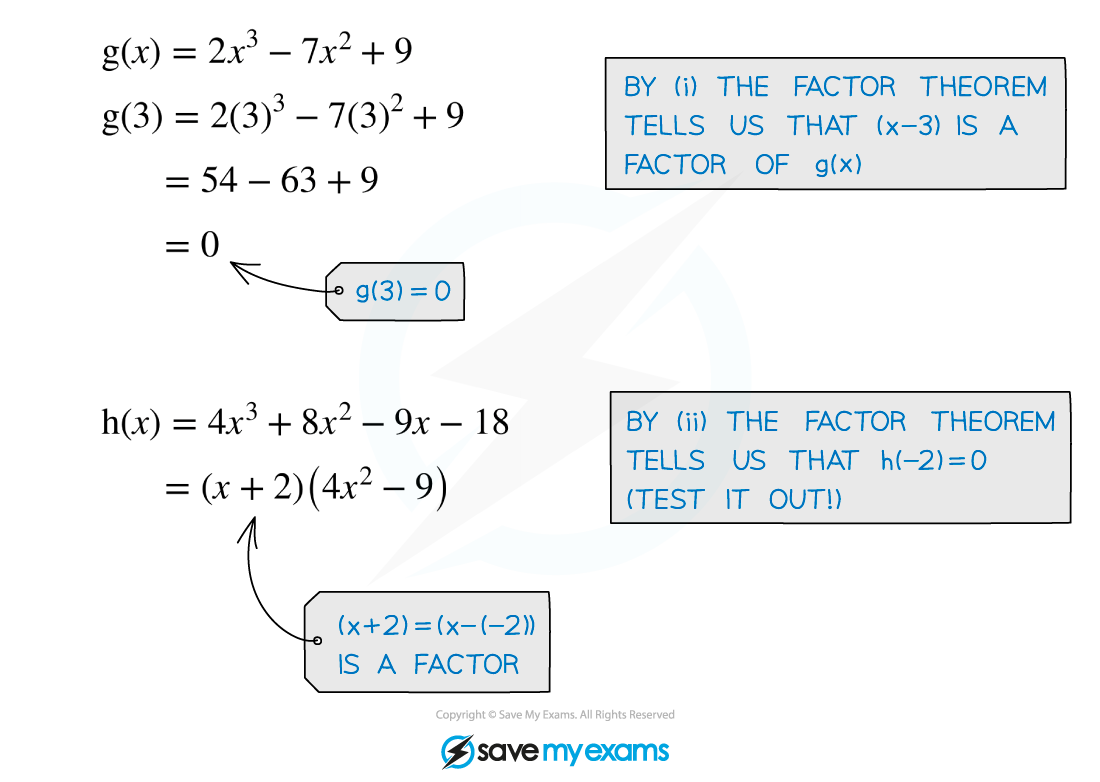
a) Show that is a factor of the polynomial .
(From part (ii) of our definition of factor theorem ...) ... if is a factor of then .
Since , is factor of .
b) Use the factor theorem to find another factor of .
Try first,
Since , is not a factor of .
Try ,
Since , is a factor of .
is another factor of .
is the third (linear) factor.
Once one factor is known, polynomial division could be used to find the others. (In this case we were specifically asked to use factor theorem.)
Remainder theorem
What is the remainder theorem?
The factor theorem is actually a special case of the more general remainder theorem
The remainder theorem states that when the polynomial is divided by the remainder is
You may see this written formally as
In polynomial division
would be the result (at the top) of the division (the quotient)
would be the remainder (at the bottom)
is called the divisor
In the case when and hence is a factor of – the factor theorem!
How do I solve problems involving the remainder theorem?
If it is the remainder that is of particular interest, the remainder theorem saves the need to carry out polynomial division in full
e.g. The remainder from is
This is because if and
If the remainder from a polynomial division is known, the remainder theorem can be used to find unknown coefficients in polynomials
g. The remainder from is 8 so the value of p can be found by solving , leading to
In harder problems there may be more than one unknown in which case simultaneous equations would need setting up and solving
The more general version of remainder theorem is if is divided by then the remainder is
The remainder is still found by evaluating the polynomial at the value of such that (the divisor is zero) but it is not necessarily an integer
Examiner Tips and Tricks
Exam questions will use formal mathematical language which can make factor and remainder theorem questions sound more complicated than they are
Ensure you are familiar with the various terms from these revision notes
Worked Example
The polynomial is given by , where and are integer constants.
When is divided by the remainder is 9.
When is divided by the remainder is 1.
Find the values of and .
Remainder theorem: " is the remainder when is divided by ".
when :
when :
Solving simultaneously,
format('truetype')%3Bfont-weight%3Anormal%3Bfont-style%3Anormal%3B%7D%3C%2Fstyle%3E%3C%2Fdefs%3E%3Ctext%20fill%3D%22%23000%22%20font-family%3D%22Times%20New%20Roman%22%20font-size%3D%2218%22%20font-style%3D%22italic%22%20text-anchor%3D%22middle%22%20x%3D%2215.5%22%20y%3D%2216%22%3Ea%3C%2Ftext%3E%3Ctext%20fill%3D%22%23000%22%20font-family%3D%22math12ed72e0d2d50af08c235c494fe%22%20font-size%3D%2216%22%20text-anchor%3D%22middle%22%20x%3D%2227.5%22%20y%3D%2216%22%3E%2B%3C%2Ftext%3E%3Ctext%20fill%3D%22%23000%22%20font-family%3D%22Times%20New%20Roman%22%20font-size%3D%2218%22%20font-style%3D%22italic%22%20text-anchor%3D%22middle%22%20x%3D%2239.5%22%20y%3D%2216%22%3Eb%3C%2Ftext%3E%3Ctext%20fill%3D%22%23000%22%20font-family%3D%22math12ed72e0d2d50af08c235c494fe%22%20font-size%3D%2216%22%20text-anchor%3D%22middle%22%20x%3D%2253.5%22%20y%3D%2216%22%3E%3D%3C%2Ftext%3E%3Ctext%20fill%3D%22%23000%22%20font-family%3D%22Times%20New%20Roman%22%20font-size%3D%2218%22%20text-anchor%3D%22middle%22%20x%3D%2267.5%22%20y%3D%2216%22%3E2%3C%2Ftext%3E%3Ctext%20fill%3D%22%23000%22%20font-family%3D%22Times%20New%20Roman%22%20font-size%3D%2218%22%20font-style%3D%22italic%22%20text-anchor%3D%22middle%22%20x%3D%224.5%22%20y%3D%2237%22%3Ea%3C%2Ftext%3E%3Ctext%20fill%3D%22%23000%22%20font-family%3D%22math12ed72e0d2d50af08c235c494fe%22%20font-size%3D%2216%22%20text-anchor%3D%22middle%22%20x%3D%2215.5%22%20y%3D%2237%22%3E%2B%3C%2Ftext%3E%3Ctext%20fill%3D%22%23000%22%20font-family%3D%22Times%20New%20Roman%22%20font-size%3D%2218%22%20text-anchor%3D%22middle%22%20x%3D%2227.5%22%20y%3D%2237%22%3E2%3C%2Ftext%3E%3Ctext%20fill%3D%22%23000%22%20font-family%3D%22Times%20New%20Roman%22%20font-size%3D%2218%22%20font-style%3D%22italic%22%20text-anchor%3D%22middle%22%20x%3D%2239.5%22%20y%3D%2237%22%3Eb%3C%2Ftext%3E%3Ctext%20fill%3D%22%23000%22%20font-family%3D%22math12ed72e0d2d50af08c235c494fe%22%20font-size%3D%2216%22%20text-anchor%3D%22middle%22%20x%3D%2253.5%22%20y%3D%2237%22%3E%3D%3C%2Ftext%3E%3Ctext%20fill%3D%22%23000%22%20font-family%3D%22Times%20New%20Roman%22%20font-size%3D%2218%22%20text-anchor%3D%22middle%22%20x%3D%2267.5%22%20y%3D%2237%22%3E6%3C%2Ftext%3E%3Cline%20stroke%3D%22%23000%22%20stroke-linecap%3D%22square%22%20stroke-width%3D%221%22%20x1%3D%220.5%22%20x2%3D%2271.5%22%20y1%3D%2246.5%22%20y2%3D%2246.5%22%2F%3E%3Ctext%20fill%3D%22%23000%22%20font-family%3D%22Times%20New%20Roman%22%20font-size%3D%2218%22%20font-style%3D%22italic%22%20text-anchor%3D%22middle%22%20x%3D%2239.5%22%20y%3D%2265%22%3Eb%3C%2Ftext%3E%3Ctext%20fill%3D%22%23000%22%20font-family%3D%22math12ed72e0d2d50af08c235c494fe%22%20font-size%3D%2216%22%20text-anchor%3D%22middle%22%20x%3D%2253.5%22%20y%3D%2265%22%3E%3D%3C%2Ftext%3E%3Ctext%20fill%3D%22%23000%22%20font-family%3D%22Times%20New%20Roman%22%20font-size%3D%2218%22%20text-anchor%3D%22middle%22%20x%3D%2267.5%22%20y%3D%2265%22%3E4%3C%2Ftext%3E%3C%2Fsvg%3E)

Unlock more, it's free!
Join the 100,000+ Students that ❤️ Save My Exams
the (exam) results speak for themselves:

Was this revision note helpful?
Build on this topic