Second Order Derivatives (Cambridge (CIE) O Level Additional Maths): Revision Note
Exam code: 4037

Second order derivatives
What is the second order derivative of a function?
If you differentiate the derivative of a function (i.e. differentiate the function a second time) you get the second order derivative of the function
The second order derivative can be referred to simply as the second derivative
We can write the second derivative as
Note the position of the powers of 2
differentiating twice (so) with respect to twice (so)
A first derivative is the rate of change of a function (the gradient)
a second order derivative is the rate of change of the rate of change of a function
i.e. the rate of change of the function’s gradient
A positive second derivative means the gradient is increasing
For instance in a u-shape, the gradient is changing from negative to positive
A negative second derivative means the gradient is decreasing
For instance in an n-shape, the gradient is changing from positive to negative
Second order derivatives can be used to test whether a point is a minimum or maximum
To find a second derivative, you simply differentiate twice!
It is important to write down your working with the correct notation, so you know what each expression means
For example
Examiner Tips and Tricks
Even if you think you can find the second derivative in your head and write it down, make sure you write down the first derivative as well
If you make a mistake, you will most likely get marks for finding the first derivative
Worked Example
Work out when
(a)
Find the first derivative of the function first by considering each term in turn.
Find the second derivative, by differentiating each term in the first derivative.
(b)
To find the first derivative of the function, begin by separating the terms in the fraction.
Rewrite each term using index notation so that they are in a form that can be differentiated.
Find the first derivative of the function first by differentiating each term in turn.
Find the second derivative, by differentiating each term in the first derivative.
You can turn the second derivative back into the same format as the original function by rewriting as a fraction.
Stationary points & turning points
What are stationary points?
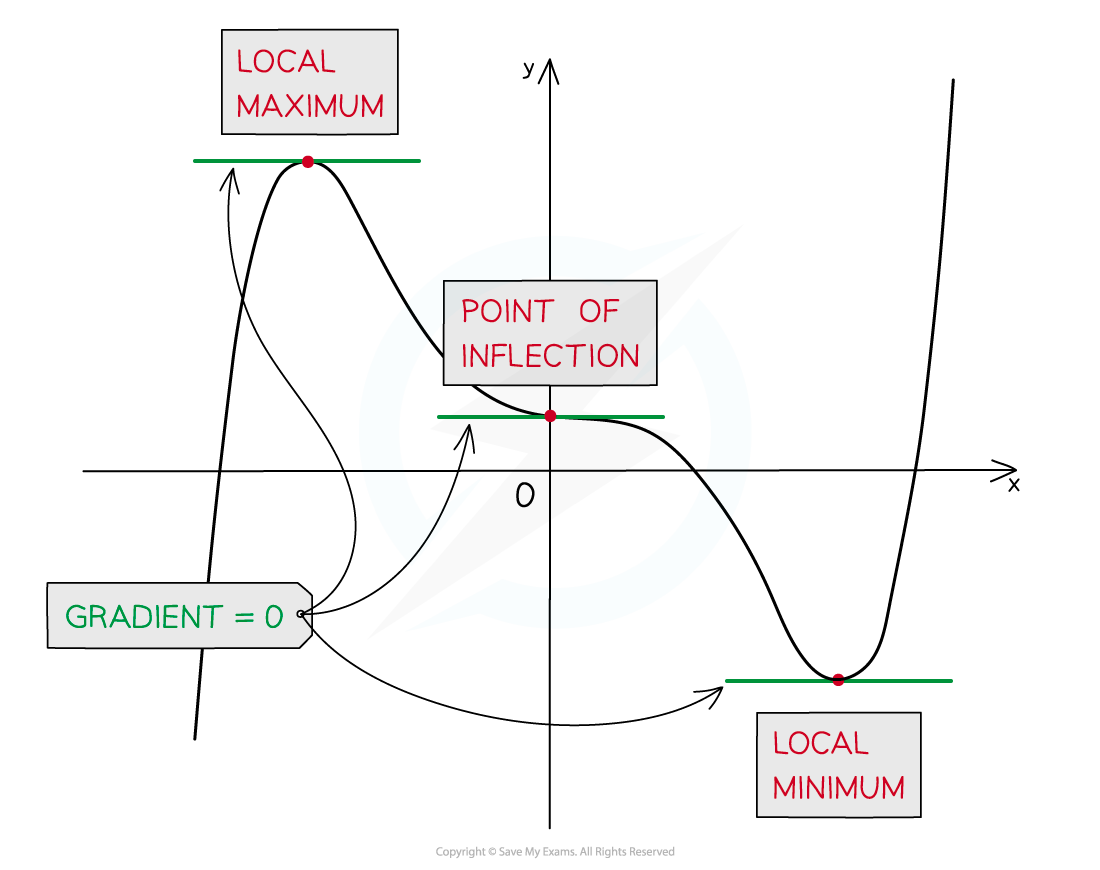
A stationary point is any point on a curve where the gradient is zero
To find stationary points of a curve
Step 1 Find the first derivative
Step 2 Solve to find the -coordinates of any stationary points
Step 3 Substitute those -coordinates into the equation of the curve to find the corresponding -coordinates
A stationary point may be either a local minimum, a local maximum, or a point of inflection
Stationary points on quadratics
The graph of a quadratic function only has a single stationary point
For a positive quadratic this is the minimum; for a negative quadratic it is the maximum
No need to talk about 'local' here, as it is the overall minimum/maximum for the whole curve
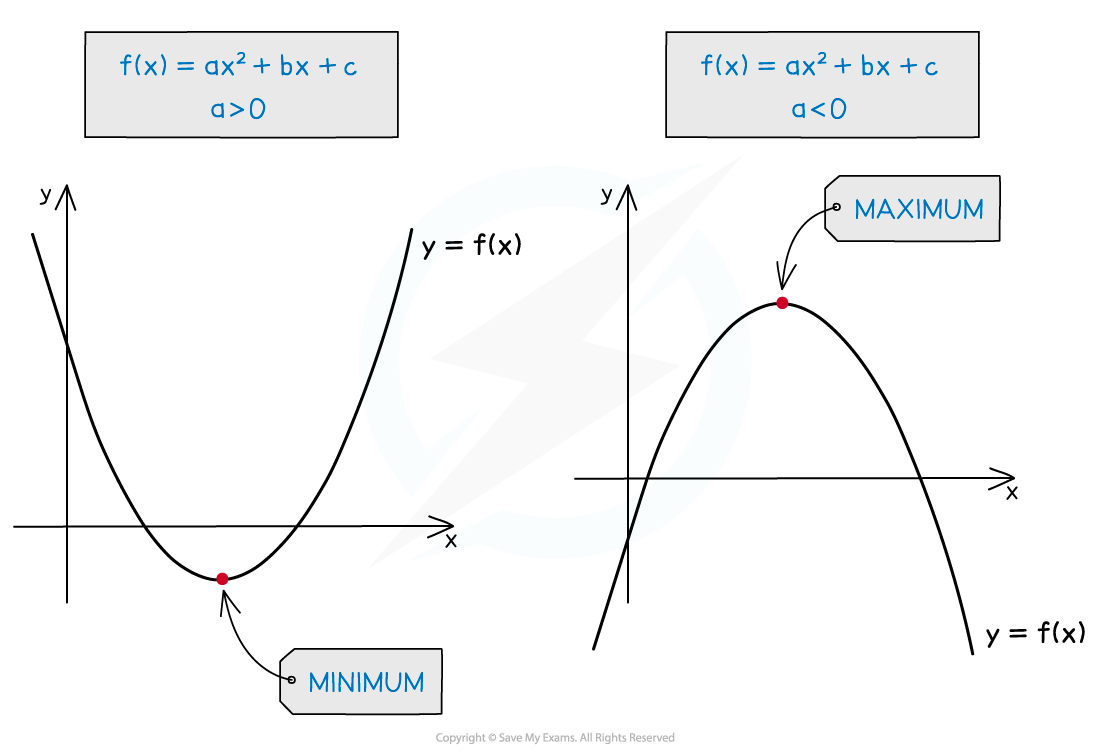
The y value/coordinate of the stationary point is therefore the minimum or maximum value of the quadratic function
For quadratics especially, minimum and maximum points are often referred to as turning points
Worked Example
Find the stationary point of
and explain why it will be a minimum point.
Find the derivative.
Solve
Find the corresponding -coordinate.
Write the answer as a coordinate.
The stationary point is (1, -1)
To explain why it is a minimum point, consider the shape of the quadratic.
(1, -1) is a minimum point because it is a positive quadratic.
Testing for local minimum & maximum points
How do I determine the nature of stationary points on a curve?
For a graph there are two ways to determine the nature of its stationary points
Method A
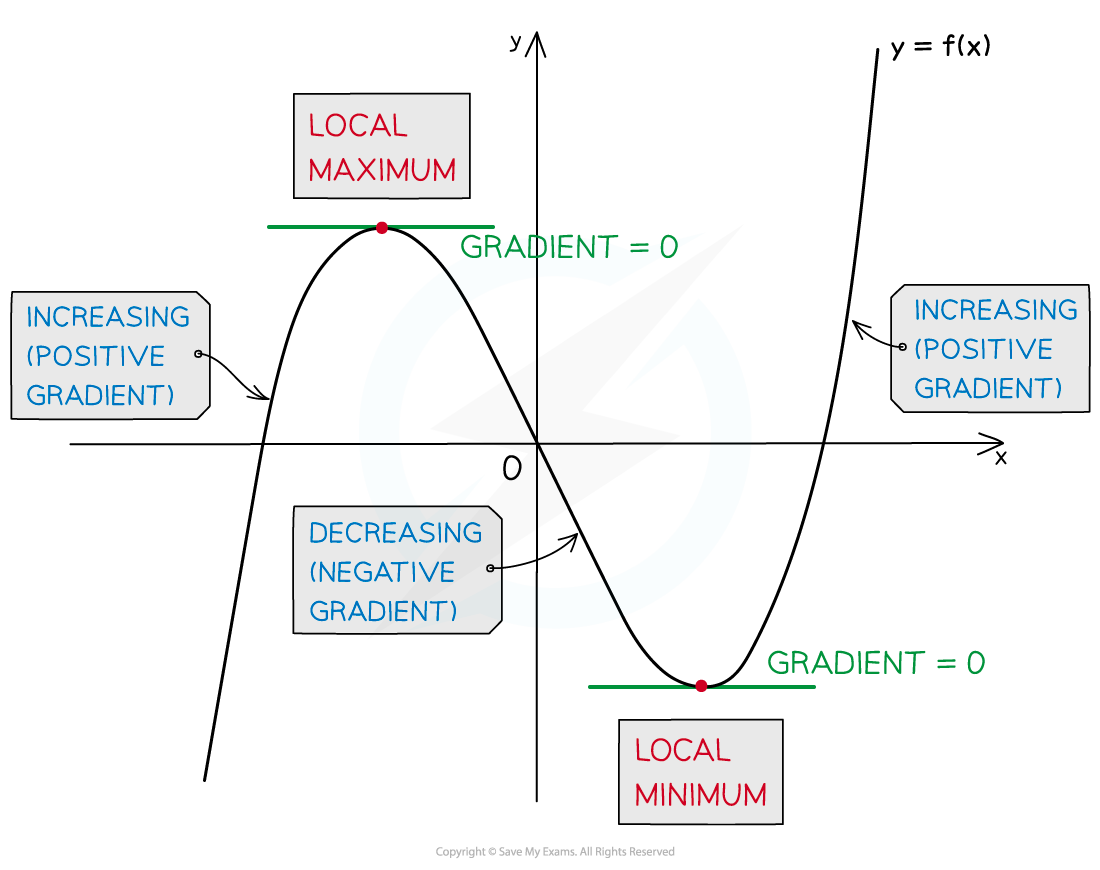
Compare the signs of the first derivative, , (positive or negative) a little bit to either side of the stationary point
e.g. if the stationary point is at x=2 then you could find the gradient at x=1.9 and x=2.1
Compare the signs (positive or negative) of the derivatives on the left and right of the stationary point
If the derivatives are negative on the left and positive on the right, the point is a local minimum (a u-shape)
If the derivatives are positive on the left and negative on the right, the point is a local maximum (an n-shape)
Method B
Look at the sign of the second derivative (positive or negative) at the stationary point
Find the second derivative
For each stationary point find the value of at the stationary point
i.e. substitute the x-coordinate of the stationary point into and evaluate
If is positive then the point is a local minimum
If is negative then the point is a local maximum
If is zero then the point could be a local minimum, a local maximum OR a point of inflection
In this case you will need to use method A instead
Examiner Tips and Tricks
Usually, using the second derivative (Method B above) is a much quicker way of determining the nature of a stationary point
Sketching the curve can also help
Worked Example
Find the stationary points of
and determine the nature of each.
Start by expanding the brackets in the expression for
Step 1 Find the first derivative
Step 2 Solve
Divide through by 8
Fully factorise, spotting the difference of two squares
Solve to find the -coordinates of the stationary (turning) points
Step 3 Find the corresponding -coordinates
Write the answers as coordinates, being careful to correctly match 's and 's
The stationary points are (0, 0), (1, -2) and (-1, -2)
To find the nature of each stationary point, use Method B
Step 4 Find the second derivative
Step 5 Evaluate the second derivative at each stationary point
The nature of each stationary point is now determined
(0, 0) is a local maximum point
(1, -2) is a local minimum point
(-1, -2) is a local minimum point

Unlock more, it's free!
Join the 100,000+ Students that ❤️ Save My Exams
the (exam) results speak for themselves:

Was this revision note helpful?
Build on this topic
