Linear Graphs (Cambridge (CIE) O Level Additional Maths): Revision Note
Exam code: 4037

Equations of a straight line
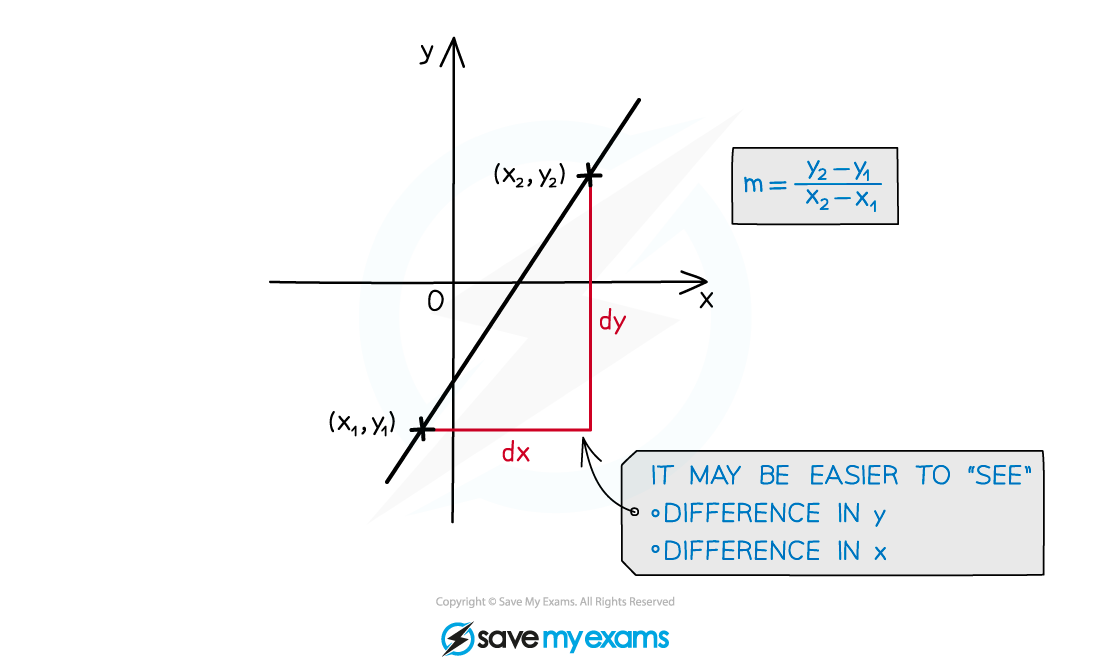
How do I find the gradient of a straight line?
Find two points that the line passes through with coordinates (x1, y1) and (x2, y2)
The gradient between these two points is calculated by
The gradient of a straight line measures its slope
A line with gradient 1 will go up 1 unit for every unit it goes to the right
A line with gradient -2 will go down two units for every unit it goes to the right
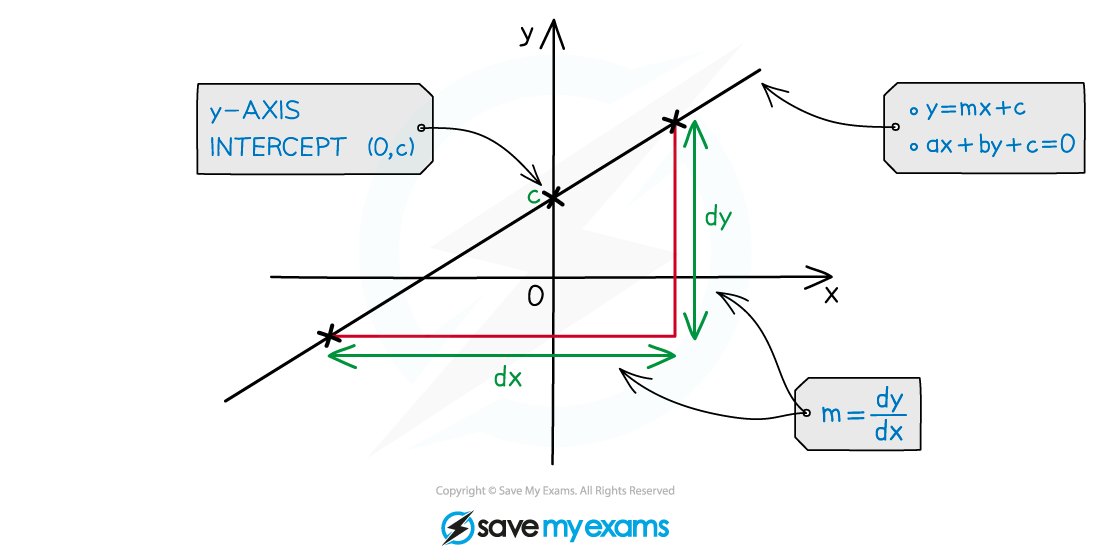
What are the equations of a straight line?
This is the gradient-intercept form
It clearly shows the gradient m and the y-intercept (0, c)
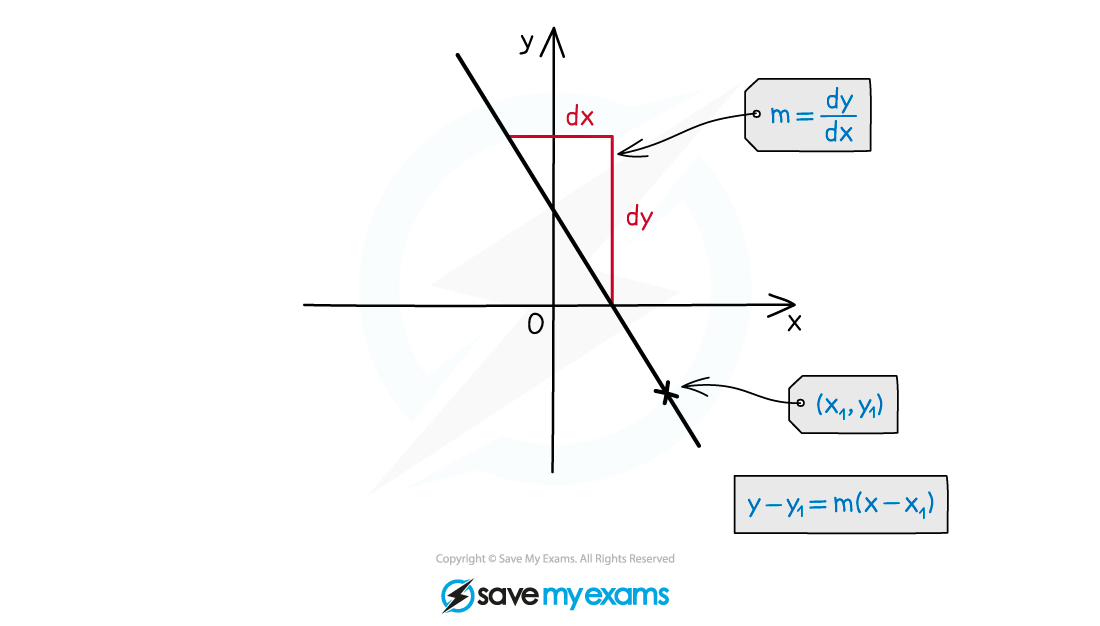
This is the point-gradient form
It clearly shows the gradient m and a point on the line (x1, y1)
This is the general form
You can quickly get the x-intercept and y-intercept
How do I find an equation of a straight line?
You will need the gradient
If you are given two points then first find the gradient
It is easiest to start with the point-gradient form
then rearrange into whatever form is required
multiplying both sides by any denominators will get rid of fractions
Examiner Tips and Tricks
Quickly sketching the graph of the straight line(s) can be helpful if you are struggling with an exam question
Ensure you state equations of straight lines in the format required
Usually or
Check whether coefficients need to be integers (they usually are for )
Worked Example
(a) Find the equation of the straight line with gradient 3 that passes through (5, 4).
We know that the gradient is 3 so the line takes the form
To find the value of c, substitute (5, 4) into the equation
Replace c with −11 to complete the equation of the line
y = 3x − 11
(b) Find the equation of the straight line that passes through (-2, 6) and (8, 1).
You may find it helpful to sketch the information given

First find m, the gradient
We know that the line takes the form
To find the value of c, substitute either of the given points into this equation. Here we will pick (8, 1) as it is doesn't contain negative numbers so is easier to work with
Replace c with −11 to complete the equation of the line
We can check against our sketch that this equation looks correct- it has a negative gradient and it crosses the y-axis between 1 and 6
Midpoint of a line segment
How do I find the midpoint of a line segment?
The midpoint of a line will be the same distance from both endpoints
You can think of a midpoint as being the average (mean) of two coordinates
The midpoint of and is
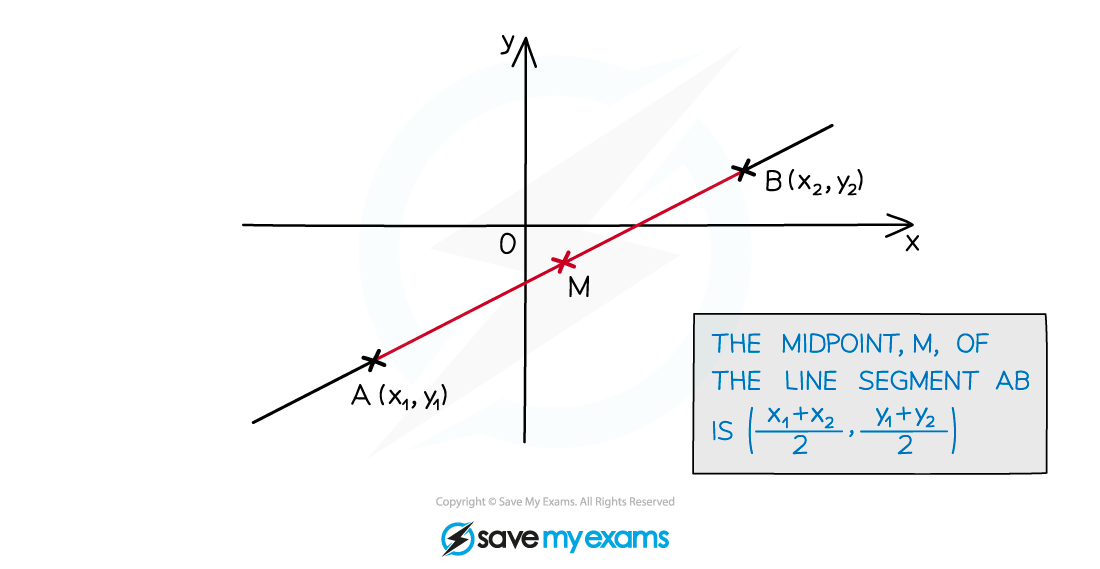
M is often used as the midpoint between two points (x1, y1) (x2, y2)
It is the average of both the x and y coordinates
Worked Example
The coordinates of A are (−4, 3) and the coordinates of B are (8, −12).
Find M, the midpoint of AB.
The midpoint can be found using M =
Fill in the values of x and y from each coordinate
Simplify
M = (2, −4.5)
Length of a line segment
How do I calculate the length of a line segment?
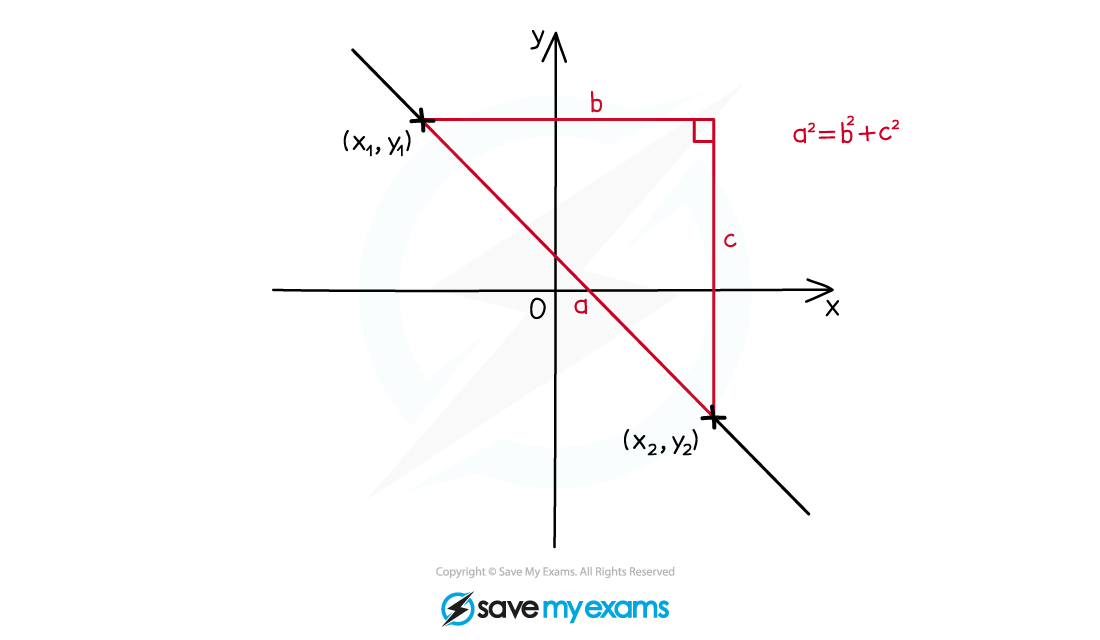
The distance between two points with coordinates and can be found using the formula
This formula is really just Pythagoras’ Theorem , applied to the difference in the -coordinates and the difference in the -coordinates;
You may be asked to find the length of a diagonal in 3D space
This can be answered using 3D Pythagoras
Examiner Tips and Tricks
Work with the square of a distance for as long as possible as this avoids early rounding errors
In the non-calculator paper your answer may need to be left as a surd
Only square root when forced to or for a final answer, and use the ANS button (and other memory features) on your calculator
Worked Example
Point A has coordinates (3, -4) and point B has coordinates (-5, 2).
Calculate the distance of the line segment AB.
Using the formula for the distance between two points,
Substituting in the two given coordinates:
Simplify:
Answer = 10 units

Unlock more, it's free!
Join the 100,000+ Students that ❤️ Save My Exams
the (exam) results speak for themselves:

Was this revision note helpful?
Build on this topic
