Modelling with Differentiation (Cambridge (CIE) O Level Additional Maths): Revision Note
Exam code: 4037

Modelling with differentiation
How is differentiation used in modelling questions?
Derivatives can be calculated for any variables – not just y and x
The derivative is a formula giving the rate of change of one variable with respect to the other variable
For example if then
is the rate of change of with respect to
The phrase 'increasing at a rate of' means the rate of change of one variable with respect to time
Differentiation can be used to find maximum and minimum points of a function
In modelling, this is called optimisation
Second derivative tests help to determine is the point is a maximum or minimum
Examiner Tips and Tricks
Read the question carefully to determine which variables you will need to use
The question may give you a formula to help you
Worked Example
The volume, , of a sphere of radius is given by
Find the rate of change of the volume with respect to the radius.
Differentiate the formula given for the volume of a sphere.
Optimisation
What is optimisation?
In general, optimisation is finding the best way to do something
In mathematics, optimisation is finding the maximum or minimum output of a function
For example, finding the maximum possible profit or minimum costs
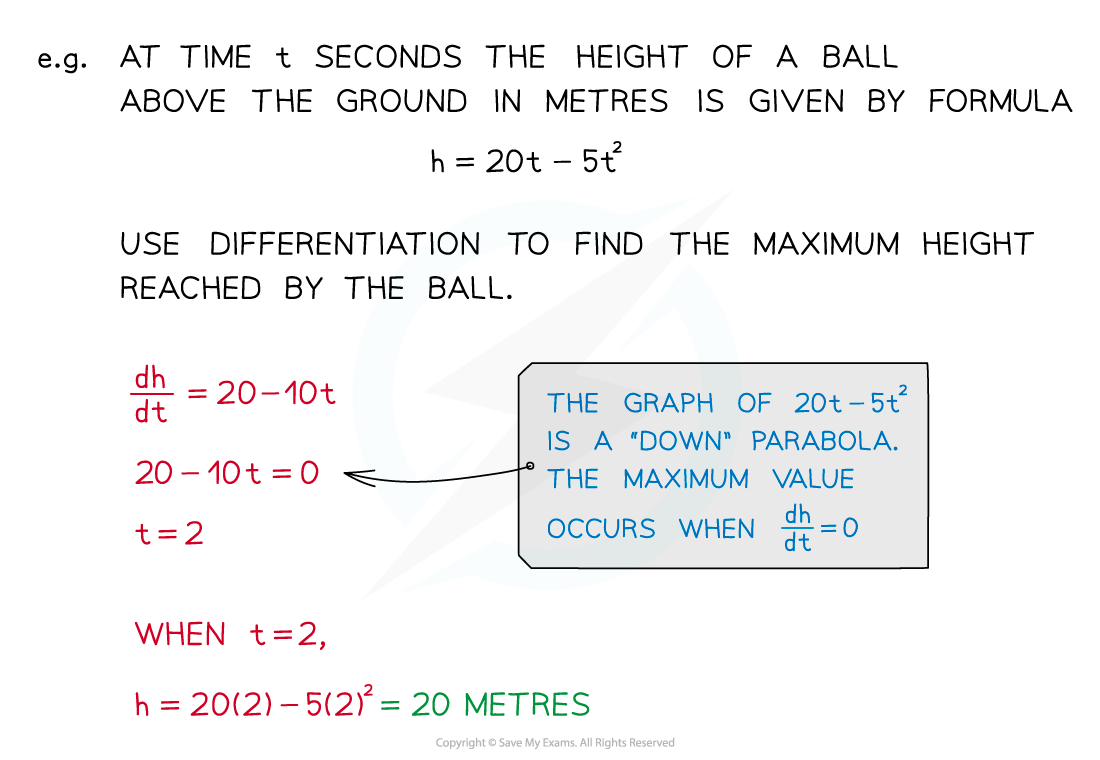
Differentiation can be used to solve optimisation problems in modelling questions
For example you may want to
Maximise the volume of a container
Minimise the amount of fuel used
Examiner Tips and Tricks
Exam questions on this topic will often be divided into two parts:
First a 'Show that...' part where you derive a given formula from the information in the question
And then a 'Find...' part where you use differentiation to answer a question about the formula
Even if you can't answer the first part you can still use the formula to answer the second part
Worked Example
A cuboid has length cm, width cm, and height cm.
(a) Show that the volume, cm3 is given by .
The volume of a cuboid is ""
Expand and simplify
(b) Find the maximum volume of the cuboid. Differentiate V with respect to x
At the maximum volume,
Solve for x
So the value of x, at the maximum volume is 0.3 Find the maximum volume by substituting x = 0.3 in to the formula for V
The maximum volume of the cuboid is 1.8 cm3
(c) Prove that your answer is a maximum value.
Using the second derivative is usually the easiest way to find the nature of a stationary point
The value of the second derivative (at ) is negative
Therefore V = 1.8 cm3 is a maximum volume

Unlock more, it's free!
Join the 100,000+ Students that ❤️ Save My Exams
the (exam) results speak for themselves:

Was this revision note helpful?
Build on this topic
