Asymptotes (College Board AP® Calculus AB): Revision Note

Roger B

Written by: Roger B

Reviewed by: Dan Finlay

Updated on

Horizontal asymptote

What is a horizontal asymptote?

  • A horizontal asymptote is a horizontal line

    • that the graph of a function gets closer and closer to (but never touches or intersects)

    • as x becomes unbounded in the positive or negative direction

  • On the following diagram, the horizontal asymptote is indicated by a dashed line
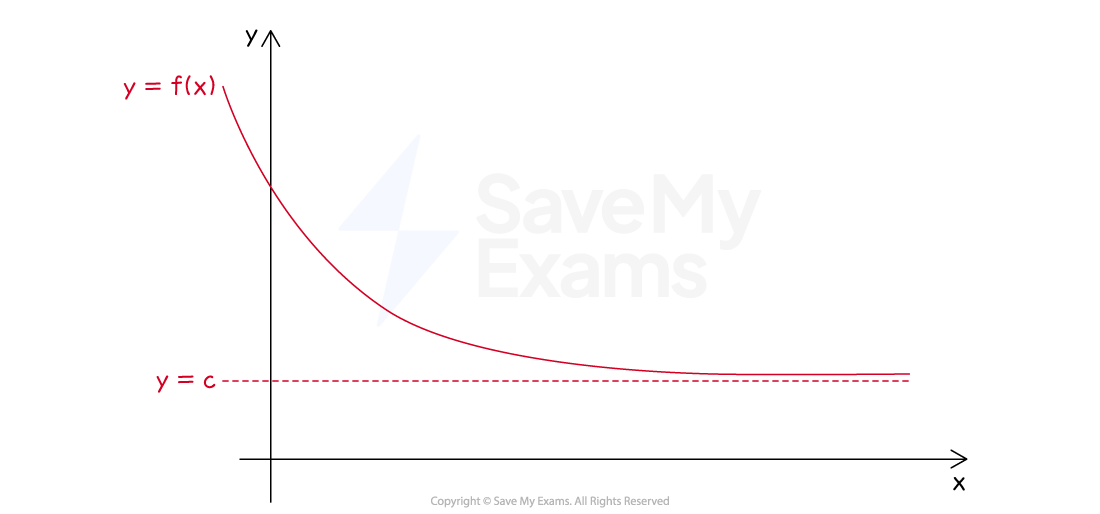
A graph of a function f with a horizontal asymptote at y=c
An example of a function with a horizontal asymptote at y=c

How can I identify horizontal asymptotes using limits?

  • A function will have a horizontal asymptote if it has a finite limit at infinity

    • I.e. the line y equals c will be a horizontal asymptote for the graph of a function f if

      • limit as x rightwards arrow infinity of f open parentheses x close parentheses equals c, or

      • limit as x rightwards arrow negative infinity of f open parentheses x close parentheses equals c

  • Horizontal asymptotes (if any) may therefore be determined by evaluating the limits at infinity

Examiner Tips and Tricks

By graphing a function on your graphing calculator you can:

  • spot any asymptotic behavior by a function at plus or minus infinity

  • check limits that you have determined analytically

How can I identify horizontal asymptotes numerically?

  • If a function has a horizontal asymptote, then its values will tend to a limit for large positive or negative values of x

  • Consider, the function space f open parentheses x close parentheses equals fraction numerator 12 plus 5 e to the power of negative x over 1000 end exponent over denominator 1 plus e to the power of negative x over 1000 end exponent end fraction

  • Consider the values for large positive x

x equals

space fraction numerator 12 plus 5 e to the power of negative x over 1000 end exponent over denominator 1 plus e to the power of negative x over 1000 end exponent end fraction equals

100

8.674...

1,000

10.117...

10,000

11.999...

100,000

12

  • The table suggests that limit as x rightwards arrow infinity of f open parentheses x close parentheses equals 12

    • Note space f open parentheses 100 space 000 close parentheses not equal to 12

    • It starts as 11.999... with a large number of 9s

    • Most calculators cannot differentiate between this value and 12

  • Consider the values for large negative x

x equals

space fraction numerator 12 plus 5 e to the power of negative x over 100 end exponent over denominator 1 plus e to the power of negative x over 100 end exponent end fraction equals

-100

8.325...

-1,000

6.882...

-10,000

5.000...

-100,000

5

  • The table suggests that limit as x rightwards arrow negative infinity of f open parentheses x close parentheses equals 5

    • Note space f open parentheses negative 100 space 000 close parentheses not equal to 5

    • It starts as 5.000... with a large number of 0s

    • Most calculators cannot differentiate between this value and 5

Vertical asymptote

What is a vertical asymptote?

  • A vertical asymptote is a vertical line

    • that the graph of a function gets closer and closer to (but never touches or intersects)

    • as x gets closer and closer to the x-value of the vertical line

  • On the following diagram, the vertical asymptote is indicated by a dashed line
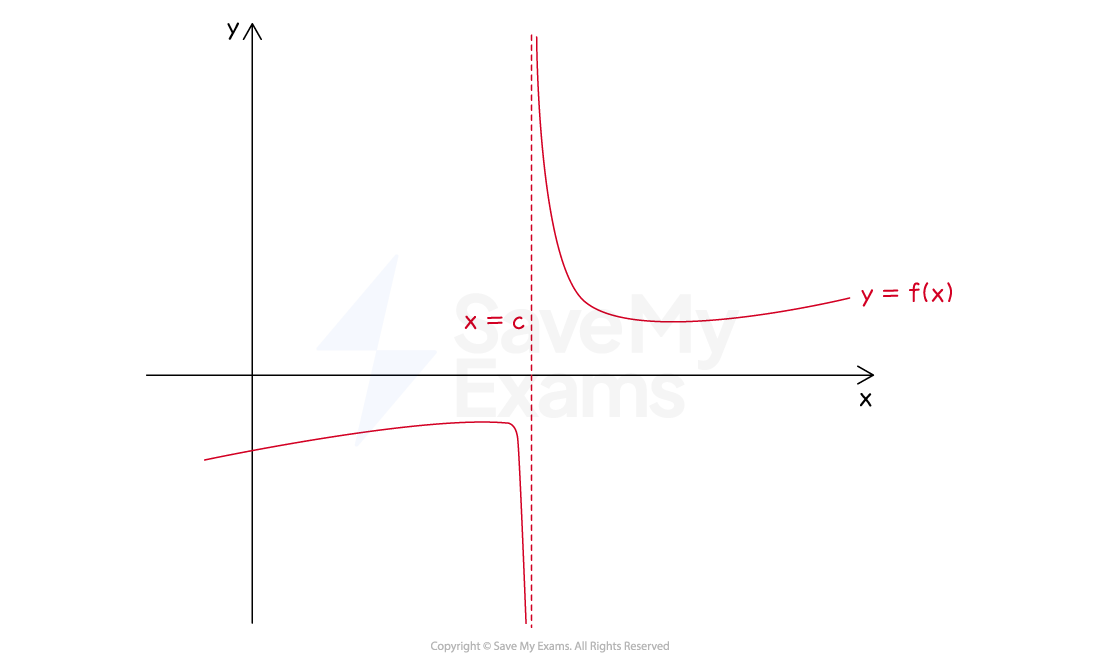
Graph of a function f with a vertical asymptote at x=c
An example of a function with a vertical asymptote at x=c

How can I identify vertical asymptotes using limits?

  • A function will have a vertical asymptote at any x-value where the function becomes unbounded

    • I.e. the line x equals c will be a vertical asymptote for the graph of a function f if

      • limit as x rightwards arrow c to the power of minus of f open parentheses x close parentheses equals plus-or-minus infinity, or

      • limit as x rightwards arrow c to the power of plus of f open parentheses x close parentheses equals plus-or-minus infinity

  • Vertical asymptotes (if any) may therefore be determined by identifying points where the function becomes unbounded

    • Usually this will involve a function in the form of a quotient

      • at points where the denominator becomes zero

How can I identify vertical asymptotes numerically?

  • If a function has a vertical asymptote, then its values tend to positive or negative infinity as the values of x get closer to the vertical asymptote

  • Consider, the function space f open parentheses x close parentheses equals csc x

  • Consider the values for values of x just smaller than 0

x equals

space csc x equals

-0.1

-10.016...

-0.01

-100.001...

-0.001

-1,000.000...

-0.0001

-10,000.000...

  • The table suggests that limit as x rightwards arrow 0 to the power of minus of f open parentheses x close parentheses equals negative infinity

    • The values of space f keep getting further from 0 as x gets closer to 0

  • Consider the values for values of x just bigger than 0

x equals

space csc x equals

0.1

10.016...

0.01

100.001...

0.001

1,000.000...

0.0001

10,000.000...

  • The table suggests that limit as x rightwards arrow 0 to the power of plus of f open parentheses x close parentheses equals infinity

    • The values of space f keep getting further from 0 as x gets closer to 0

Worked Example

Let f be the function defined by f open parentheses x close parentheses equals fraction numerator 3 x minus 11 over denominator x minus 2 end fraction.

Using limits, identify the vertical and horizontal asymptotes (if any) on the graph of f.

Answer:

The denominator becomes 0 when x equals 2, so start by considering the limits there

At 2 the numerator is equal to -5, so zero only occurs in the denominator

Just 'to the left' of 2, 3 x minus 11 less than 0 and x minus 2 less than 0 so

limit as x rightwards arrow 2 to the power of minus of f open parentheses x close parentheses equals infinity

Just 'to the right' of 2, 3 x minus 11 less than 0 and x minus 2 greater than 0 so

limit as x rightwards arrow 2 to the power of plus of f open parentheses x close parentheses equals negative infinity

This confirms that the graph of f has a vertical asymptote at x equals 2

To identify horizontal asymptotes, start by rearranging to make the behavior of the function more obvious

fraction numerator 3 x minus 11 over denominator x minus 2 end fraction equals fraction numerator 3 open parentheses x minus 2 close parentheses minus 5 over denominator x minus 2 end fraction equals fraction numerator 3 open parentheses x minus 2 close parentheses over denominator x minus 2 end fraction minus fraction numerator 5 over denominator x minus 2 end fraction equals 3 minus fraction numerator 5 over denominator x minus 2 end fraction

fraction numerator 5 over denominator x minus 2 end fraction becomes closer and closer to zero as x increases in the positive or negative directions, so

limit as x rightwards arrow negative infinity of f open parentheses x close parentheses equals limit as x rightwards arrow infinity of f open parentheses x close parentheses equals 3 minus 0 equals 3

Alternatively, divide the top and bottom of the function by x

limit as x rightwards arrow infinity of f open parentheses x close parentheses equals limit as x rightwards arrow infinity of fraction numerator 3 minus 11 over x over denominator 1 minus 2 over x end fraction equals 3 over 1 equals 3

limit as x rightwards arrow negative infinity of f open parentheses x close parentheses equals limit as x rightwards arrow negative infinity of fraction numerator 3 minus 11 over x over denominator 1 minus 2 over x end fraction equals 3 over 1 equals 3

This means that the graph of f has a horizontal asymptote at y equals 3

The graph of f has a vertical asymptote at x equals 2, and a horizontal asymptote at y equals 3

Unlock more, it's free!

Join the 100,000+ Students that ❤️ Save My Exams

the (exam) results speak for themselves:

Roger B

Author: Roger B

Expertise: Maths Content Creator

Roger's teaching experience stretches all the way back to 1992, and in that time he has taught students at all levels between Year 7 and university undergraduate. Having conducted and published postgraduate research into the mathematical theory behind quantum computing, he is more than confident in dealing with mathematics at any level the exam boards might throw at you.

Dan Finlay

Reviewer: Dan Finlay

Expertise: Maths Subject Lead

Dan graduated from the University of Oxford with a First class degree in mathematics. As well as teaching maths for over 8 years, Dan has marked a range of exams for Edexcel, tutored students and taught A Level Accounting. Dan has a keen interest in statistics and probability and their real-life applications.
