Extreme Value Theorem (College Board AP® Calculus AB): Revision Note

Extreme value theorem
What is the extreme value theorem?
The extreme value theorem states that:
If a function is continuous over the closed interval
then has at least one minimum value and at least one maximum value on the closed interval
This tells us that a continuous function
will always have a minimum and a maximum value on a closed interval
but that those values might occur at the endpoints of the interval
If a minimum or maximum value does not occur at an endpoint
then it will be a local minimum or local maximum within the open interval
In this case if the function is differentiable on
then the derivative of the function will be zero at that point
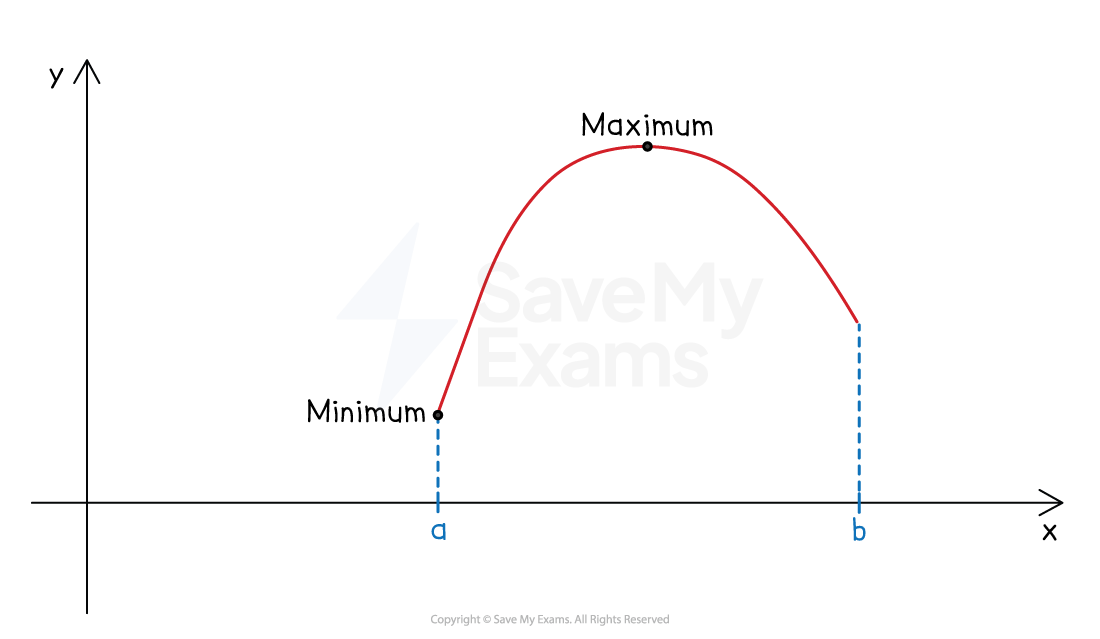
For example, consider the continuous function such that and
The EVT tells you that either 7 is the maximum value on the interval or there is a value in the interval such that for all in the interval
The EVT tells you that either 5 is the minimum value on the interval or there is a value in the interval such that for all in the interval
What does the extreme value theorem not tell me?
The EVT does not tell you where the function takes its maximum and minimum values
You need to use the candidates test to find the extreme points
The EVT does not tell you how many local maximum and minimum points the function has
The EVT does not tell you if the global maximum and global minimum points are unique
For example, there could be two points where the function is equal to the global maximum
Examiner Tips and Tricks
When using the extreme value theorem on the exam:
Be sure to justify that the theorem is valid
I.e. that the function is continuous on
Remember that if a function is differentiable on an interval
then it is also continuous on that interval
Worked Example
A social sciences researcher is using a function to model the total mass of all the garden gnomes appearing on lawns in a particular neighborhood at time . The function is twice-differentiable, with measured in kilograms and measured in days.
The table below gives selected values of over the time interval .
(days) | 0 | 3 | 7 | 10 | 12 |
(kilograms) | 24.9 | 36.0 | 70.3 | 89.7 | 89.1 |
Justify why there must be at least one time, , for , at which , the rate of change of the mass, equals 0 kilograms per day.
Answer:
You need to prove that the derivative has a particular value at an unspecified point
At first this might seem like a job for the mean value theorem
But there are no two points in the table between which the average rate of change is zero
Instead, the stated result may be proved by using the extreme value theorem
Start by showing that is continuous; then the extreme value theorem will be valid
Remember that differentiability implies continuity
differentiable continuous on
The extreme value theorem says that will have a maximum value on
Show that the maximum value does not occur at either of the endpoints of the interval
and
Because is differentiable on , this means the maximum is a local maximum point somewhere in that open interval, at which point is equal to zero
is twice-differentiable, which means is differentiable, which means is continuous on
By the extreme value theorem, has a maximum on
That maximum does not occur at or , therefore has a maximum on the interval
Because is differentiable, must equal 0 at this maximum
Examiner Tips and Tricks
In the worked example above, there are multiple other methods to show the same result.
You could use the intermediate value theorem to show that there is a value , for , such that .
You could then use the mean value theorem or Rolle's theorem to show that there is a value , for , such that .

Unlock more, it's free!
Join the 100,000+ Students that ❤️ Save My Exams
the (exam) results speak for themselves:

Was this revision note helpful?
Build on this topic
