Disc Method Around the x-Axis (College Board AP® Calculus AB): Revision Note

Volume with disc method revolving around the x-axis
What is a volume of revolution around the x-axis?
A solid of revolution is formed when an area bounded by a function
(and other boundary equations) is rotated radians around the -axisThe volume of revolution is the volume of this solid
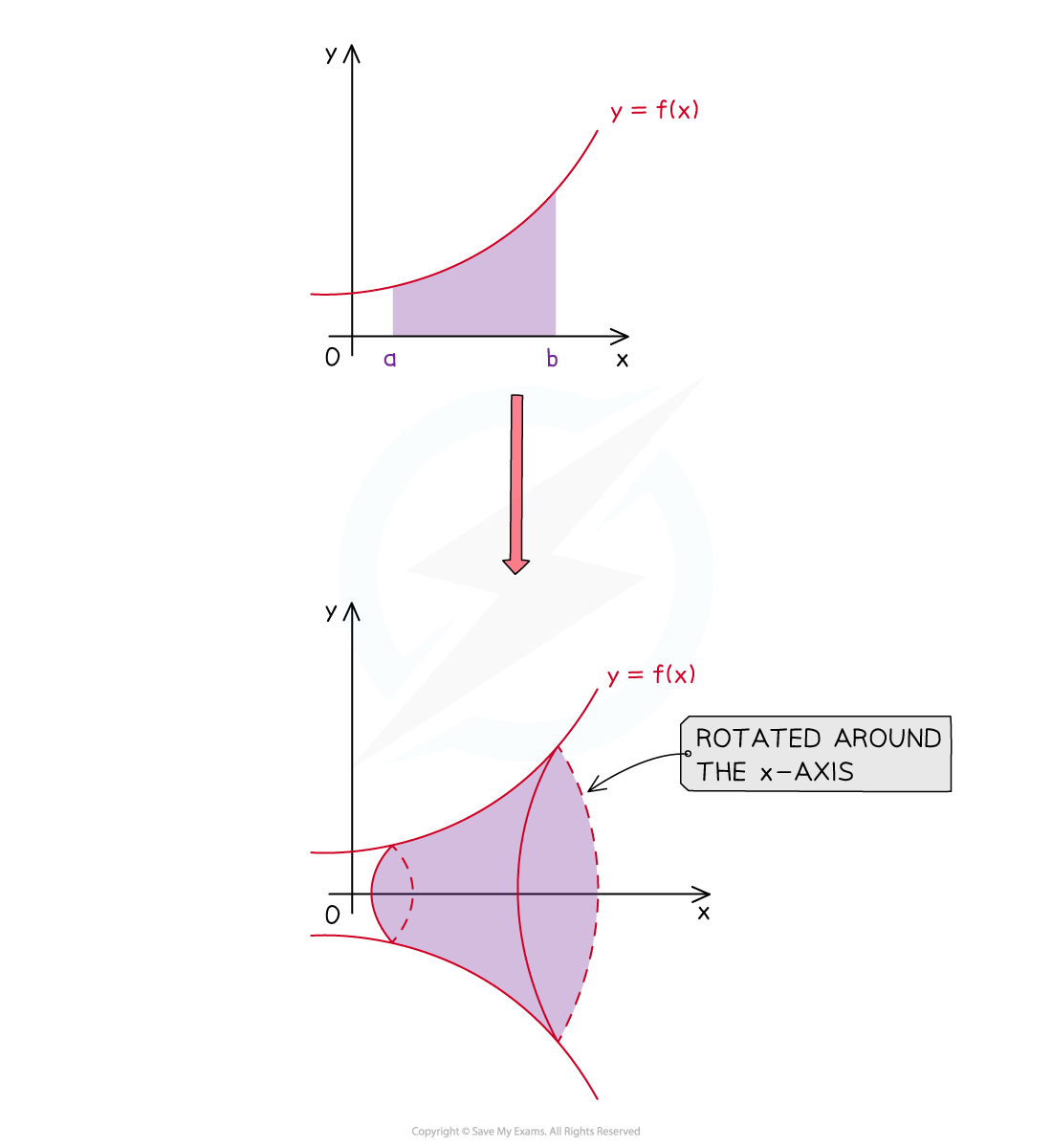
Be careful – the ’front’ and ‘back’ of this solid are flat
they were created from straight (vertical) lines
3D sketches can be misleading
How can I use the disc method to calculate a volume of revolution around the x-axis?
For a continuous function , if the region bounded by
the curve and the -axis
between and
is rotated radians around the -axis, then the volume of revolution is
Note that is a function of
If and are not stated in a question, these boundaries could involve
the -axis ()
and/or an -intercept of
This method of finding volumes of revolution uses the idea of a definite integral as calculating an accumulation of change
It is a special case of 'finding volumes from areas of known cross-sections'
is the volume of a disc with
circular cross section of radius
and length
is the limit of this volume element as
The integral sums up all these infinitesimal volume elements between and
Examiner Tips and Tricks
If the given function involves a square root, the problem may seem daunting
But the square root will be 'squared away' when using the Volume of Revolution formula
If a diagram is not provided, sketching the curve, limits, etc. can really help
A graphing calculator can help with this
Worked Example
Let be the region enclosed by the graph of , the - and -axes, and the vertical line , as shown in the figure below.

Find the volume of the solid generated when is rotated about the -axis. Give your answer as an exact value.
Answer:
Use
33π units cubed

Unlock more, it's free!
Join the 100,000+ Students that ❤️ Save My Exams
the (exam) results speak for themselves:

Was this revision note helpful?
Build on this topic
