Disc Method Around the y-Axis (College Board AP® Calculus AB): Revision Note

Volume with disc method revolving around the y-axis
What is a volume of revolution around the y-axis?
This is very similar to a volume of revolution around the -axis
A solid of revolution is formed when an area bounded by a function
(and other boundary equations) is rotated radians around the -axisThe volume of revolution is the volume of this solid
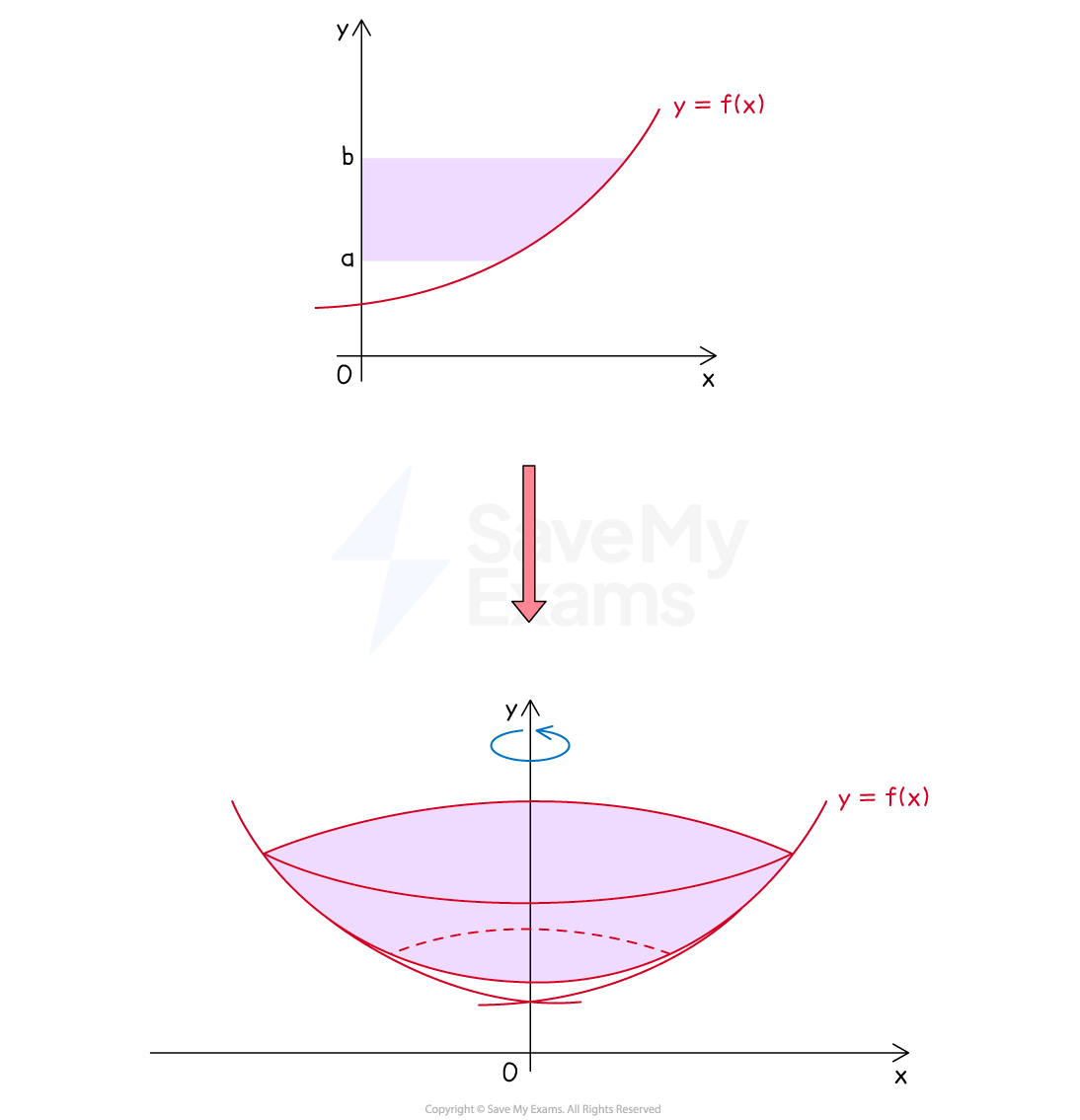
How can I use the disc method to calculate a volume of revolution around the y-axis?
For a continuous function , if the region bounded by
the curve and the -axis
between and
is rotated radians around the -axis, then the volume of revolution is
Note that here is a function of
This will mean rewriting in the form
Also note that the integration is done with respect to
If and are not stated in a question, these boundaries could involve
the -axis ()
and/or a -intercept of
Examiner Tips and Tricks
Do not get confused about the orientation of the revolution.
If it is a revolution around the -axis, then use as the radius of the discs and as the thickness.
If it is a revolution around the -axis, then use as the radius of the discs and as the thickness.
Worked Example
Let be the region enclosed by the graph of , the negative -axis, and the positive -axis, as shown in the figure below.
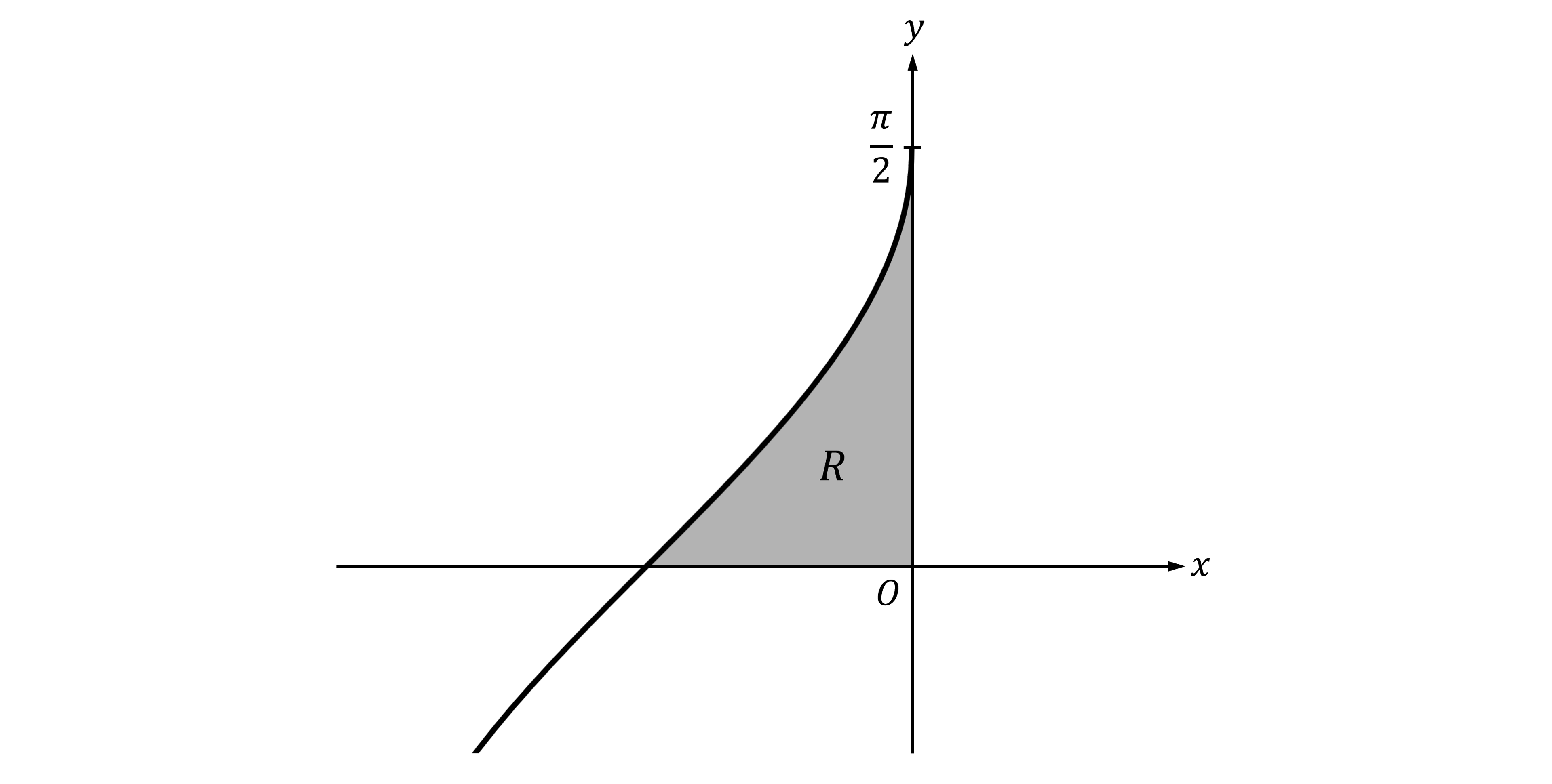
Find the volume of the solid generated when is rotated about the -axis. Give your answer correct to 3 decimal places.
Answer:
Use
First rewrite the function as a function of
Now that can be put into the integral
Note that the integration will be along the -axis, from to
The integral can be evaluated using your calculator
0.280 units cubed (to 3 decimal places)

Unlock more, it's free!
Join the 100,000+ Students that ❤️ Save My Exams
the (exam) results speak for themselves:

Was this revision note helpful?
Build on this topic
