Second Derivative Test for Local Extrema (College Board AP® Calculus AB): Revision Note

Second derivative test
First and second derivatives at key points
To be able to classify key points on the graph of a function, it is important that you are confident with the properties of the first and second derivatives at these points
Type of point | First derivative | Second derivative |
|---|---|---|
Local minimum | Zero | Positive or zero |
Local maximum | Zero | Negative or zero |
Point of inflection (critical) | Zero | Zero |
Point of inflection (non-critical) | Non-zero | Zero |
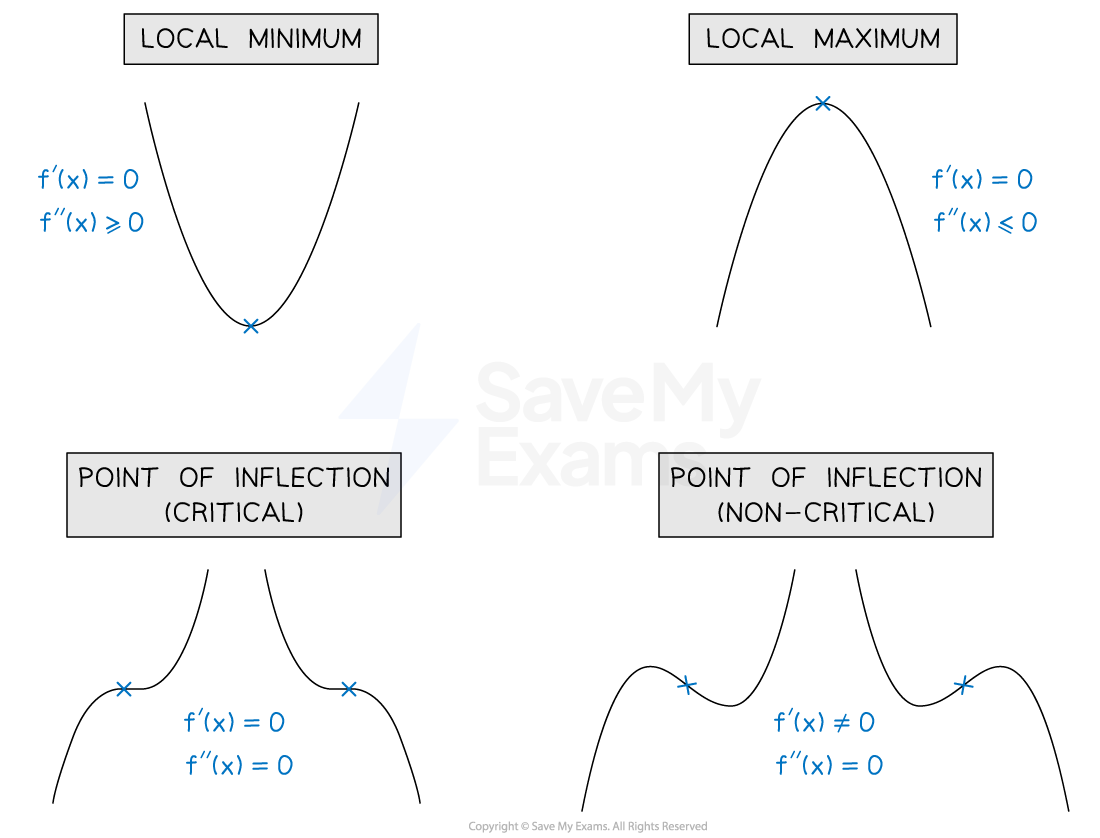
What is the second derivative test?
The information above means the second derivative can be used to determine if a critical point is a local minimum or maximum
The second derivative test states that:
If and ,
then has a local minimum at
If and ,
then has a local maximum at
If and then this test does not give any information
it could be any of a local minimum, local maximum, or point of inflection
Which points have a second derivative of zero?
All points of inflection have a second derivative of zero
However, not all points with a second derivative of zero are points of inflection
It is possible for local minimums or maximums to have a second derivative of zero
It is also possible for the second derivative to be zero, but for the point to not be a critical point nor a point of inflection
The second derivative test is only for determining if a critical point is a local minimum or maximum
If you find that and then you need to investigate further
You can check the sign of the first derivative on either side of the point
If it changes from positive to negative, it is a local maximum
If it changes from negative to positive, it is a local minimum
If it stays the same, it is a point of inflection
You can also check the sign of the second derivative on either side of the point
If it changes, it is a point of inflection
If it is positive on both sides, then it is a local minimum
If it is negative on both sides, then it is a local maximum
Worked Example
Let the function be defined by .
Find the coordinates of any local extrema on the graph of , and classify the nature of these extrema.
Answer:
Find the critical points by finding the first derivative and setting equal to zero
or
Find the -coordinates at these points
Critical points at (2, -1) and (0, 3)
Classify these points by using the second derivative test
Substitute the value of each critical point into the second derivative
(2, -1) is a local minimum by the second derivative test because and
(0, 3) is a local maximum by the second derivative test because and
Worked Example
Determine the nature of the critical point on the graph of .
Answer:
Find the critical point first, by using
is the only real solution
Find the -coordinate
The critical point is at (0, 0)
To determine the nature of the critical point, start by finding the second derivative at this point
First derivative is zero, and second derivative is zero
Therefore could be any of minimum, maximum, or point of inflection
Method 1 - Using the first derivative
Check the first derivative either side of the point to determine the nature of the point
Just before , is decreasing because
Just after , is increasing because
Therefore, has a local minimum at by the first derivative test
Method 2 - Using the second derivative
Check the second derivative either side of the point to determine the nature of the point
Just before , is concave up because
Just after , is concave up because
Therefore, has a local minimum at because and is concave up around the point

Unlock more, it's free!
Join the 100,000+ Students that ❤️ Save My Exams
the (exam) results speak for themselves:

Was this revision note helpful?
Build on this topic
