Slope Fields (College Board AP® Calculus AB): Revision Note

Slope fields
What is a slope field?
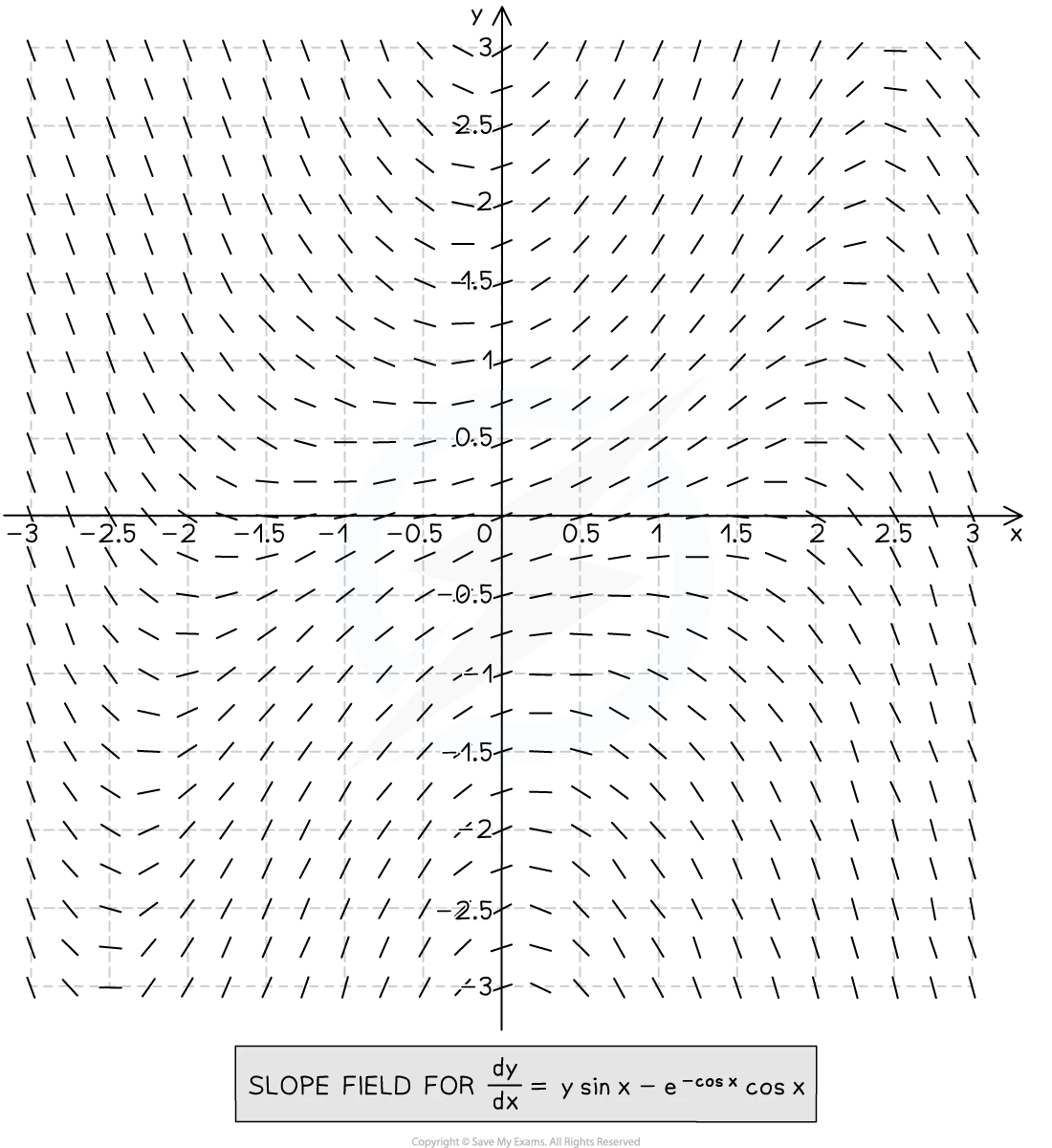
A slope field for a differential equation is a diagram with short tangent lines drawn at a number of points
The slope of the tangent line drawn at any given point will be equal to the value of at that point
I.e. equal to the slope of the solution curve that goes through that point
Normally the tangent lines will be drawn for points that form a regularly-spaced grid of x and y values
How can I calculate the slope at a point on a slope field?
Rewrite the differential equation in the form (if it isn't in that form already)
I.e., the derivative is equal to some function of x and y
Calculate the derivative at any point (x, y) by substituting the x and y values into
This gives the slope of the solution curve at that point
Estimating a solution using slope fields
How can I use slope fields to estimate a solution for a differential equation?
In some cases it may be possible to solve the differential equation analytically
But in other cases this is not possible
The tangent lines in a slope field diagram give a general sense for what the solution curves will look like
Remember that the general solution to a differential equation is actually a family of solutions
At each point, the tangent line gives a sense of what one of those solutions is doing
Think of the tangent lines in a slope diagram as ‘flow lines’
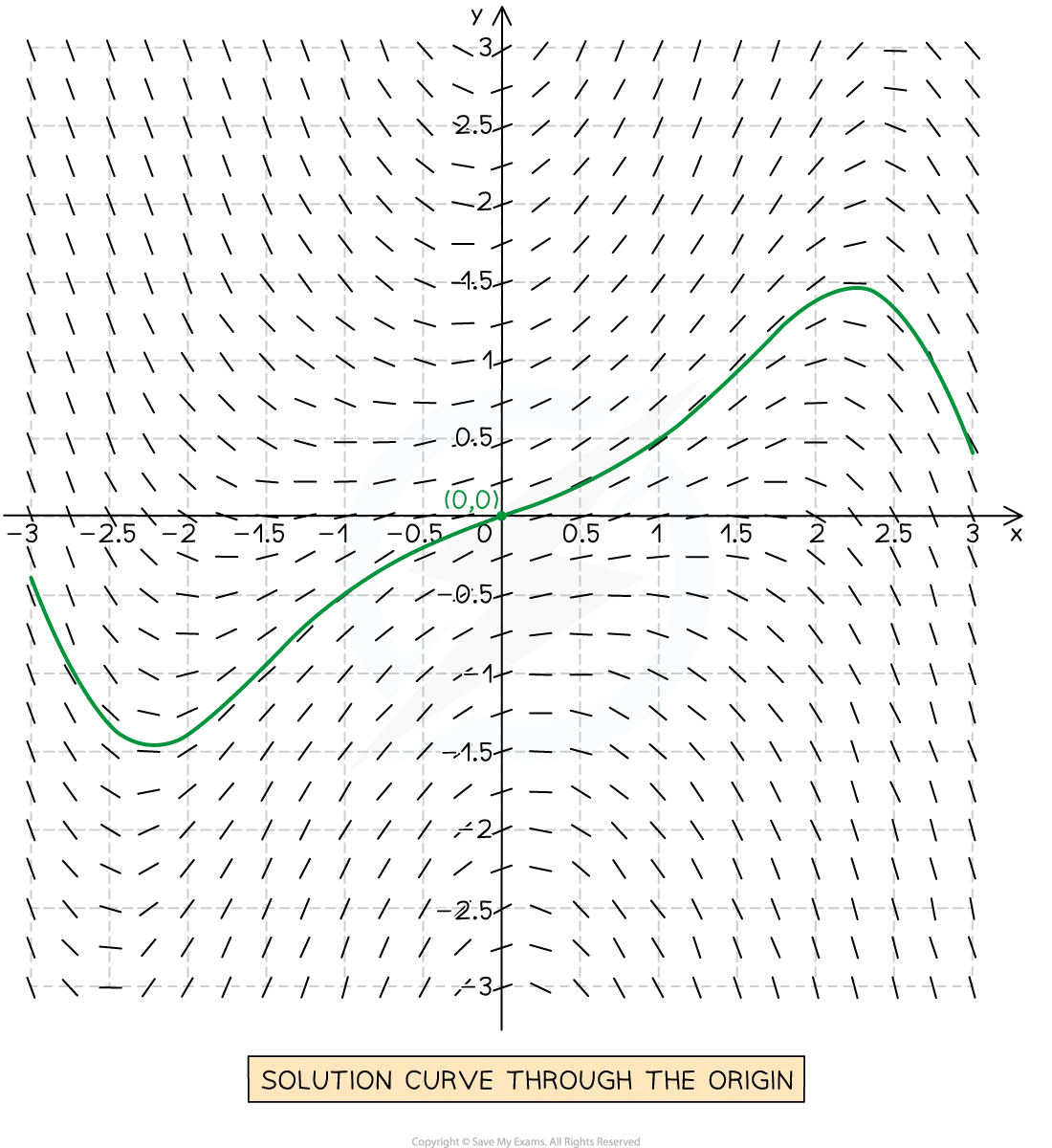
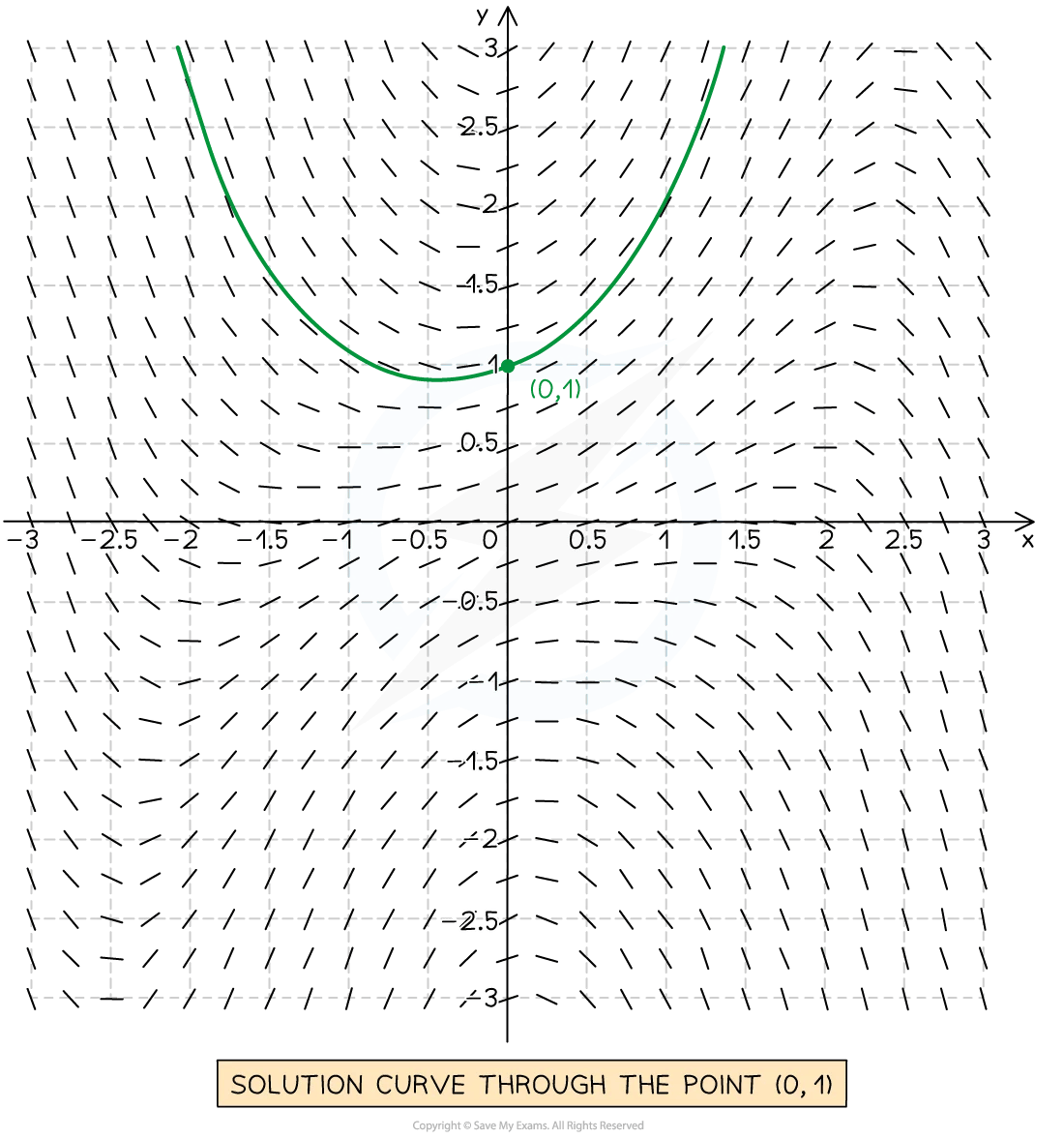
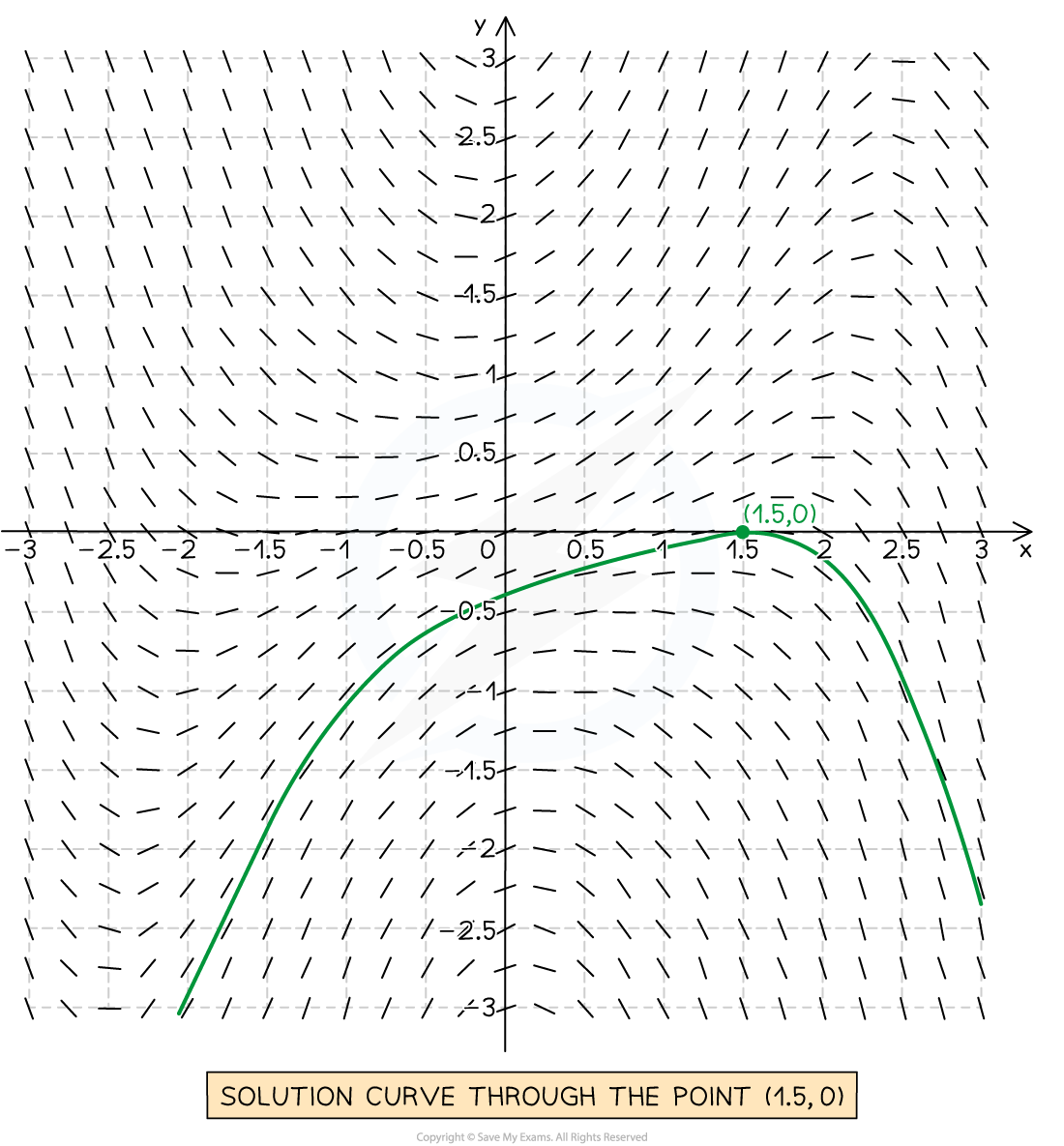
From a given point the solution curve through that point will ‘flow’ away from the point in the direction of the tangent line
To sketch a solution that goes through a particular point on a slope field
The given point serves as a boundary condition,
letting you know which solution curve is the one you want to sketch
The sketch should go through the given point,
and follow the general ‘flow’ of the tangent lines through the rest of the slope field diagram
The sketched solution curve should not attempt to connect together different tangent lines in the diagram
You don't know that the solution curve goes through any exact point in the ‘grid’ of points at which tangent lines have been drawn
The only tangent line that your solution curve should definitely go through
is the one at the given point
The sketched solution curve may go along some of the tangent lines
but it should not cut across any of them
What else should I look out for on a slope field diagram?
Look out for places where the tangent lines are horizontal
At such points
Such points may indicate local minimum or maximum points for a solution curve
Be careful – not every point where is a local minimum or maximum
But every local minimum or maximum will be at a point where
You can solve the equation directly to identify points where the slope is zero
This is another way to identify possible local minimum and maximum points
If such a point falls between the ‘grid points’ at which the tangent lines have been drawn
then this may be the only way to identify such a point exactly
Worked Example
Consider the differential equation .
(a) Using the equation, determine the set of points for which the solutions to the differential equation will have horizontal tangents.
The diagram below shows the slope field for the differential equation, for and .
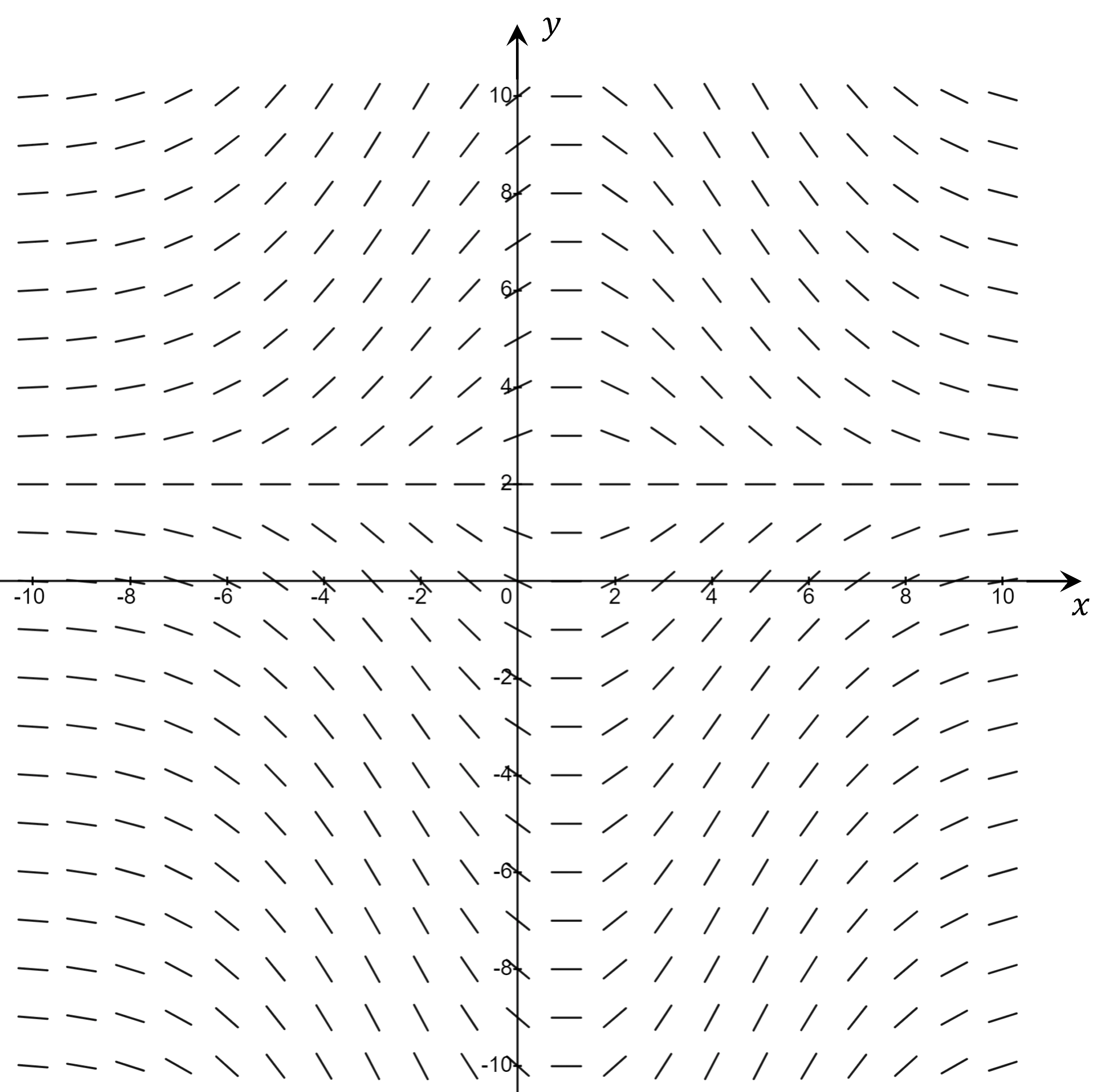
(b) Sketch the solution curve for the solution to the differential equation that passes through the point .
Answer:
(a)
The solution will have horizontal tangents wherever
The exponential function is never equal to zero, therefore
when or
The solutions will have horizontal tangents at any point where or
(b)
Make sure the curve goes through (0, -8)
It should be a smooth curve following the 'flow' of the tangent lines, and should not cut across any of the tangent lines


Unlock more, it's free!
Join the 100,000+ Students that ❤️ Save My Exams
the (exam) results speak for themselves:

Was this revision note helpful?
Build on this topic