Multiple Areas (College Board AP® Calculus AB): Revision Note

Using multiple definite integrals to find multiple areas
How do I find areas of enclosed regions partly above and partly below the x-axis using multiple integrals?
If an area between a curve and the -axis is partly above and partly below the -axis
then you need to be careful when calculating areas
Consider the diagram below
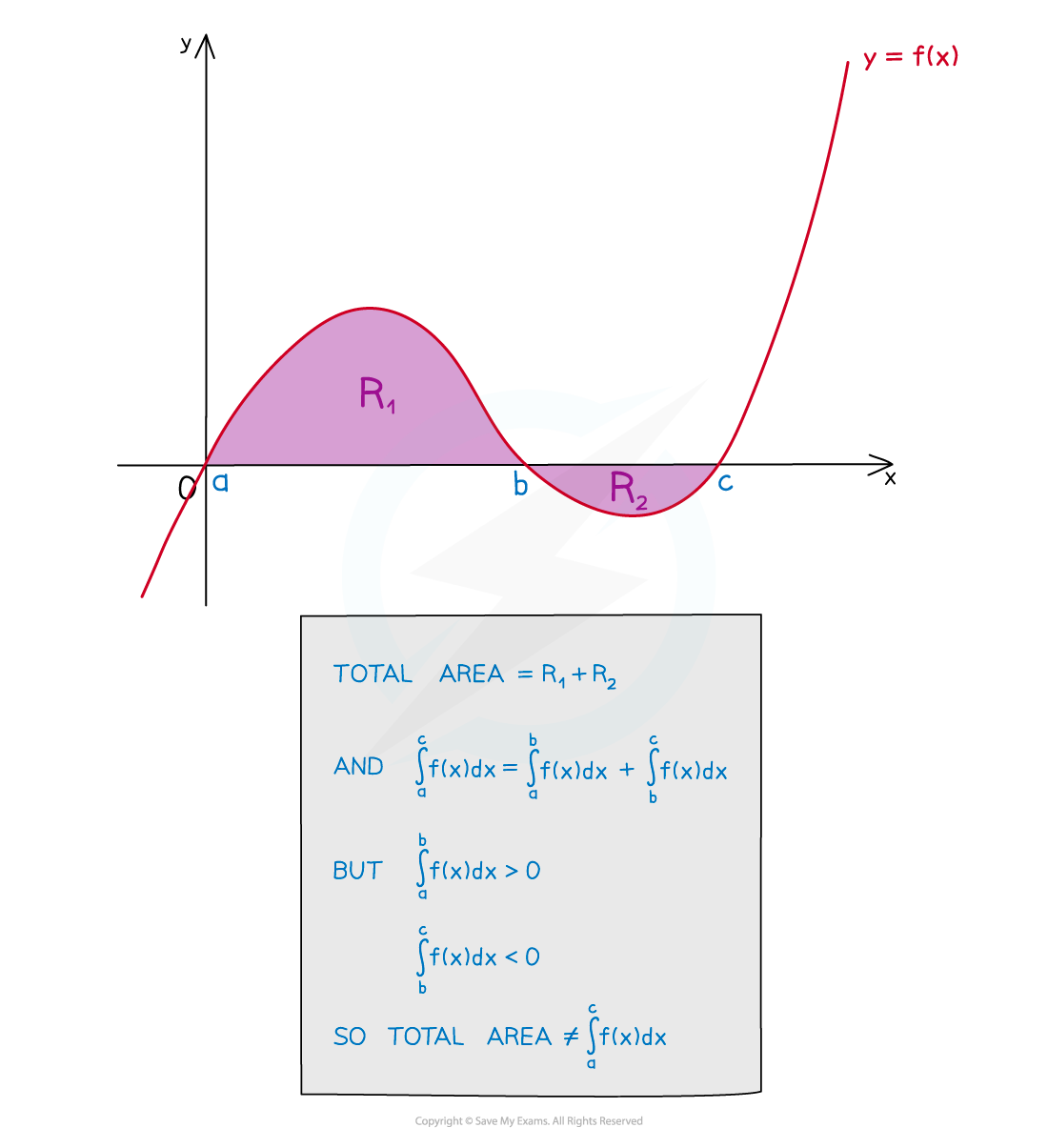
The total area is found using the absolute value of the function
The total area cannot be found using
You can also find it by splitting the interval into sub-intervals using the zeros of the function
Find
And add the absolute valueof
I.e.
In general, calculate areas above and below the axis separately
Add together the integrals for the areas above
and the modulus of the integrals for the areas below
Worked Example
The figure below shows a sketch of the curve with equation .

Find the total area of the shaded regions.
Answer:
The zeros are
Find the definite integral from to
Find the definite integral from to
Subtract the negative integral from the positive one
units squared
How do I find total areas between two curves using multiple integrals?
If curves intersect at more than two points
then you need to be careful when calculating the total area they enclose
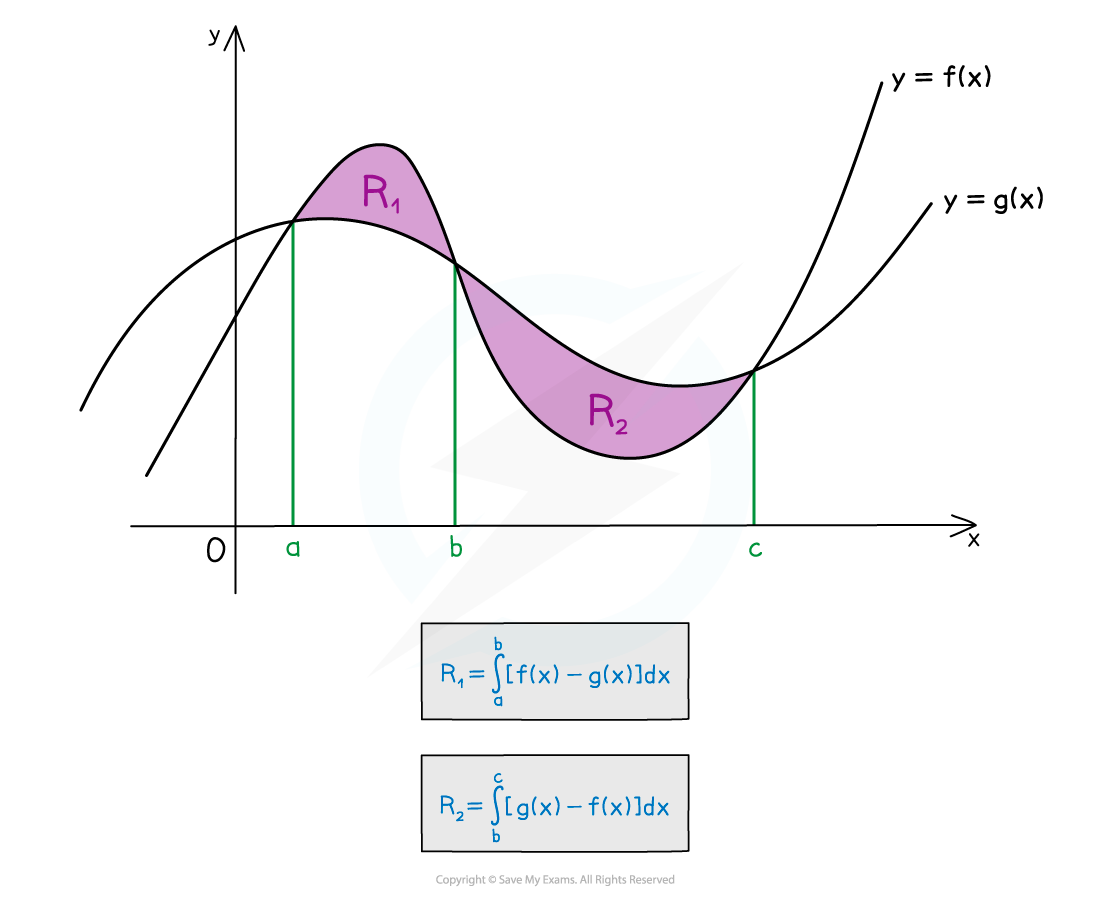
Alternatively, calculate areas of different regions separately
In the integral for each region
make sure the 'bottom' function (closer to the -axis)
is being subtracted from the 'top' function (further from the -axis)
Worked Example
The shaded region in the diagram below is the region enclosed by the curves with equations and where
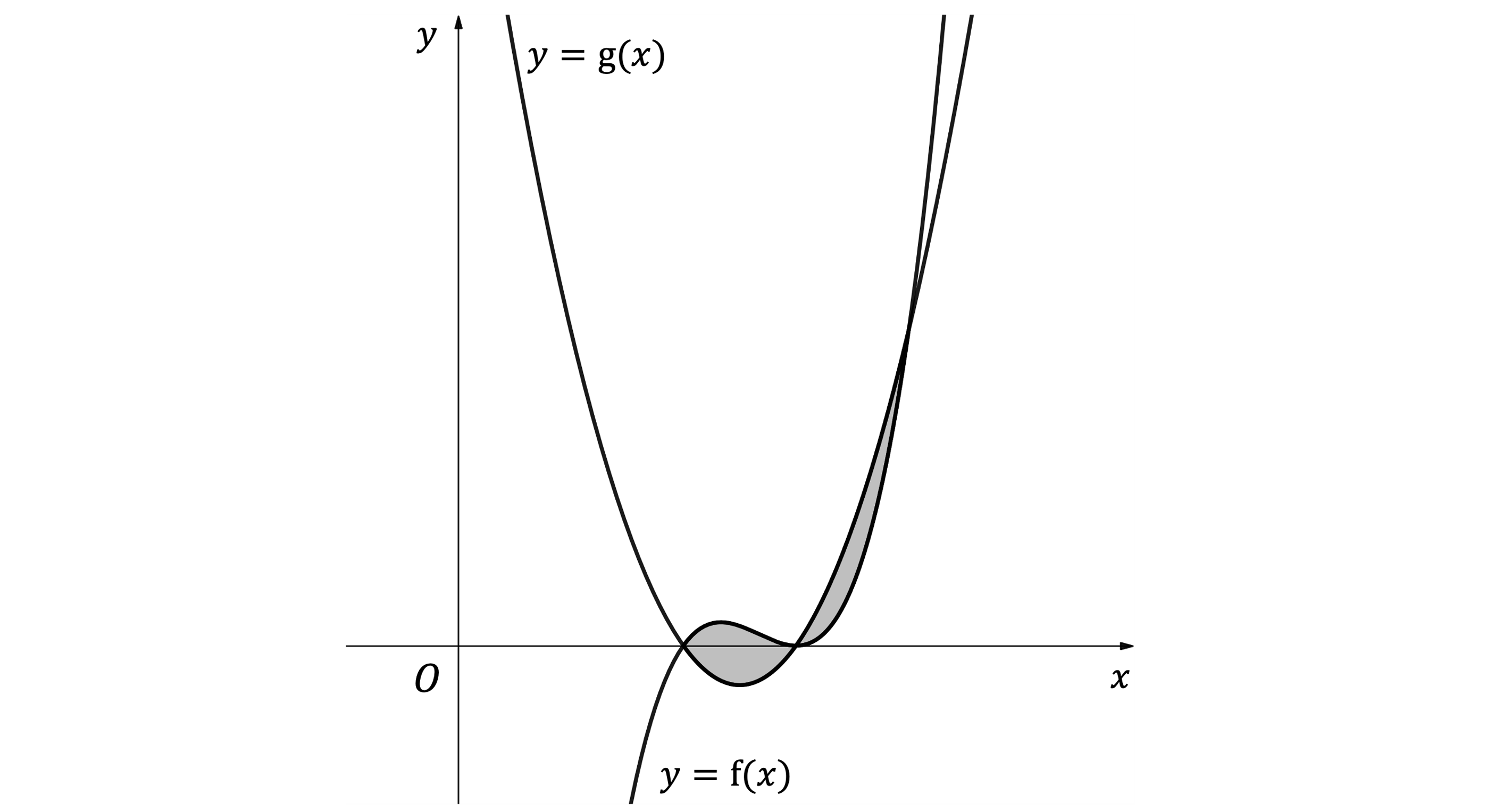
Find the total area of the shaded region.
Answer:
Note first of all that for calculating areas between two curves, it doesn't matter that the areas are partially above and partially below the -axis
Start by finding the -values of the points of intersection of the two curves
This can be solved by moving everything to one side of the equation and factoring further
Those will be the integration limits for the two integrals we need
Between and , is the 'top' function, so
That is the area for the part of the region on the left
Between and , is the 'top' function, so
That is the area for the part of the region on the right
Add together to get the total area
The total area is units squared
Using absolute value to find multiple areas
How do I find areas of regions partly above and partly below the x-axis using absolute value?
If you are using your calculator to work out area integrals you can use
I.e. integrate the absolute value (modulus) of the function
This will find the area
between the curve and the -axis
between and
Because the absolute value changes any negative parts of into their positive equivalents
you don't need to worry about different parts of the area being above or below the -axis
Examiner Tips and Tricks
Even if you are using your calculator to work out the value of an integral on the exam
you should write down the integral you are evaluating, to make sure your answer gets full credit
Worked Example
The shaded region in the diagram below is the region enclosed by the -axis and the graph of the function .
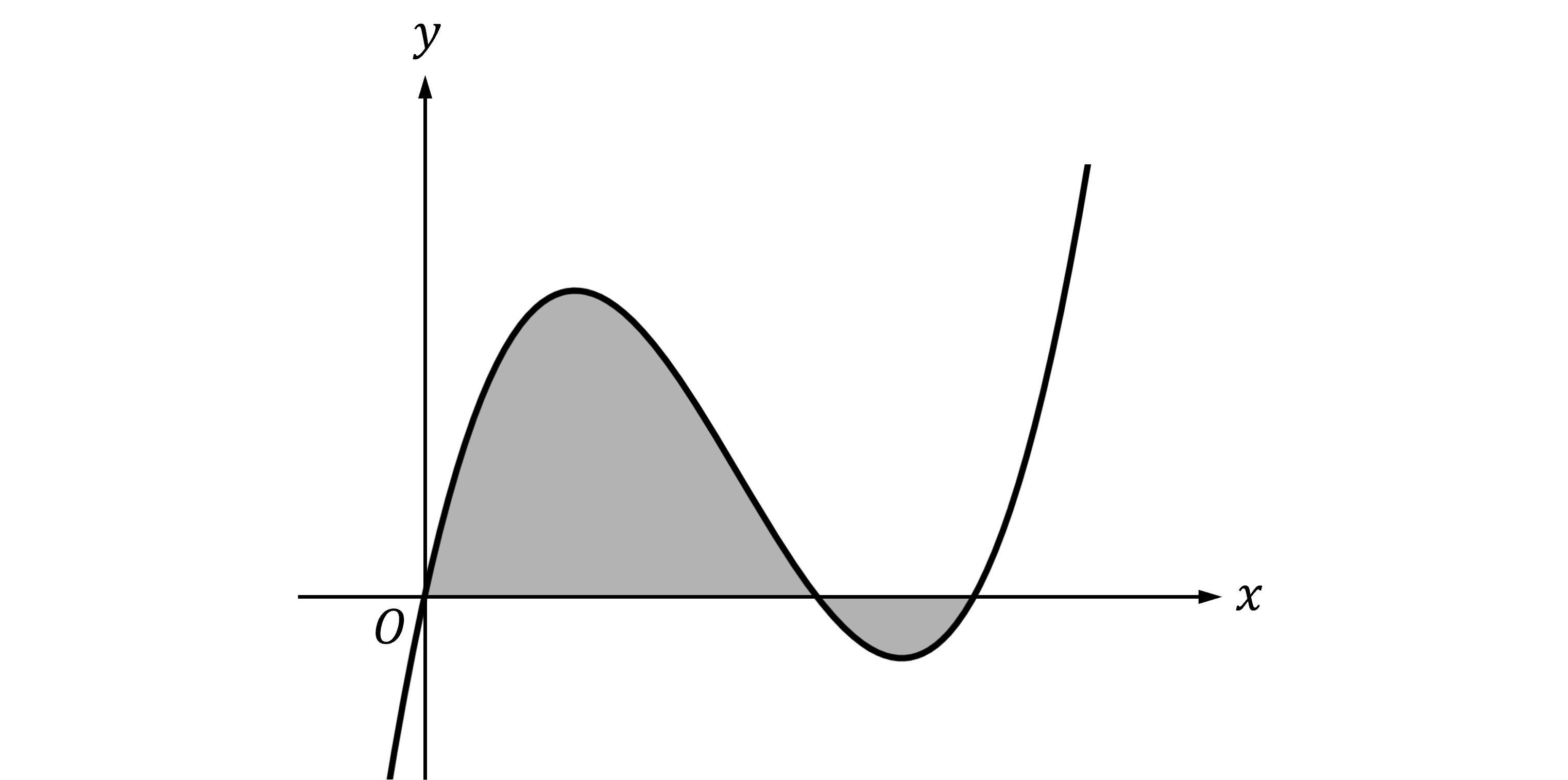
Find the total area of the shaded region.
Answer:
Start by finding the points where the graph intersects the -axis
To work this out by hand we'd need to find the two areas separately, between and (the bit above the -axis), and between and (the bit below the -axis)
Instead we can work out the entire area between and with one integral using absolute value
That integral can be evaluated using your graphing calculator
Total area = 101.75 units squared
How do I find total areas between two curves using absolute value?
If you are using your calculator to work out area integrals you can use
I.e. integrate the absolute value (modulus) of the function
This will find the area
between the curve and the curve
between and
Because the absolute value changes any negative parts of into their positive equivalents
you don't need to worry about which function is 'on top' in different parts of the area
You also don't need to worry about the order of the functions inside the absolute value
Worked Example
The shaded region in the diagram below is the region enclosed by the curves with equations and where
Find the total area of the shaded region.
Answer:
Start by finding the -values of the points of intersection of the two curves
To work this out by hand we'd need to find the two areas separately, between and (where is on top), and between and (where is on top)
Instead we can work out the entire area between and with one integral using absolute value
That integral can be evaluated using your graphing calculator
Total area = 0.5 units squared

Unlock more, it's free!
Join the 100,000+ Students that ❤️ Save My Exams
the (exam) results speak for themselves:

Was this revision note helpful?
Build on this topic
