Concavity of Functions (College Board AP® Calculus AB): Revision Note

Concavity of functions
What is concavity?
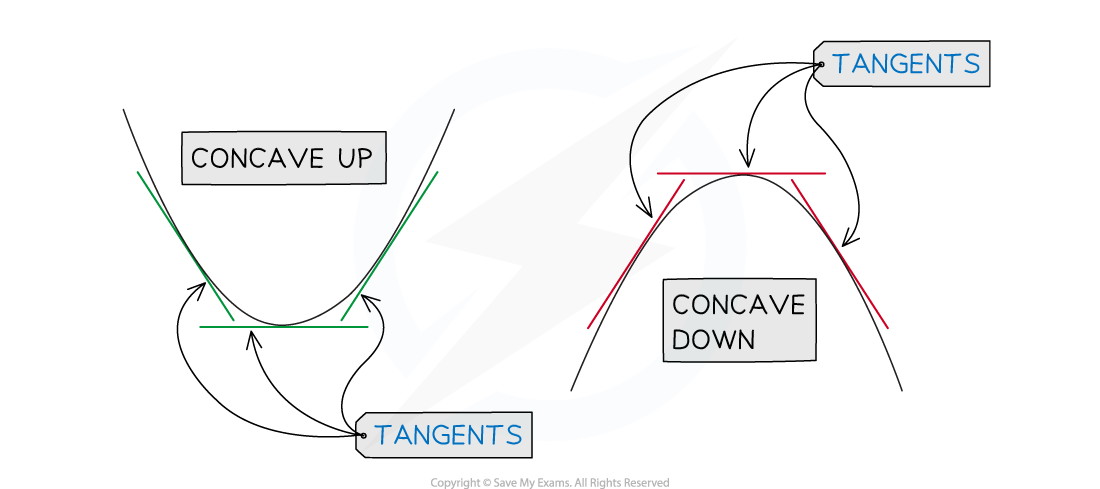
Concavity is the way in which a curve bends and is related to the second derivative of a function
A curve is:
Concave up if is increasing in this interval
for all values of in an interval
Concave down if is decreasing in this interval
for all values of in an interval
Examiner Tips and Tricks
Zero is included in both the inequalities above because the function could be concave up or concave down when . However, in your exam, you will only need to use or to find the concavity of functions. The functions will be chosen to make this work.
How do I find where a function is concave up or concave down using the second derivative?
The second derivative of a function, , describes the rate of change of the first derivative,
If the rate of change is positive, the first derivative is increasing
If the rate of change is negative, the first derivative is decreasing
This means you can determine if a function is concave up or down at a point using the second derivative
If then is concave up at
If then is concave down at
You can also find an interval where a function is concave up or down
To find where the function is concave up,
Solve the inequality
To find where the function is concave down,
Solve the inequality
What happens if the second derivative is zero?
If then the function could be concave up, concave down, or neither at these points
You determine what is happening at this point by looking at the sign of the second derivative on either side of this point
If the second derivative is positive on either side of the point, then is concave up at
Consider
and
Therefore, is concave up at (0, 0)
If the second derivative is negative on either side of the point, then is concave down at
Consider
and
Therefore, is concave down at (0, 0)
If the sign of the second derivative changes on either side of the point, then is neither concave up nor concave down
Consider
and
Therefore, is neither concave up nor concave down at (0, 0)
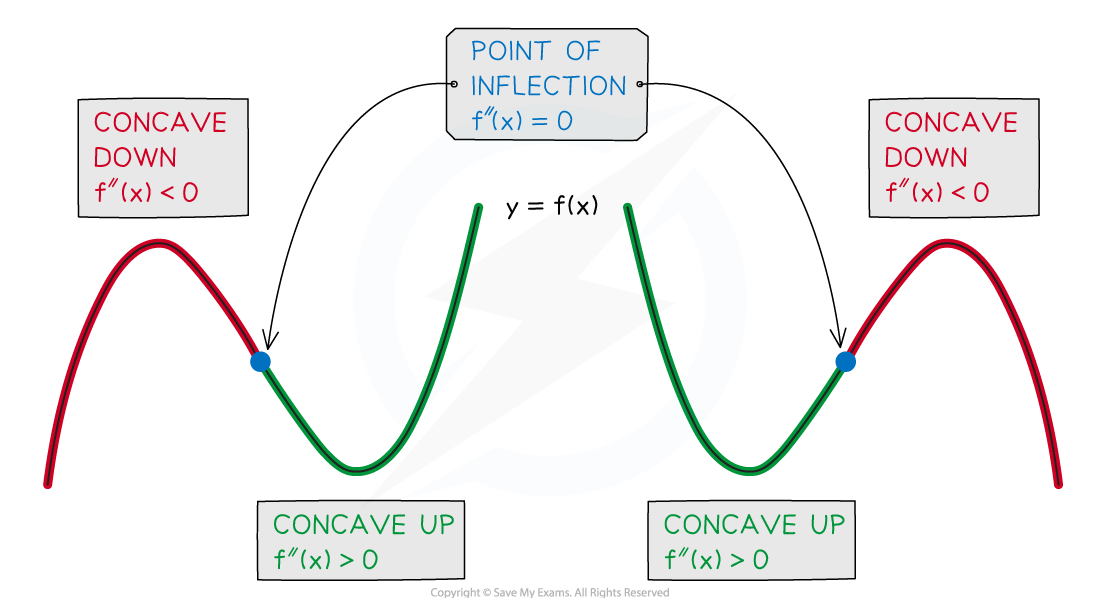
It is called a point of inflection
How do I find points of inflection?
Find the points where the second derivative is zero
The value of the first derivative could be any value
Find the sign of the second derivative around the points to find whether the concavity changes
Check whether it goes from concave up to concave down or vice versa
If it does, then the point is a point of inflection
Examiner Tips and Tricks
In an exam, an easy way to remember the difference is:
Concave down is the shape of (the mouth of) a sad smiley ☹️
They are feeling negative!
Concave up is the shape of (the mouth of) a happy smiley 🙂
They are feeling positive!
Worked Example
The function is defined by
State the open interval for which is concave down.
Answer:
A function is concave down when is negative
The following must then be solved in the given domain
The easiest way to solve this is with a graph of
Sketch the graph of for and highlight where the graph is less than zero
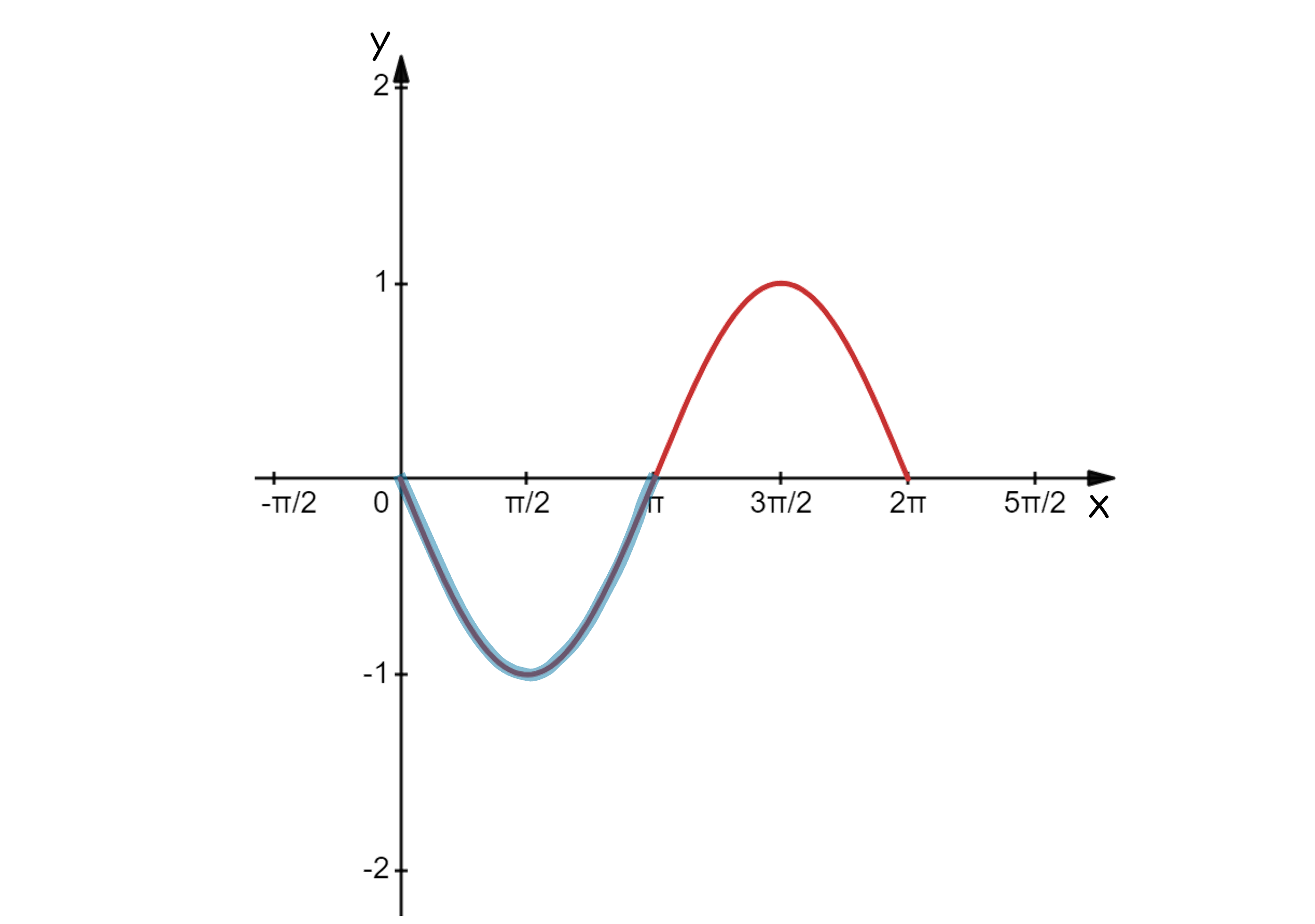
The function is concave down on the interval where the second derivative is less than or equal to zero,
Concave down when
Concave down on because
Worked Example
Let the function be defined by .
Find the coordinates of the point of inflection on the graph of . Justify how you know it is a point of inflection.
Answer:
Points of inflection have a second derivative of zero
Potential points of inflection can therefore be found by setting
Find the -coordinate
(1, 1)
So the point at (1, 1) could be a point of inflection
Check the sign of the second derivative at either side of to find the concavity of the curve
Just before , is concave down because
Just after , is concave up because
Therefore, has a point of inflection at because the concavity changes

Unlock more, it's free!
Join the 100,000+ Students that ❤️ Save My Exams
the (exam) results speak for themselves:

Was this revision note helpful?
Build on this topic
