Increasing & Decreasing Functions (College Board AP® Calculus AB): Revision Note

Increasing & decreasing functions
What are increasing and decreasing functions?
A non-constant function is increasing on the interval if:
whenever
If whenever , then the function is strictly-increasing
A non-constant function is decreasing on the interval if:
whenever
If whenever , then the function is strictly-decreasing
A constant function is neither increasing nor decreasing
How do I find where a function is increasing and decreasing using the first derivative?
The first derivative of a function, , describes the rate of change of
If the rate of change is positive, the function is increasing
If the rate of change is negative, the function is decreasing
This means you can determine if a function is increasing or decreasing at a point using the first derivative
If then is increasing at
If then is decreasing at
You can also find an interval where a function is increasing or decreasing
To find where the function is increasing,
Solve the inequality
To find where the function is decreasing,
Solve the inequality
What happens if the first derivative is zero?
If then there is a critical point at
The function could be increasing, decreasing, or neither at these points
You determine what is happening at this point by looking at the sign of the derivative on either side of this point
If the derivative is positive on either side of the point, then is increasing at
Consider
and
Therefore, is increasing at (0, 0)
If the derivative is negative on either side of the point, then is decreasing at
Consider
and
Therefore, is decreasing at (0, 0)
If the sign of the derivative changes on either side of the point, then is neither increasing nor decreasing
Consider
and
Therefore, is neither increasing nor decreasing at (0, 0)
If the derivative is also zero on either side of the point, then is constant on an interval
Therefore, is neither increasing nor decreasing
Examiner Tips and Tricks
The definitions for where a function is increasing or decreasing include the endpoints, however the scoring guidelines for exam questions often allow the point to still be awarded if the endpoints are not included.
I.e. " is increasing for " would receive the same points as " is increasing for ".
This usually comes up as an MCQ so you do not need to worry about whether to use an open or closed interval.
How can I identify intervals where the function is increasing or decreasing by using the graph of the derivative?
Sketching a graph of both and can help to identify where a function will be increasing or decreasing
On the graph of ,
An upward slope from left to right is where the function is increasing
A downward slope from left to right is where the function is decreasing
On the graph of ,
The portion of the graph above the -axis is where the function is increasing
The portion of the graph below the -axis is where the function is decreasing
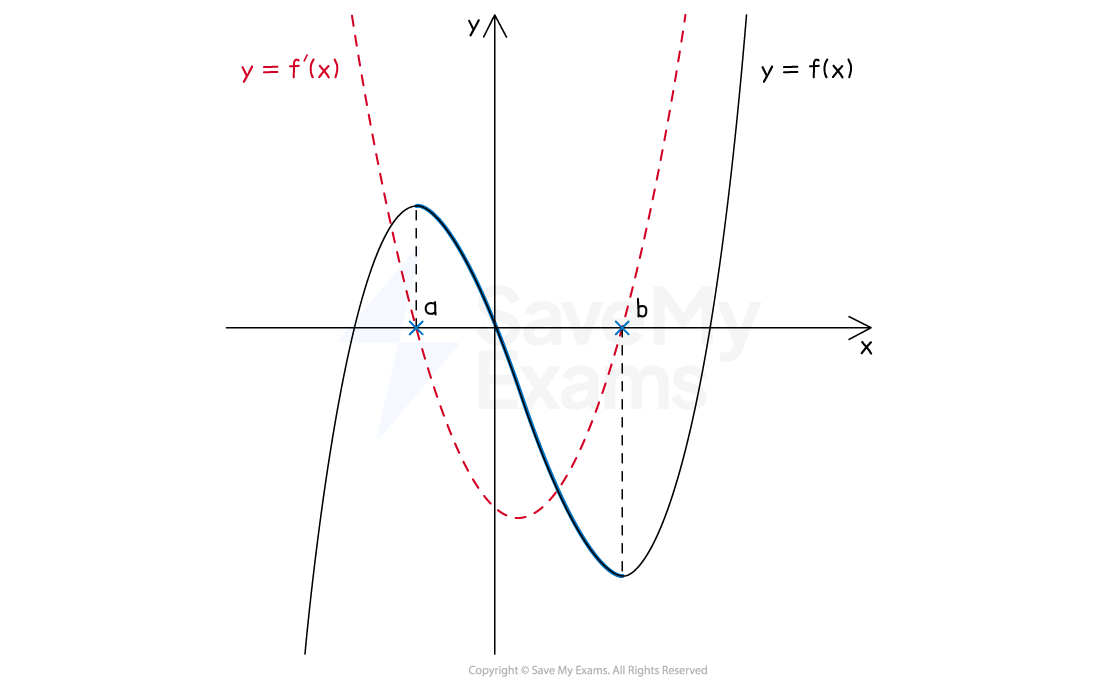
The diagram below shows a cubic and its derivative, a quadratic, plotted on the same graph
Between the critical points at and , the cubic is decreasing
Therefore, the graph of the derivative is below the -axis between and
Worked Example
Let be the function given by . On which of the following intervals is the function decreasing?
(A) and
(B) and
(C) and
(D)
Answer:
The function is decreasing where
Find
Solve the inequality
The easiest way to solve a cubic inequality is to graph it, you could use your calculator to help you
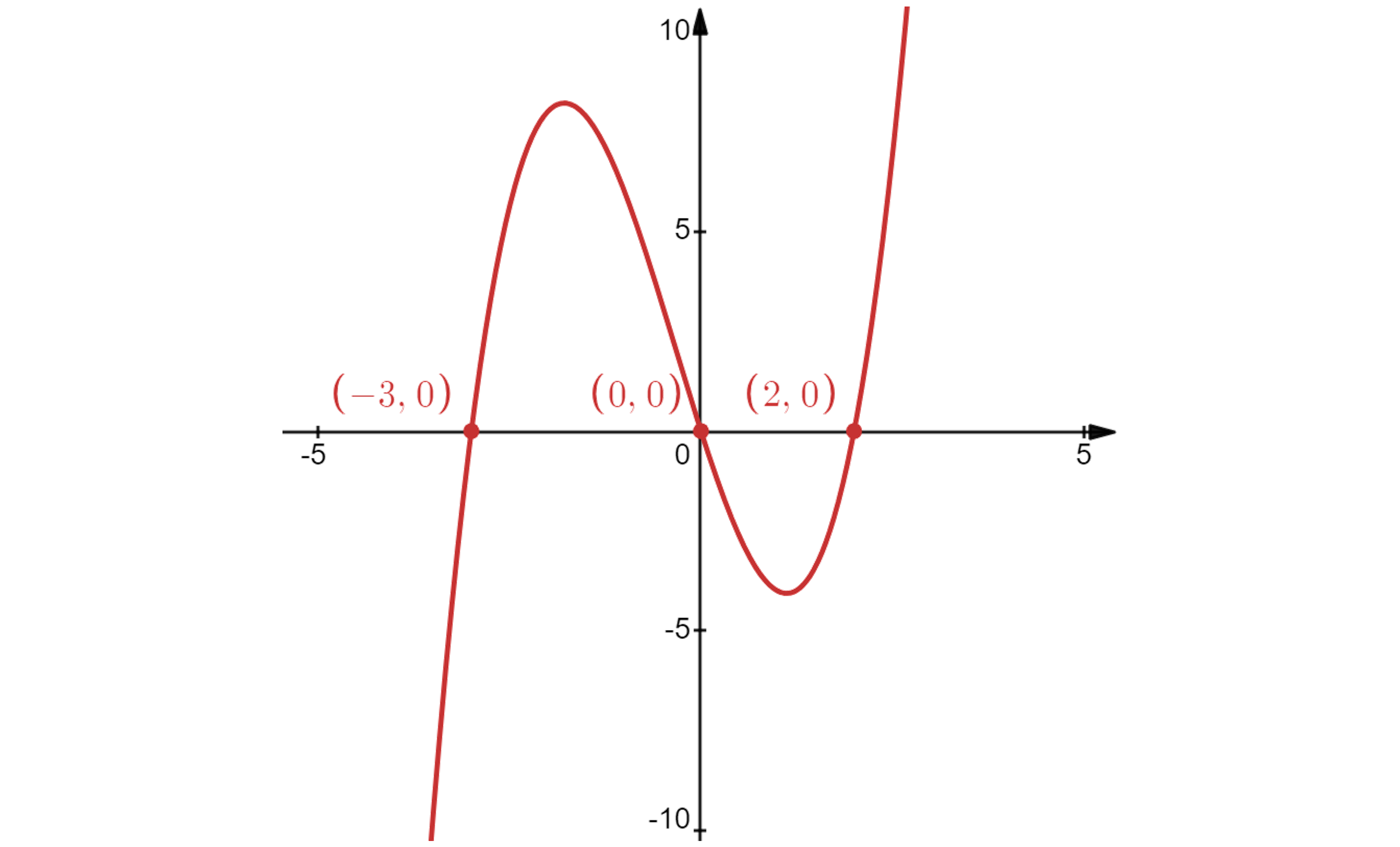
Use the graph to identify where (the parts underneath the -axis)
and
So these are the regions where , therefore these are the regions where the graph of is decreasing
The question asks for intervals, rather than values of
Decreasing on the intervals and
The following options are incorrect:
(B) because these are the intervals where is negative
(C) because these are the intervals where is increasing
(D) because this is the interval where the derivative of is decreasing
Worked Example
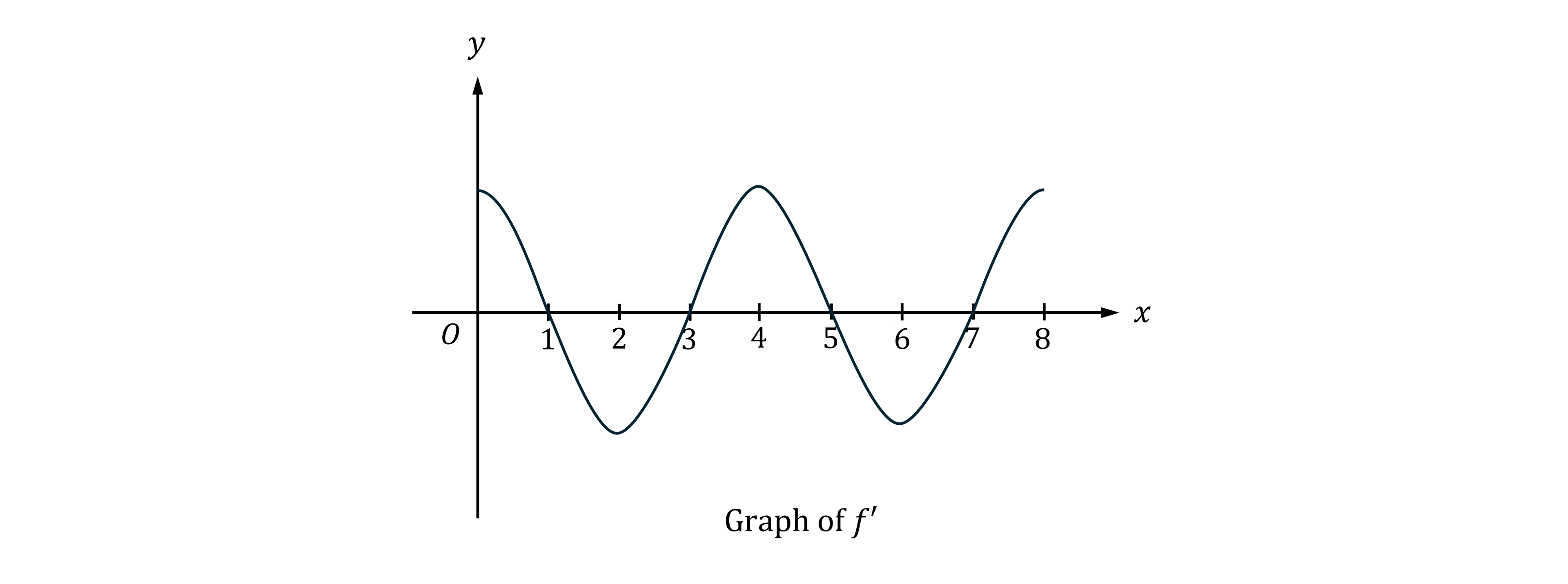
The function is differentiable on the open interval . The graph of , the derivative of is shown in the figure above.
On what open intervals is increasing? Justify your answer.
Answer:
Check when
when , and
Therefore, is increasing on the intervals , and because on these intervals
Examiner Tips and Tricks
For the worked example above, the function is not increasing at because the sign of changes either side of these points.
You do not need to mention this in the answer because the question already asks for the open intervals.

Unlock more, it's free!
Join the 100,000+ Students that ❤️ Save My Exams
the (exam) results speak for themselves:

Was this revision note helpful?
Build on this topic