Area Between a Curve & x-Axis (College Board AP® Calculus AB): Revision Note

Area between a curve & x-axis
How do I find an area between a curve and the x-axis?
The value found when calculating the definite integral of a function with respect to between and ,
as long as on the interval
is equal to the area between the curve and the -axis between and
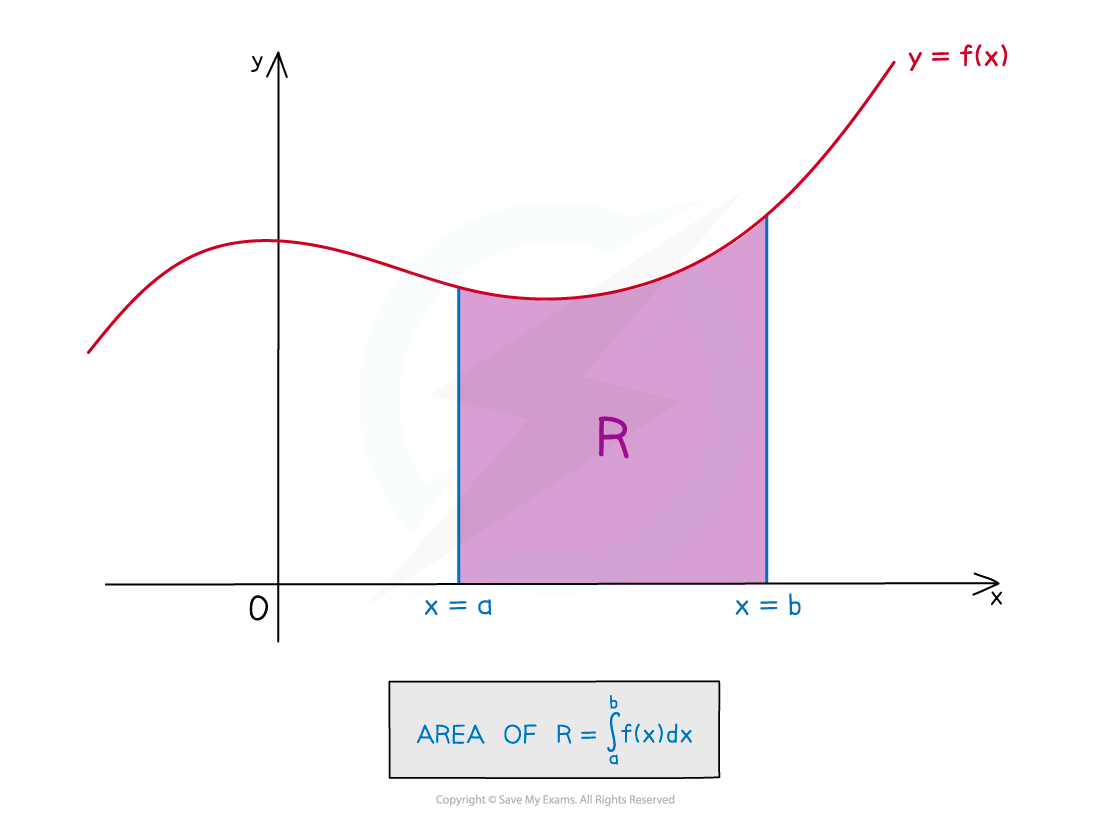
Consider finding the area between the graph of and the -axis, between and
This method of finding areas uses the idea of a definite integral as calculating an accumulation of change
is the area of a rectangle with height and width
is the limit of this area element as
The integral sums up all these infinitesimal area elements between and
What if I am not told the limits of integration?
If limits are not provided they will often be the -axis intercepts
Set and solve the equation to find the -axis intercepts first
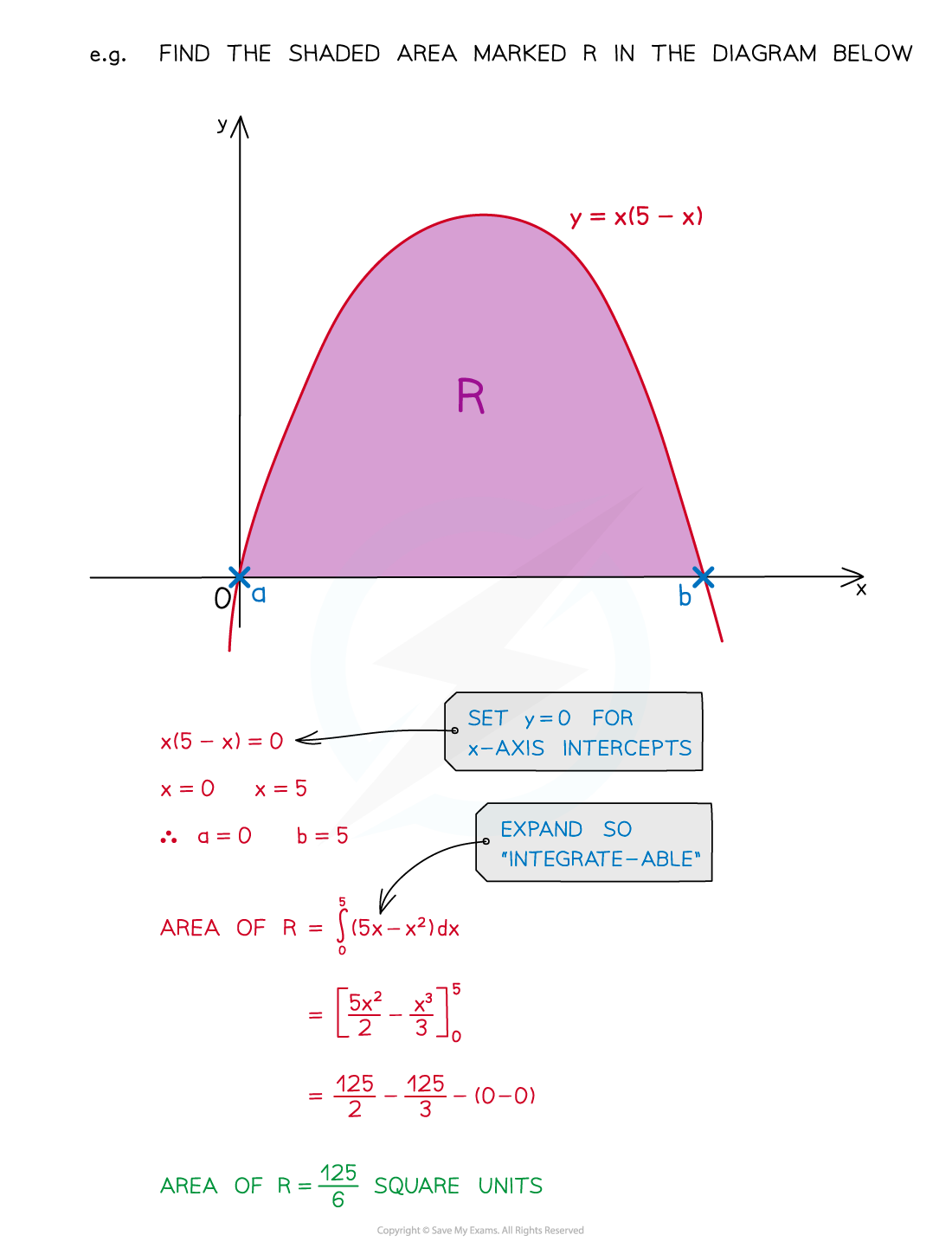
Remember that the -axis (i.e. ) may also be one of the limits
Worked Example
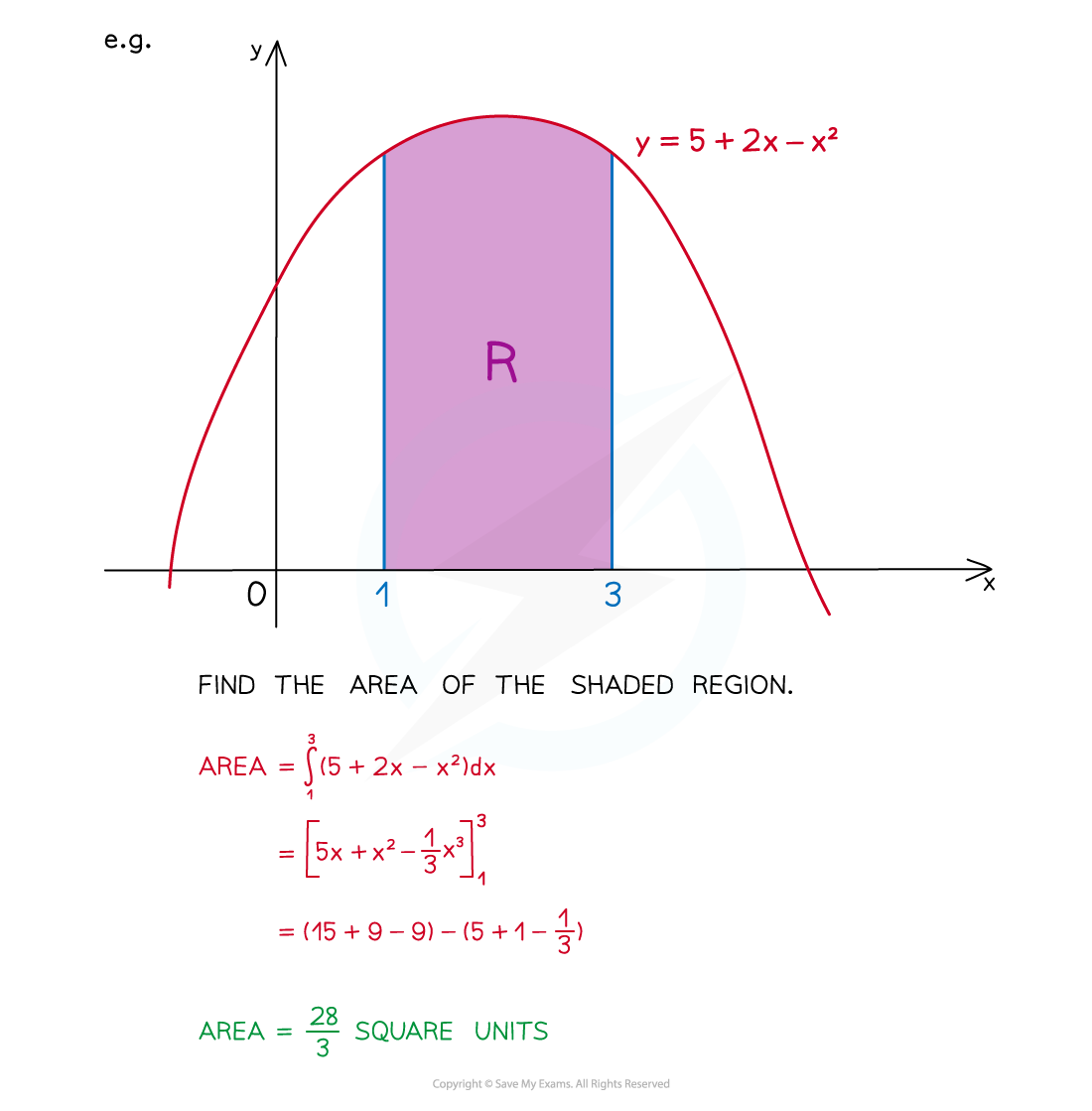
The area bounded by the curve with equation , the -axis and the vertical lines with equations and is shaded below.

Find the area of the shaded region.
Answer:
Find the definite integral from to
units squared
When is the area integral negative?
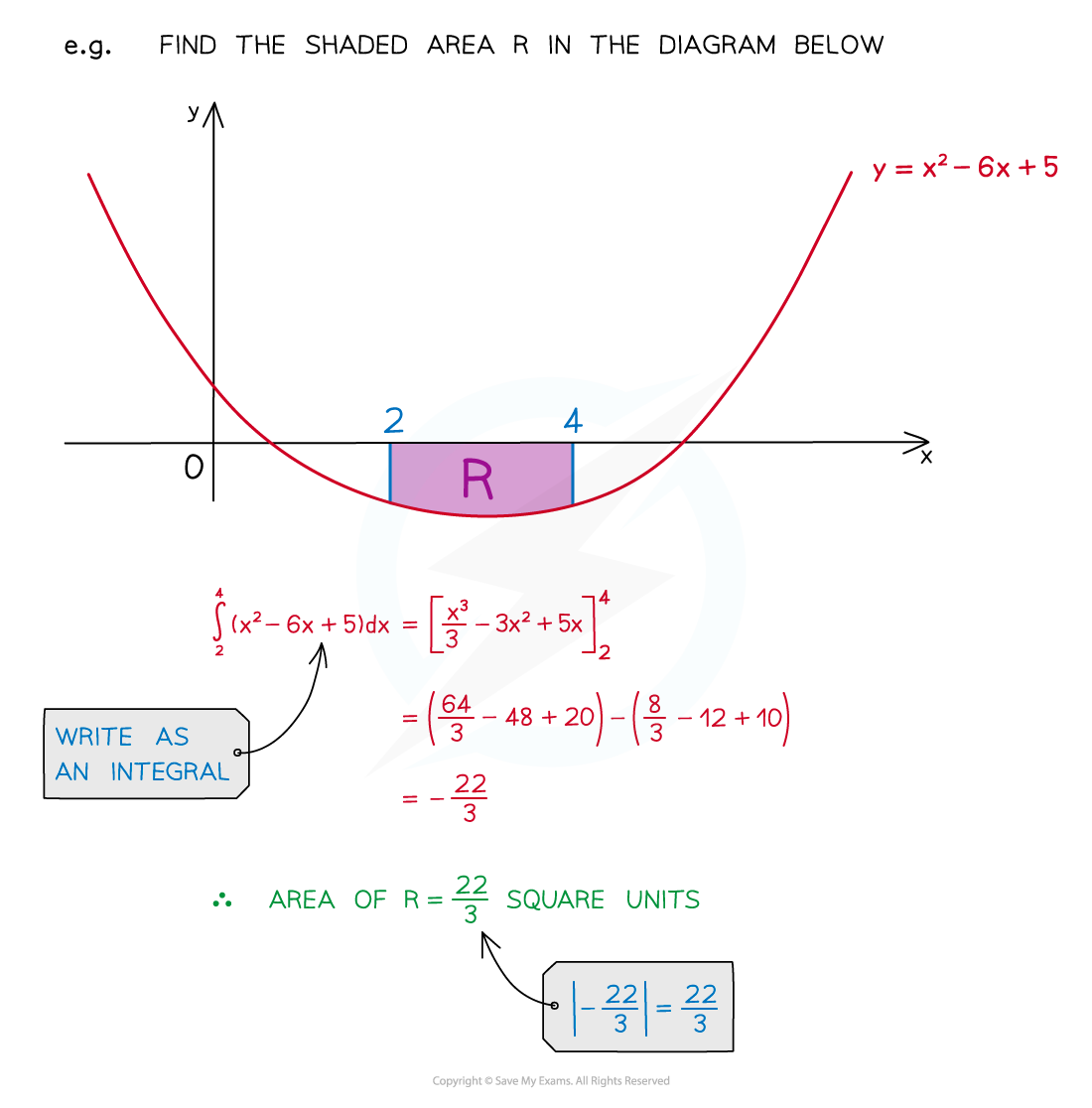
If the area lies underneath the -axis the value of the definite integral will be negative
However, an area cannot be negative
The area is equal to the modulus (absolute value) of the definite integral
If the area has some parts which are above the -axis, and some which are below the -axis
then see the method outlined in the 'Multiple Areas' study guide
Examiner Tips and Tricks
Always check whether you need to find the value of an integral, or an area.
When areas below the -axis are involved, these will be two different values.
Examiner Tips and Tricks
In an FRQ, make sure you clearly state the integrand and the limits of integration.
Worked Example
The finite region , shown in the figure below, is bounded by the curve with equation and the -axis.
Find the exact area of .

Answer:
Find the definite integral from to
Take the absolute value to find the area
units squared

Unlock more, it's free!
Join the 100,000+ Students that ❤️ Save My Exams
the (exam) results speak for themselves:

Was this revision note helpful?
Build on this topic
