Washer Method Around Other Axes (College Board AP® Calculus AB): Revision Note

Volume with washer method revolving around other axes
How can I use the washer method to calculate a volume of revolution around a line parallel to the x-axis?
Let and be continuous functions such that on the interval
I.e. is closer to the horizontal line than is on that interval
If the region bounded by
the curves and
between and
is rotated radians around the line , then the volume of revolution is
Note that and are both functions of
Make sure that is the curve further away from the line
and is the curve closer to the line
If the curves 'swap places' over the interval
then split the calculation into separate integrals
If and are not stated in a question, these boundaries could involve
the -axis ()
and/or point(s) of intersection of the two curves
Worked Example
Let be the region enclosed by the graphs of and , as shown in the figure below.
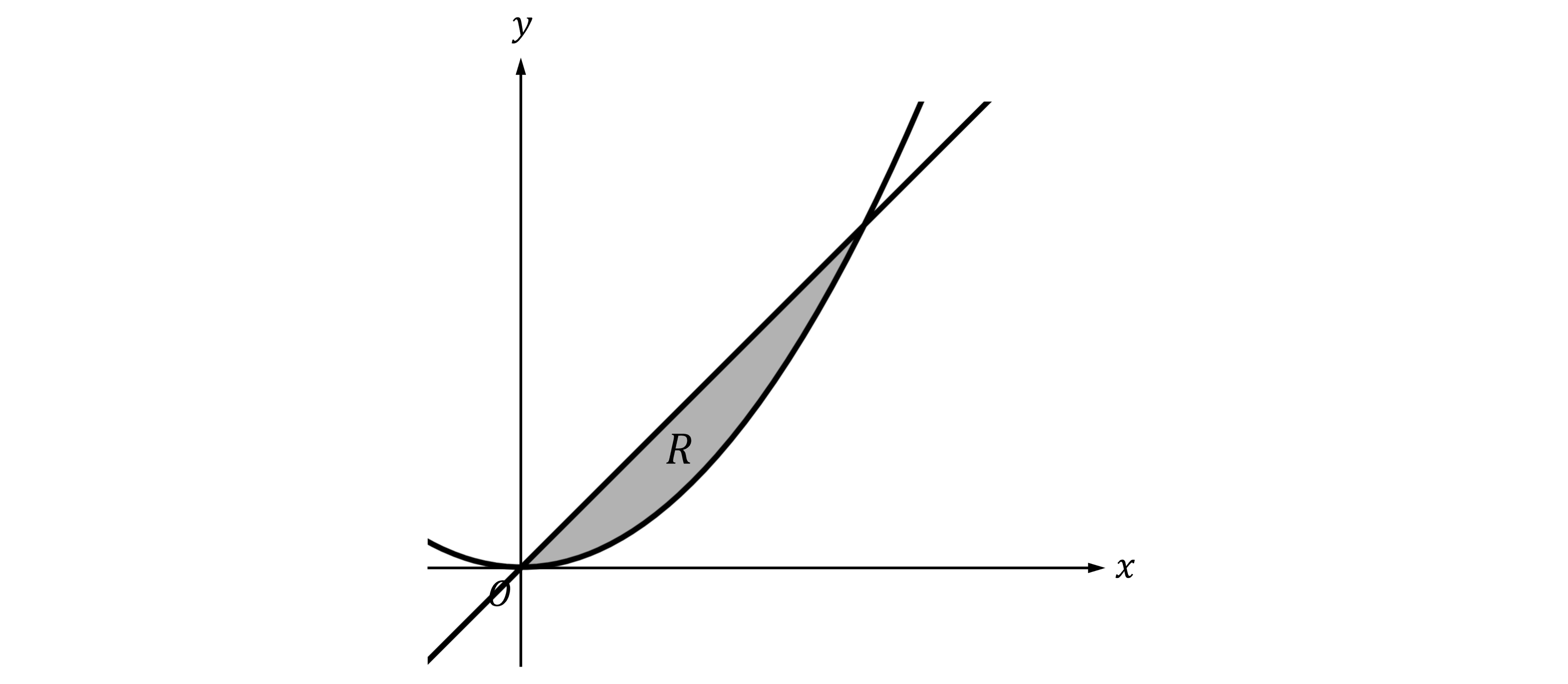
Find the volume of the solid generated when is rotated about the horizontal line .
Answer:
Use
To find and , solve to find the -coordinates of the points of intersection of the two curves
So and
At , , so is above region in the diagram
Therefore is the function closest to the line , so use and
Set up and solve the integral
56.968 units cubed (to 3 decimal places)
How can I use the washer method to calculate a volume of revolution around a line parallel to the y-axis?
Let and be continuous functions of such that on the interval
I.e. is closer to the vertical line than is on that interval
If the region bounded by
the curves and
between and
is rotated radians around the line , then the volume of revolution is
Note that and are both functions of
If the functions are given as functions of
e.g and
then you will need to rewrite them as functions of
See the Worked Example
Also note that the integration is done with respect to
Make sure that is the curve further away from the line
and is the curve closer to the line
If the curves 'swap places' over the interval
then split the calculation into separate integrals
If and are not stated in a question, these boundaries could involve
the -axis ()
and/or point(s) of intersection of the two curves
Worked Example
Let be the region enclosed by the graphs of and , as shown in the figure below.
Find the volume of the solid generated when is rotated about the vertical line .
Answer:
Use
First rewrite the functions as functions of
Note that is used instead of because it can be seen from the graph that the values of the relevant part of the curve are positive
The line is to the left of region in the diagram
Therefore is the function closest to the line , so use and
To find and , solve to find the -coordinates of the points of intersection of the two curves
So and
Set up and solve the integral
67.021 units cubed (to 3 decimal places)

Unlock more, it's free!
Join the 100,000+ Students that ❤️ Save My Exams
the (exam) results speak for themselves:

Was this revision note helpful?
Build on this topic
