The Inverse Function Theorem (College Board AP® Calculus AB): Revision Note

The reciprocal of a derivative
What is the reciprocal of a derivative?
Derivatives are not fractions, but they behave in the same way as fractions when finding reciprocals
The reciprocal of is
This is only true if
Likewise, the reciprocal of is
This is only true if
This property is useful when:
Finding the derivative of the inverse of a function
Relating rates of change to one another using the chain rule
Derivatives of inverse functions
How are the derivatives of a function and its inverse related?
Provided that a function is:
Differentiable
A one-to-one function (so that it has an inverse, )
Its inverse, at the point will be differentiable and the derivative of the inverse at this point will be equal to:
This is provided that
You may also see this written as:
Where
This is provided that
This is known as the inverse function theorem
To explain why this is true, consider the diagram below
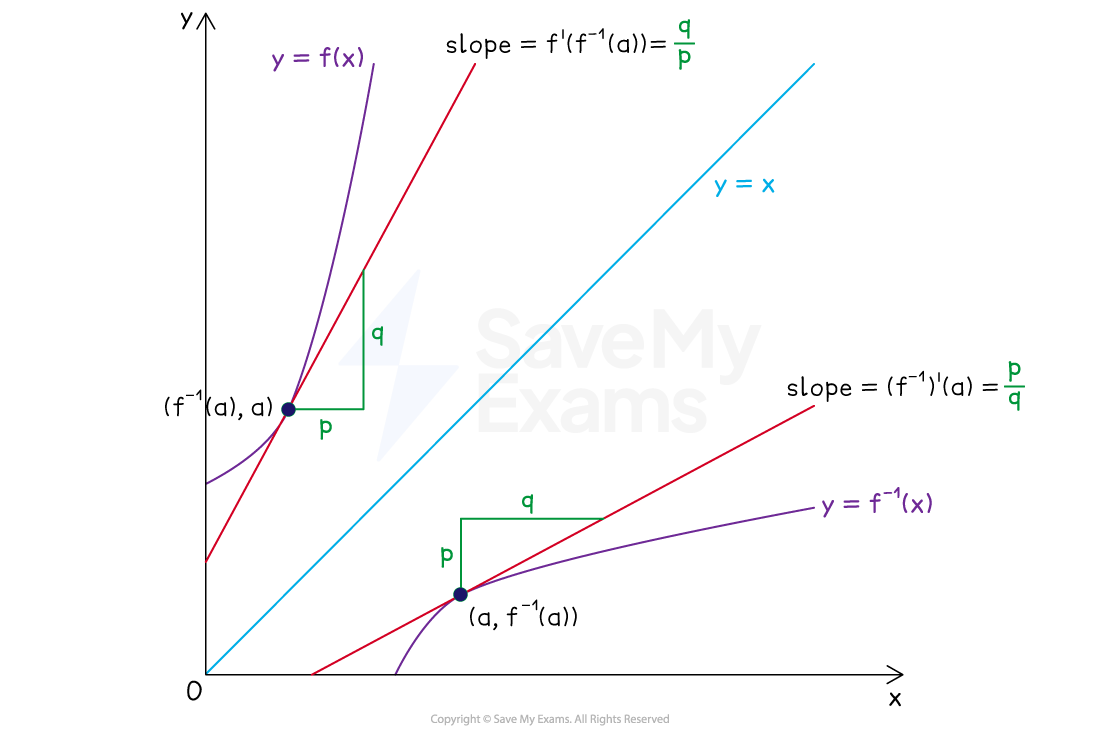
The diagram shows that because the graphs of and are reflections in the line :
If the slope of at is ,
then the slope of at will be
This also means that the theorem does not hold if
The derivates of these functions at these points are reciprocals of one another,
this helps explain why the equation is true
If so that ,
then the inverse function theorem can be written as
This form can be more useful for finding an expression for the derivative of the inverse, but it will be in terms of rather than
The form stated earlier is more useful for finding the derivative of the inverse at a point
Examiner Tips and Tricks
If and are inverses, then they can be interchanged in the formula:
Worked Example
Let be the function defined by for .
Use the inverse function theorem to show that.
Answer:
Define the inverse of
Let
Differentiate
Use the inverse function theorem
As , it follows that
How is the inverse function theorem derived?
The inverse function theorem can be derived using the definition of an inverse, and the chain rule
Let
because and are inverses of each other
Differentiate both sides with respect to
Apply the chain rule to the left-hand side
Rearrange
Recall that
Worked Example
Let and let be the inverse function of .
Given that , what is the value of ?
Answer:
Write the inverse function theorem using and
We are trying to find , so fill this in
We need to find and to be able to calculate the value
Find by differentiating using the chain rule
Using the statement , apply the inverse to both sides to undo the function on the left-hand side
is the inverse of
We now have all the information we need, so substitute these in
Worked Example
The function is defined by .
Show that the inverse of exists, and then find the derivative of the inverse of at the point where .
Answer:
First check that the inverse exists
, which is always positive
So is always strictly increasing, which means it is a one-to-one function
Therefore exists
Use the inverse function theorem
We are trying to find the derivative of the inverse at , or
Fill this in
We already know from the first step that
So we just need to find ; this is the inverse of , when
To find an equation for the inverse of , simply switch and
Inverse:
Find the inverse when
Solve the cubic equation
If it were a calculator question, you could solve the cubic equation on your calculator
If it were a non-calculator question, you could test values for using factors of 135
Fill this in

Unlock more, it's free!
Join the 100,000+ Students that ❤️ Save My Exams
the (exam) results speak for themselves:

Was this revision note helpful?
Build on this topic