Triangles as Cross Sections (College Board AP® Calculus AB): Revision Note

Roger B

Written by: Roger B

Reviewed by: Dan Finlay

Updated on

Volumes with cross sections as triangles

How can I find the volume of a solid with a triangular cross section?

  • Use the basic concept

    • If the area of the cross section of a solid is given by A(x)

      • and A(x) is continuous on [a, b]

    • Then the volume of the corresponding solid from x=a to x=b is

      • Volume=abA(x) dx

  • You may need to create the cross sectional area function A(x) based on information provided

    • For example, A(x) may depend on the values of another function (or functions) given to you in the question

  • Remember that the area of a triangle is

    • Area=12×base×perpendicular height

Worked Example

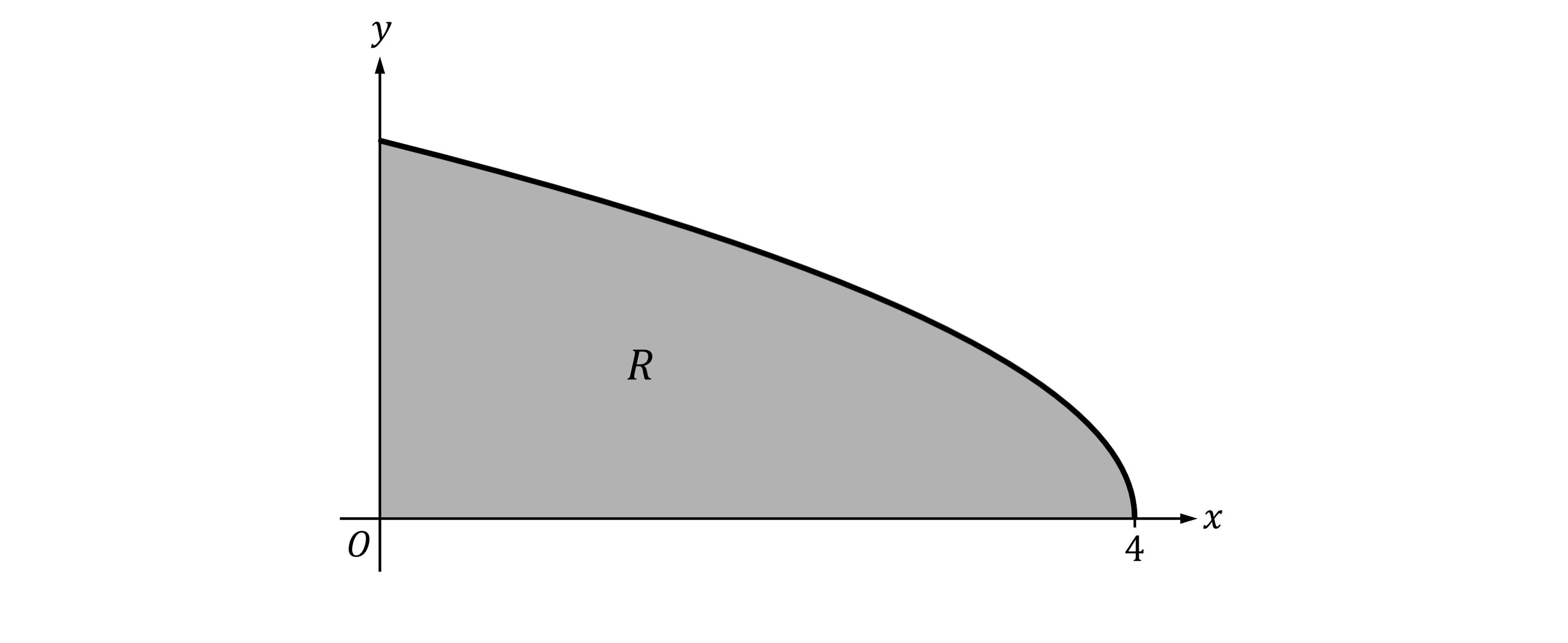
Let R be the region enclosed by the graph of f(x)=4x and the x- and y-axes, as shown in the figure below.

A shaded region labeled "R" is enclosed by the x-axis, the y-axis and the curve y=sqrt(4-x) from x=0 to x=4

Region R is the base of a solid. For the solid, at each x the cross section perpendicular to the x-axis is an equilateral triangle. Find the volume of the solid.

Answer:

Use Volume=abA(x) dx

Use Pythagoras' theorem to work out the relevant lengths in the cross section
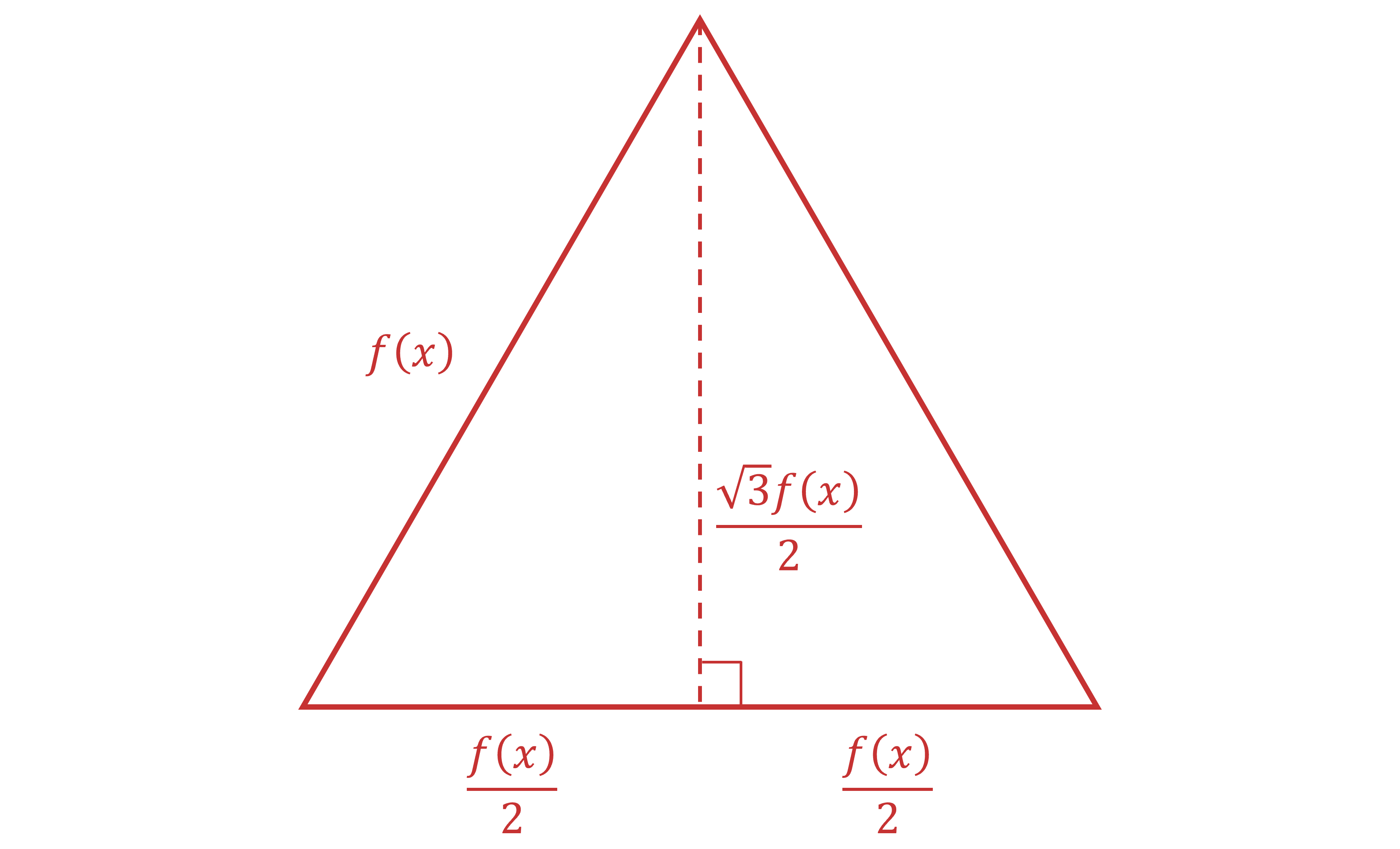
Equilateral triangle with side lengths of f(x), showing that the perpendicular height of the triangle is (sqrt(3)/2) * f(x)

height=(f(x))2(f(x)2)2=32f(x)

At each x the cross-sectional area is 12×base×height

A(x)=12·f(x)·32f(x)=34(f(x))2

Now the volume integral can be used

Volume=0434(4x )2 dx=3404(4x) dx=34[4x12x2]04=34((4(4)12(4)2)(0))=23=3.464101...

3.464 units cubed

Unlock more, it's free!

Join the 100,000+ Students that ❤️ Save My Exams

the (exam) results speak for themselves:

Build on this topic

Roger B

Author: Roger B

Expertise: Development Editor

Roger's teaching experience stretches all the way back to 1992, and in that time he has taught students at all levels between Year 7 and university undergraduate. Having conducted and published postgraduate research into the mathematical theory behind quantum computing, he is more than confident in dealing with mathematics at any level the exam boards might throw at you.

Dan Finlay

Reviewer: Dan Finlay

Expertise: Portfolio Lead

Dan graduated from the University of Oxford with a First class degree in mathematics. As well as teaching maths for over 8 years, Dan has marked a range of exams for Edexcel, tutored students and taught A Level Accounting. Dan has a keen interest in statistics and probability and their real-life applications.