Washer Method Around the x-Axis (College Board AP® Calculus AB): Revision Note

Volume with washer method revolving around the x-axis
When should I use the washer method for a volume of revolution around the x-axis?
The washer method should be used when there is a gap between a region being rotated and the line it is being rotated around
For example, in the following diagram consider rotating the shaded area between the two curves around the -axis
There would be a gap between the -axis and the curve
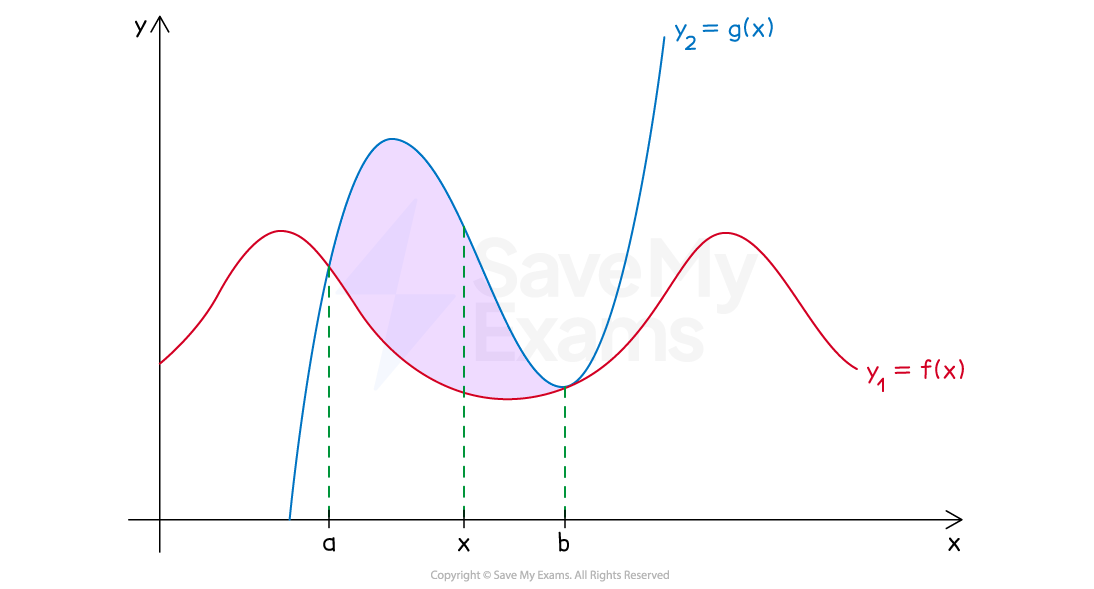
At a point between and , the cross section of the solid of revolution would look like this:
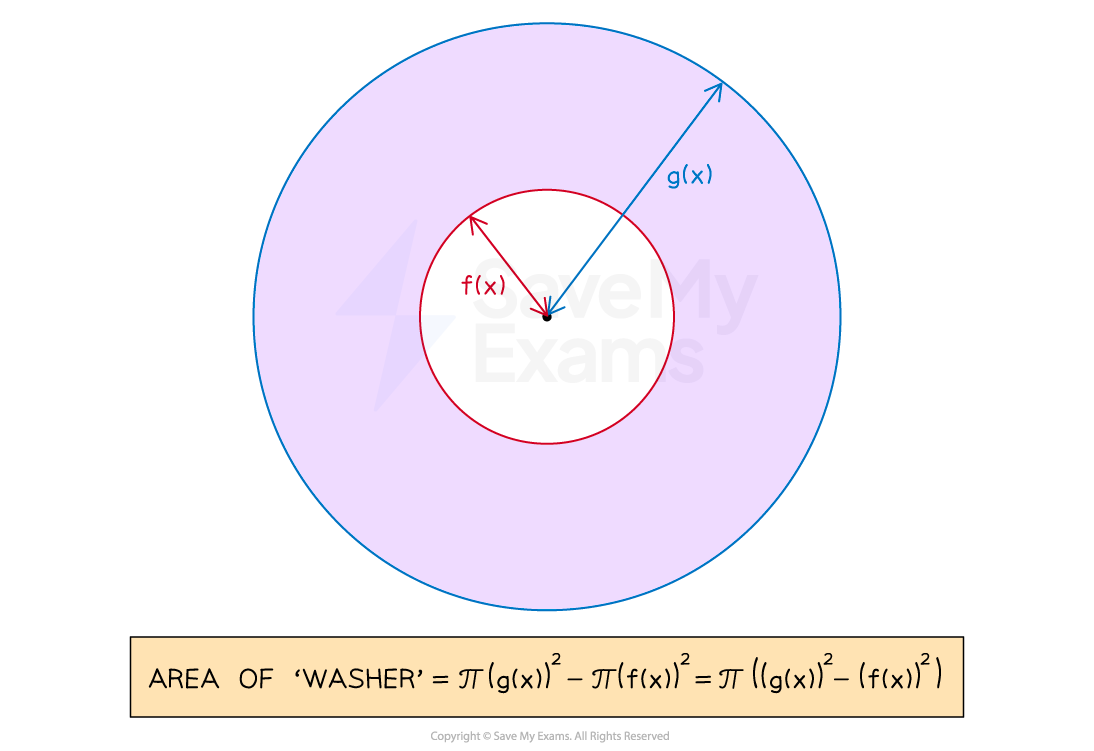
I.e., it would have the shape of a washer, with
How can I use the washer method to calculate a volume of revolution around the x-axis?
Let and be continuous functions such that on the interval
I.e. is closer to the -axis than is on that interval
Consider the region bounded by
the curves and
between and
If it is rotated radians around the -axis, then the volume of revolution is
Note that and are both functions of
Make sure that is the curve further away from the -axis
and is the curve closer to the -axis
If the curves 'swap places' over the interval, then split the calculation into separate integrals
If and are not stated in a question, these boundaries could involve
the -axis ()
and/or point(s) of intersection of the two curves
This method of finding volumes of revolution uses the idea of a definite integral as calculating an accumulation of change
It is a special case of 'finding volumes from areas of known cross-sections'
is the volume of a washer with
inner radius
outer radius
and length
is the limit of this volume element as
The integral sums up all these infinitesimal volume elements between and
Examiner Tips and Tricks
Be careful not to confuse with
These are not equal!
Worked Example
Let be the region enclosed by the graphs of and , as shown in the figure below.
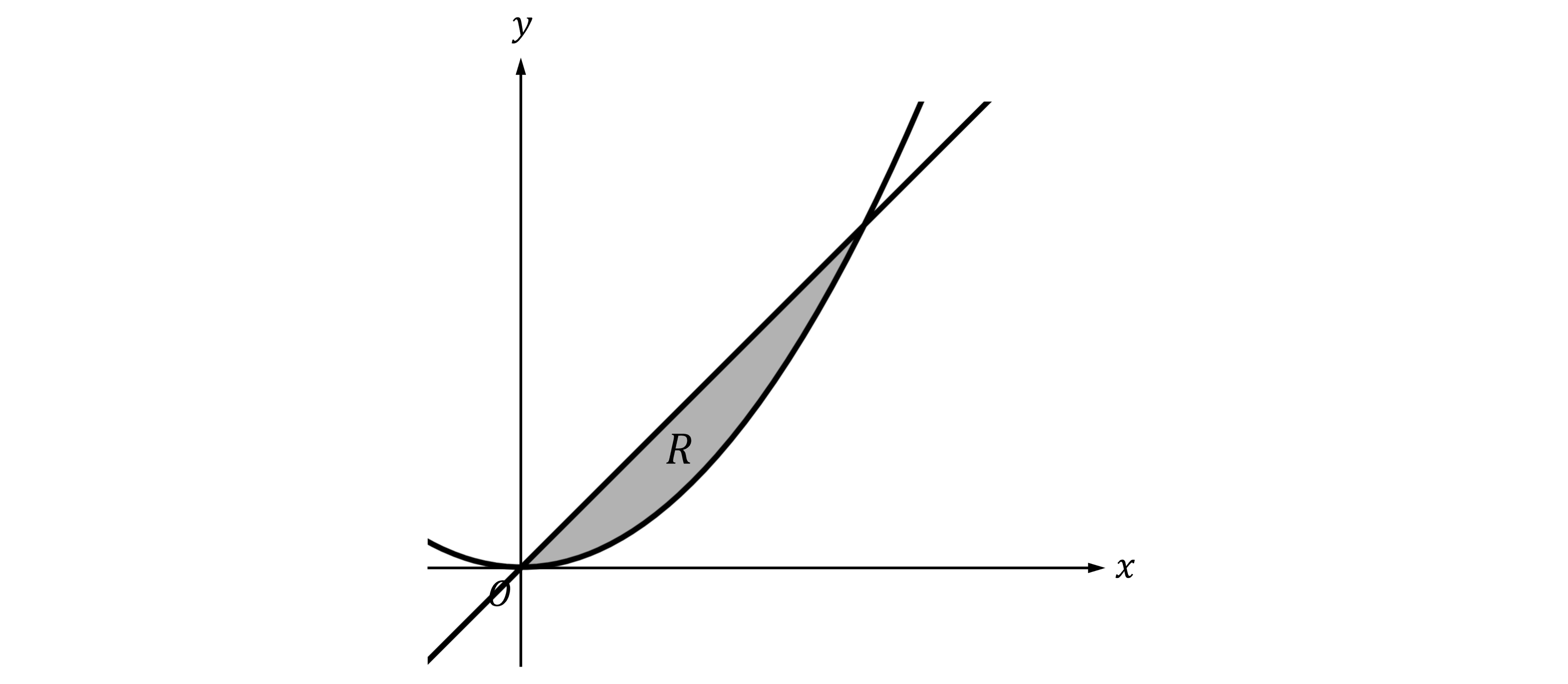
Find the volume of the solid generated when is rotated about the -axis.
Answer:
Use
is the function closest to the -axis, so use and
To find and , solve to find the -coordinates of the points of intersection of the two curves
So and
Set up and solve the integral
26.808 units cubed (to 3 decimal places)

Unlock more, it's free!
Join the 100,000+ Students that ❤️ Save My Exams
the (exam) results speak for themselves:

Was this revision note helpful?
Build on this topic
