Integration Using Long Division (College Board AP® Calculus AB): Revision Note

Roger B

Written by: Roger B

Reviewed by: Dan Finlay

Updated on

Integration using long division

How do I divide polynomials?

  • It is possible to use polynomial long division to simplify a rational function like x3+6x29x11x2

    • This can make the function much easier to integrate

  • Polynomial division works just like the long division method used for regular numbers:
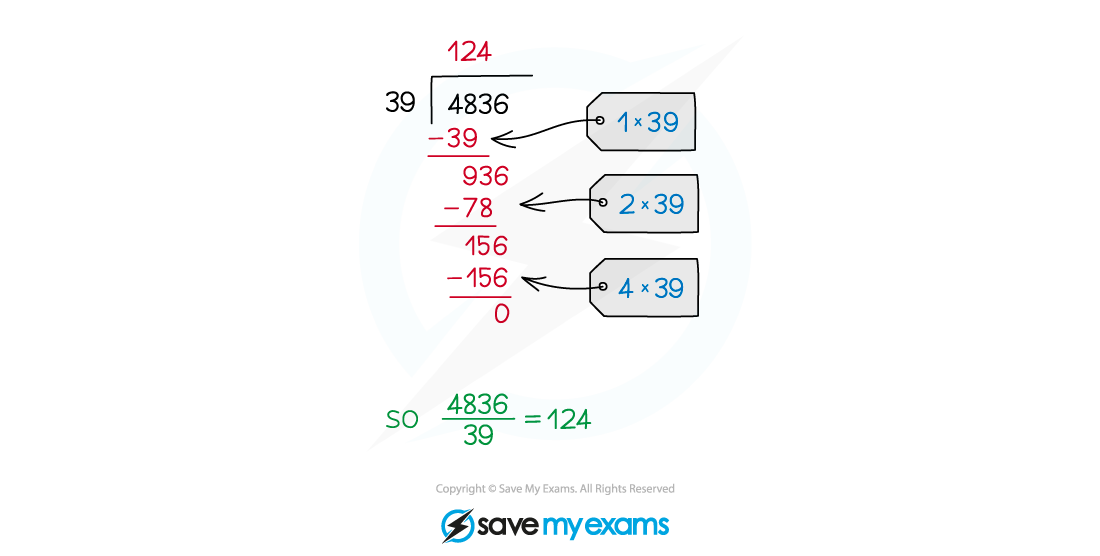
Worked long division of 4836 ÷ 39 using repeated subtraction of 1×39, 2×39 and 4×39, showing steps to get quotient 124 and remainder 0
  • The answer to a polynomial division is built up term by term

    • working downwards in powers of the variable (usually x)

  • E.g. dividing  x3+6x29x11  by  x2

Beginning of a polynomial long division problem, dividing x^3+6x^2-9x-11 by x-2
  •  x3+6x29x11 (the thing being divided) is known as the dividend

    • and  x2 (the thing we're dividing by) is known as the divisor

  • Start by dealing with the highest power term in the dividend (x3)

    • Compare the highest power term in the divisor (x)

    • x3÷x=x2  so

      • put x2 on top of the division line

      • and subtract  x2·(x2)=x32x2  from the dividend

First step of a polynomial long division problem, dividing x^3+6x^2-9x-11 by x-2
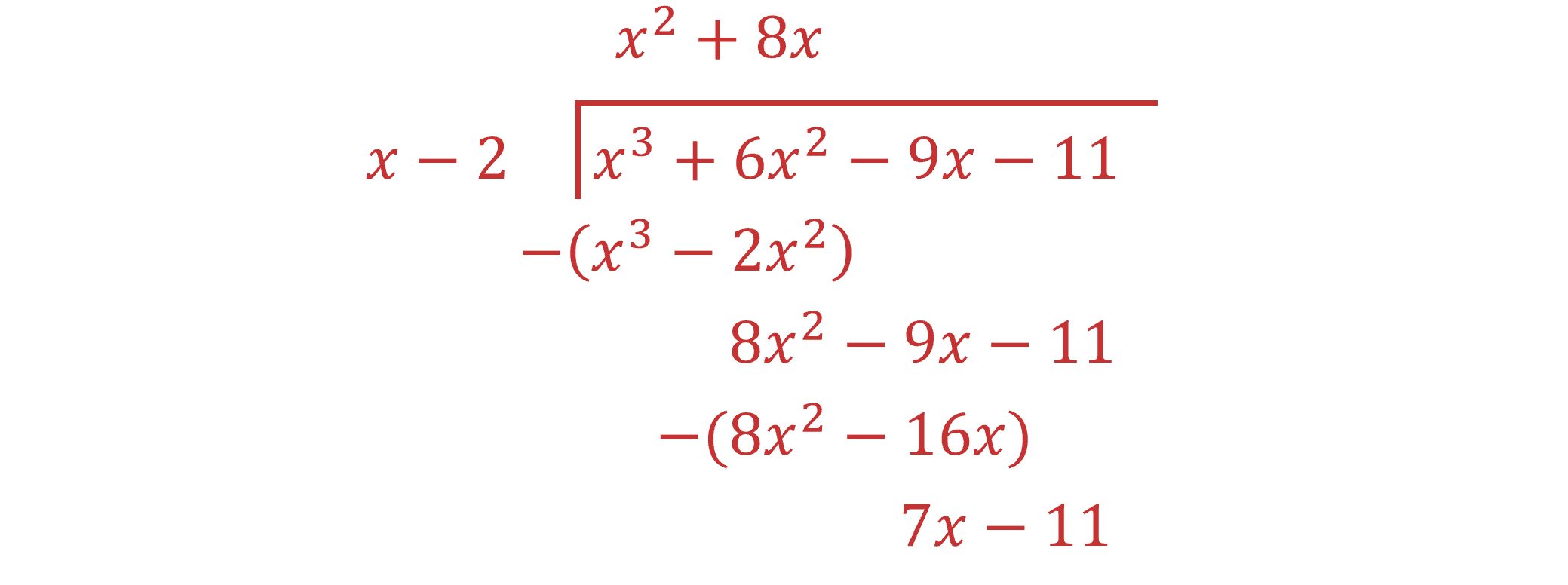
  •  Now deal with the highest power remaining in the expression on the bottom line (8x2)

    • Compare the highest power term in the divisor (x)

    • 8x2÷x=8x  so

      • add 8x on top of the division line

      • and subtract  8x·(x2)=8x216x  from the bottom line

Second step of a polynomial long division problem, dividing x^3+6x^2-9x-11 by x-2
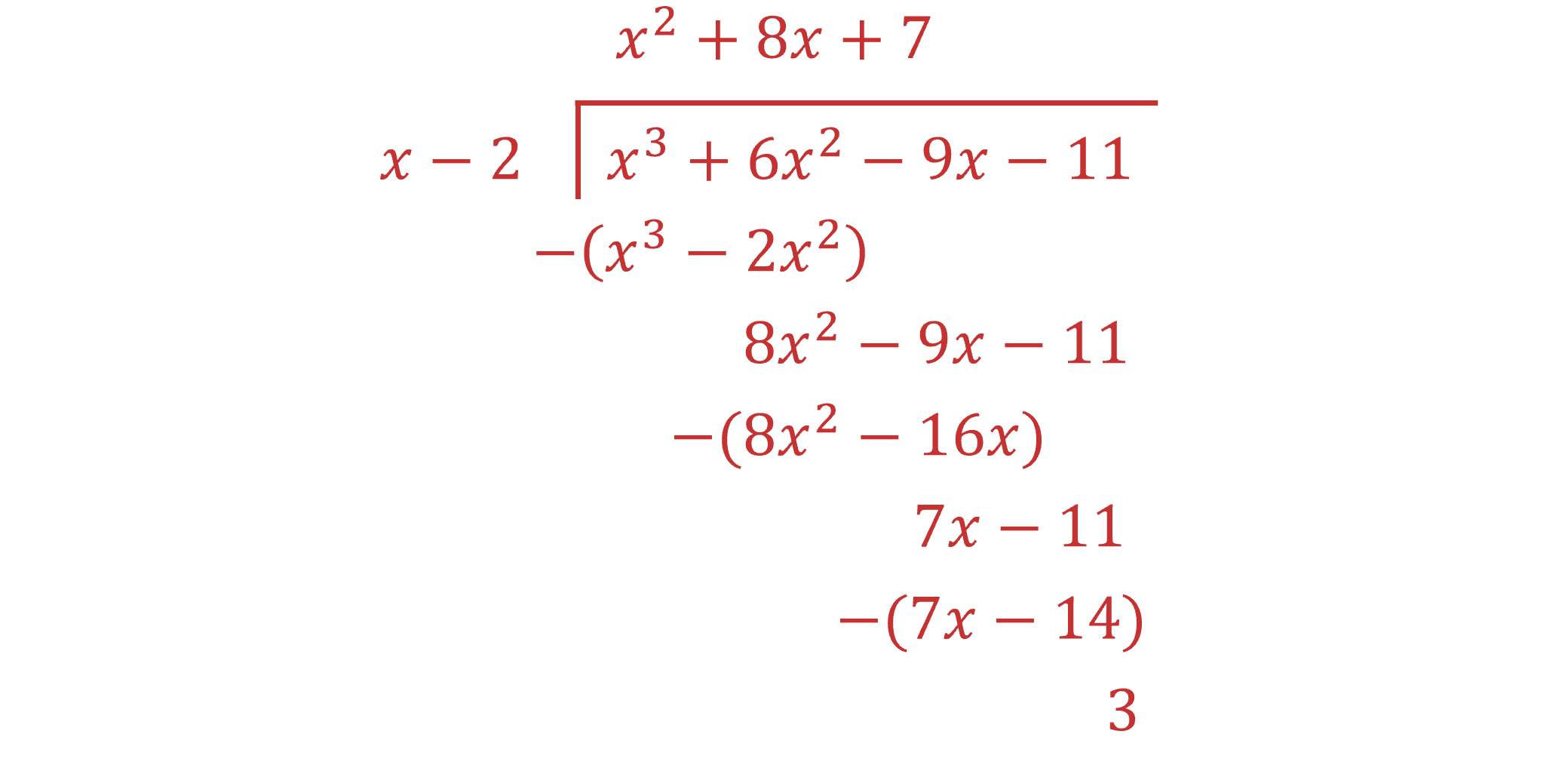
  • Now deal with the highest power remaining in the expression on the bottom line (7x)

    • Compare the highest power term in the divisor (x)

    • 7x÷x=7  so

      • add 7 on top of the division line

      • and subtract  7·(x2)=7x14  from the bottom line

Third step of a polynomial long division problem, dividing x^3+6x^2-9x-11 by x-2
  • The 3 'left over' at the bottom is the remainder

    • Therefore  x3+6x29x11x2=x2+8x+7+3x2

    • In that new form, the function would be very easy to integrate

Examiner Tips and Tricks

Be extra careful when subtracting expressions with negative coefficients

  • Using brackets can help you keep track of things

Worked Example

Find the indefinite integral x3+2x+13x+3 dx.

Answer:

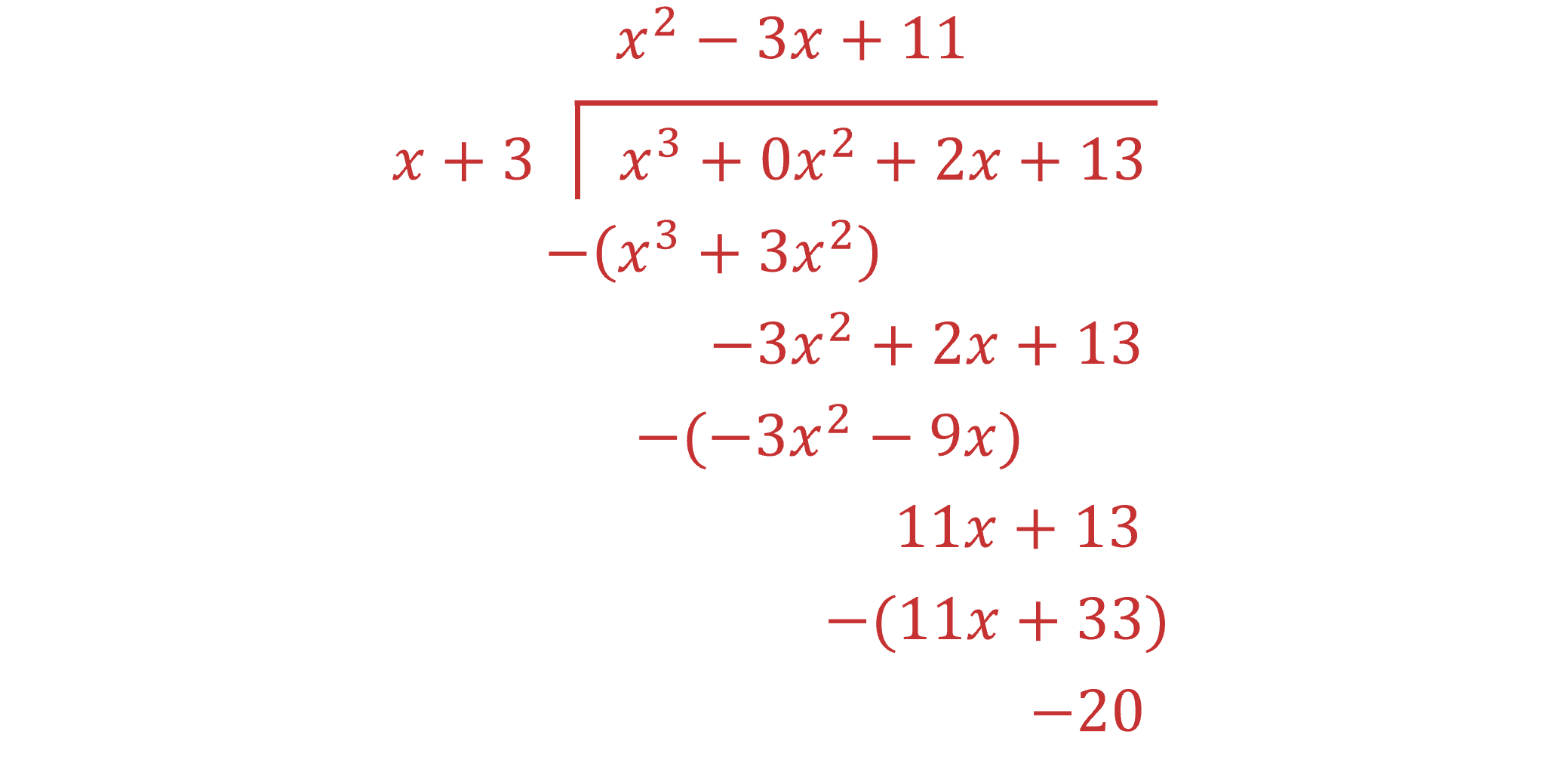
Start by using polynomial long division to rewrite the function being integrated

Add in +0x2 to the dividend as a placeholder for the 'missing' x2 term

The workings out for a polynomial long division problem, dividing x^3++2x+13 by x+3

That means x3+2x+13x+3=x23x+1120x+3, which may be integrated easily

x3+2x+13x+3 dx=(x23x+1120x+3) dx=13x332x2+11x20ln|x+3|+C

x3+2x+13x+3 dx=13x332x2+11x20ln|x+3|+C

Unlock more, it's free!

Join the 100,000+ Students that ❤️ Save My Exams

the (exam) results speak for themselves:

Build on this topic

Roger B

Author: Roger B

Expertise: Development Editor

Roger's teaching experience stretches all the way back to 1992, and in that time he has taught students at all levels between Year 7 and university undergraduate. Having conducted and published postgraduate research into the mathematical theory behind quantum computing, he is more than confident in dealing with mathematics at any level the exam boards might throw at you.

Dan Finlay

Reviewer: Dan Finlay

Expertise: Portfolio Lead

Dan graduated from the University of Oxford with a First class degree in mathematics. As well as teaching maths for over 8 years, Dan has marked a range of exams for Edexcel, tutored students and taught A Level Accounting. Dan has a keen interest in statistics and probability and their real-life applications.