Unit 9 Overview (College Board AP® Calculus BC): Exam Questions

2 hours10 questions
1a
Sme Calculator
3 marks

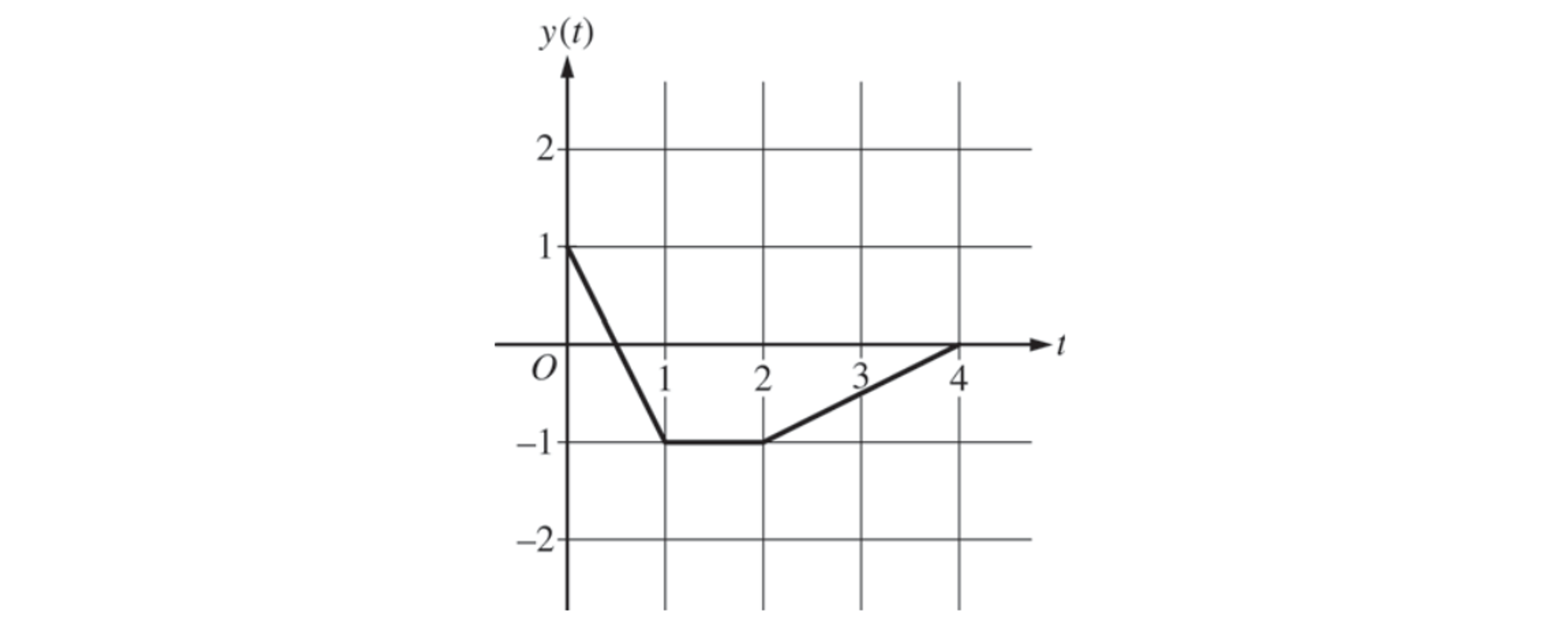
At time t, the position of a particle moving in the xy-plane is given by the parametric functions left parenthesis x left parenthesis t right parenthesis comma space y left parenthesis t right parenthesis right parenthesis, where \frac{\text{d} x}{\text{d} t} = t^{2} + \text{sin}(3 t^{2}). The graph of y, consisting of three line segments, is shown in the figure below. At t = 0, the particle is at position left parenthesis 5 comma space 1 right parenthesis.

Graph of y(t) versus t with origin O; the t-axis runs from 1 to 4 and the y(t)-axis from -2 to 2. The graph is three connected line segments: from (0, 1) down to (1, -1), then horizontally from (1, -1) to (2, -1), then up from (2, -1) to (4, 0).

Find the position of the particle at t = 3.

1b
Sme Calculator
1 mark

Find the slope of the line tangent to the path of the particle at t = 3.

1c
Sme Calculator
2 marks

Find the speed of the particle at t = 3.

1d
Sme Calculator
3 marks

Find the total distance traveled by the particle from t = 0 to t = 2.

2a
Sme Calculator
2 marks

For 0 \leq t \leq \pi, a particle is moving along the curve shown so that its position at time t is left parenthesis x left parenthesis t right parenthesis comma space y left parenthesis t right parenthesis right parenthesis, where x(t) is not explicitly given and y(t) = 2 \text{sin} t. It is known that \frac{\text{d} x}{\text{d} t} = e^{\text{cos} t}. At time t = 0, the particle is at position (1, 0).

The particle's path in the xy-plane, a curve rising from (1, 0) to a maximum near (4, 2) and then falling steeply to (5, 0)

Find the acceleration vector of the particle at time t = 1. Show the setup for your calculations.

2b
Sme Calculator
2 marks

For 0 \leq t \leq \pi, find the first time t at which the speed of the particle is 1.5. Show the work that leads to your answer.

2c
Sme Calculator
3 marks

Find the slope of the line tangent to the path of the particle at time t = 1. Find the x-coordinate of the position of the particle at time t = 1. Show the work that leads to your answers.

2d
Sme Calculator
2 marks

Find the total distance traveled by the particle over the time interval 0 \leq t \leq \pi. Show the setup for your calculations.

3a
Sme Calculator
2 marks

Researchers on a boat are investigating plankton cells in a sea. At a depth of h meters, the density of plankton cells, in millions of cells per cubic meter, is modeled by p(h) = 0.2 h^{2} e^{- 0.0025 h^{2}} for 0 \leq h \leq 30, and is modeled by f(h) for h greater or equal than 30. The continuous function f is not explicitly given.

Find p'(25). Using correct units, interpret the meaning of p'(25) in the context of the problem.

3b
Sme Calculator
2 marks

Consider a vertical column of water in this sea with horizontal cross sections of constant area 3 square meters. To the nearest million, how many plankton cells are in this column of water between h = 0 and h = 30 meters?

3c
Sme Calculator
3 marks

There is a function u such that 0 \leq f(h) \leq u(h) for all h \geq 30 and \int_{30}^{\infty} u(h) \text{d} h = 105. The column of water in part (b) is K meters deep, where K > 30. Write an expression involving one or more integrals that gives the number of plankton cells, in millions, in the entire column. Explain why the number of plankton cells in the column is less than or equal to 2000 million.

3d
Sme Calculator
2 marks

The boat is moving on the surface of the sea. At time t \geq 0, the position of the boat is the point with coordinates left parenthesis x left parenthesis t right parenthesis comma space y left parenthesis t right parenthesis right parenthesis, where x'(t) = 662 \text{sin}(5 t) and y'(t) = 880 \text{cos}(6 t). Time t is measured in hours, and x(t) and y(t) are measured in meters. Find the total distance traveled by the boat over the time interval 0 \leq t \leq 1.

4a
Sme Calculator
2 marks

A particle moving along a curve in the x y-plane has position left parenthesis x left parenthesis t right parenthesis comma space y left parenthesis t right parenthesis right parenthesis at time t seconds, where x(t) and y(t) are measured in centimeters. It is known that x ' (t) = 8 t - t^{2} and y ' (t) = - t + \sqrt{t^{1.2} + 20}. At time t = 2 seconds, the particle is at the point (3, 6).

Find the speed of the particle at time t = 2 seconds. Show the setup for your calculations.

4b
Sme Calculator
2 marks

Find the total distance traveled by the particle over the time interval 0 \leq t \leq 2. Show the setup for your calculations.

4c
Sme Calculator
3 marks

Find the y-coordinate of the position of the particle at the time t = 0. Show the setup for your calculations.

4d
Sme Calculator
2 marks

For 2 \leq t \leq 8, the particle remains in the first quadrant. Find all times t in the interval 2 \leq t \leq 8 when the particle is moving toward the x-axis. Give a reason for your answer.

5a
Sme Calculator
2 marks

For time t \geq 0, a particle moves in the x y-plane with position left parenthesis x left parenthesis t right parenthesis comma space y left parenthesis t right parenthesis right parenthesis and velocity vector open parentheses left parenthesis t minus 1 right parenthesis e to the power of t squared end exponent comma space text sin end text open parentheses t to the power of 1.25 end exponent close parentheses close parentheses. At time t = 0, the position of the particle is (- 2, 5).

Find the speed of the particle at time t = 1.2. Find the acceleration vector of the particle at time t = 1.2.

5b
Sme Calculator
2 marks

Find the total distance traveled by the particle over the time interval 0 \leq t \leq 1.2.

5c
Sme Calculator
5 marks

Find the coordinates of the point at which the particle is farthest to the left for t \geq 0. Explain why there is no point at which the particle is farthest to the right for t \geq 0.

6a
Sme Calculator
1 mark

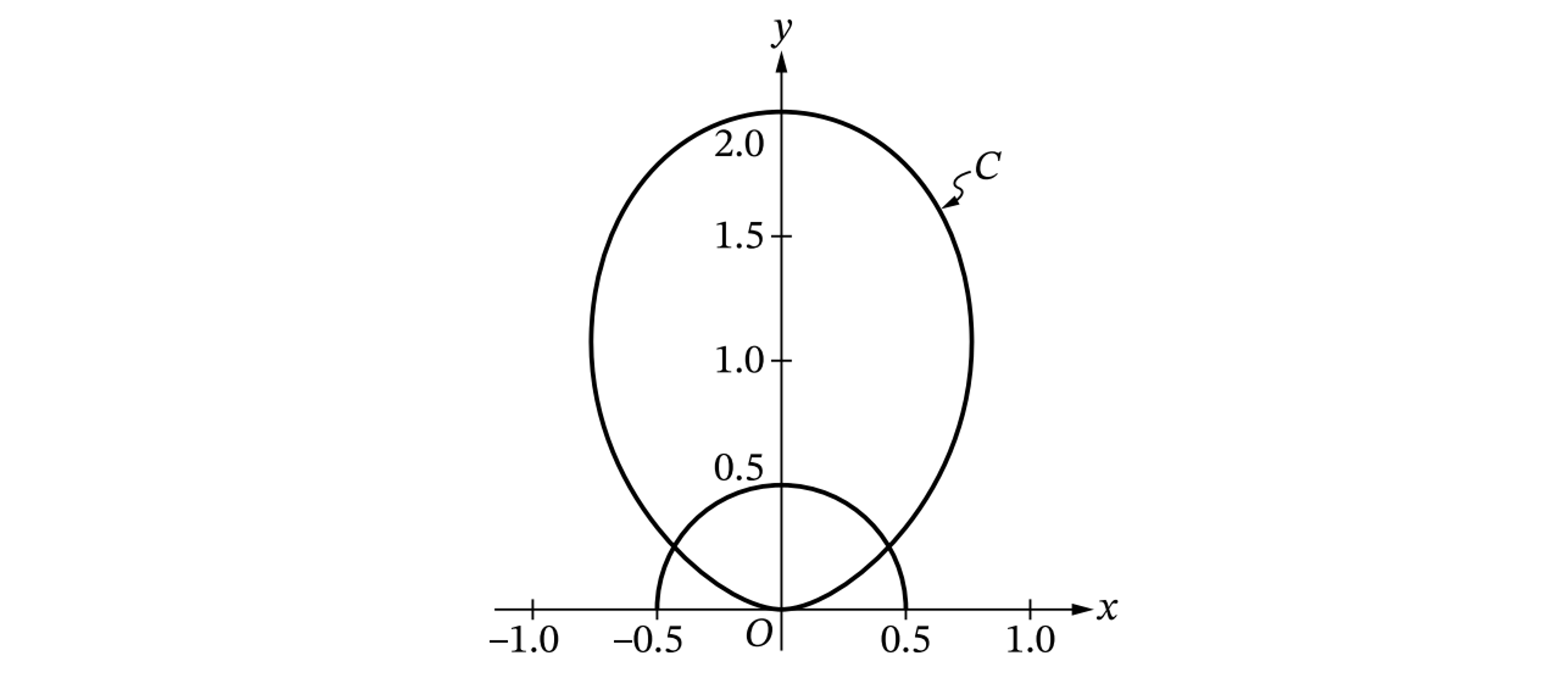
Curve C is defined by the polar equation r(\theta) = 2 \text{sin}^{2} \theta for 0 \leq \theta \leq \pi. Curve C and the semicircle r = \frac{1}{2} for 0 \leq \theta \leq \pi are shown in the x y-plane.

Polar graph of curve C (a large loop above the origin peaking near y ≈ 2.1, labelled C) together with the semicircle r = 1/2 (radius 0.5) at the origin, for 0 ≤ θ ≤ π in the xy-plane

(Note: Your calculator should be in radian mode.)

Find the rate of change of r with respect to \theta at the point on curve C where \theta = 1.3. Show the setup for your calculations.

6b
Sme Calculator
3 marks

Find the area of the region that lies inside curve C but outside the graph of the polar equation r = \frac{1}{2}. Show the setup for your calculations.

6c
Sme Calculator
3 marks

It can be shown that \frac{\text{d} x}{\text{d} \theta} = 4 \text{sin} \theta \text{cos}^{2} \theta - 2 \text{sin}^{3} \theta for curve C. For 0 \leq \theta \leq \frac{\pi}{2}, find the value of \theta that corresponds to the point on curve C that is farthest from the y-axis. Justify your answer.

6d
Sme Calculator
2 marks

A particle travels along curve C so that \frac{\text{d} \theta}{\text{d} t} = 15 for all times t. Find the rate at which the particle's distance from the origin changes with respect to time when the particle is at the point where \theta = 1.3. Show the setup for your calculations.

7a
Sme Calculator
2 marks

The polar curves r = f(\theta) = 1 + \text{sin} \theta \text{cos}(2 \theta) and r = g(\theta) = 2 \text{cos} \theta for 0 \leq \theta \leq \frac{\pi}{2} are shown below. Let R be the region in the first quadrant bounded by the curve r = f(\theta) and the x-axis. Let S be the region in the first quadrant bounded by the curve r = f(\theta), the curve r = g(\theta), and the x-axis.

Two polar curves in the first quadrant of the xy-plane with origin O; 1 and 2 marked on the x-axis and 1 on the y-axis. The lower curve r = f(theta) starts at O, rises to about (0.8, 0.7), curves down through about (1.2, 0.4), and meets the x-axis at (1, 0). The upper curve r = g(theta) = 2cos(theta) is a larger arc from O up and over, meeting the x-axis at (2, 0). Region R is enclosed between the lower curve r = f(theta) and the x-axis. Region S is between the two curves, above r = f(theta) and below r = g(theta).

Find the area of R.

7b
Sme Calculator
2 marks

The ray \theta = k, where 0 < k < \frac{\pi}{2}, divides S into two regions of equal area. Write, but do not solve, an equation involving one or more integrals whose solution gives the value of k.

7c
Sme Calculator
3 marks

For each \theta with 0 \leq \theta \leq \frac{\pi}{2}, let w(\theta) be the distance between the points with polar coordinates left parenthesis f left parenthesis theta right parenthesis comma space theta right parenthesis and left parenthesis g left parenthesis theta right parenthesis comma space theta right parenthesis. Write an expression for w(\theta). Find w_{A}, the average value of w(\theta) over the interval 0 \leq \theta \leq \frac{\pi}{2}.

7d
Sme Calculator
2 marks

Using the information from part (c), find the value of \theta for which w(\theta) = w_{A}. Is the function w(\theta) increasing or decreasing at that value of \theta? Give a reason for your answer.

8a
Sme Calculator
1 mark

A particle moving along a curve in the x y-plane is at position left parenthesis x left parenthesis t right parenthesis comma space y left parenthesis t right parenthesis right parenthesis at time t > 0. The particle moves in such a way that \frac{\text{d} x}{\text{d} t} = \sqrt{1 + t^{2}} and \frac{\text{d} y}{\text{d} t} = \text{ln}(2 + t^{2}). At time t = 4, the particle is at the point (1, 5).

Find the slope of the line tangent to the path of the particle at time t = 4.

8b
Sme Calculator
3 marks

Find the speed of the particle at time t = 4, and find the acceleration vector of the particle at time t = 4.

8c
Sme Calculator
3 marks

Find the y-coordinate of the particle's position at time t = 6.

8d
Sme Calculator
2 marks

Find the total distance the particle travels along the curve from time t = 4 to time t = 6.

9a
Sme Calculator
2 marks

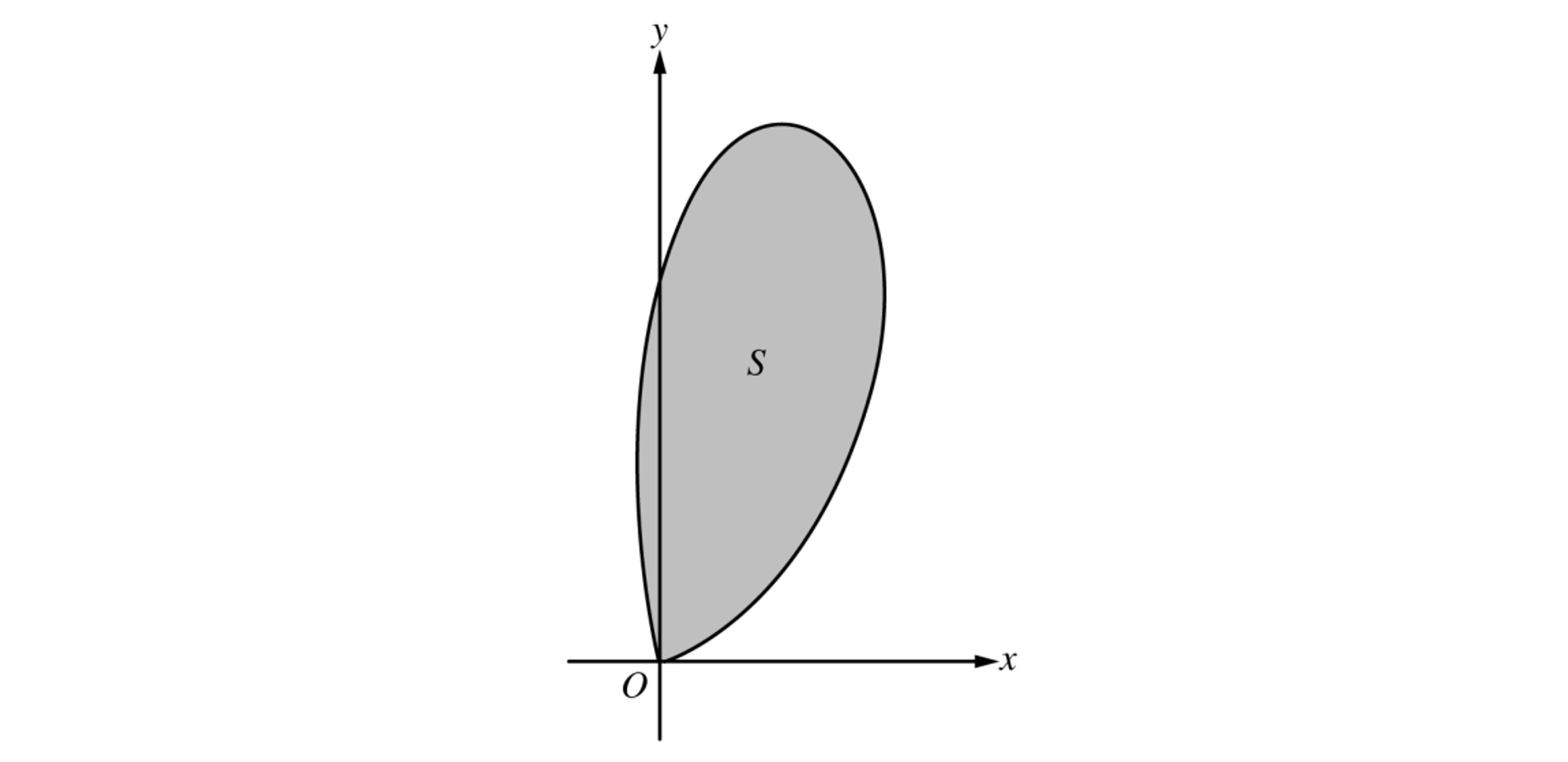
Let S be the region bounded by the graph of the polar curve r(\theta) = 3 \sqrt{\theta} \text{sin} \left(\theta^{2}\right) for 0 \leq \theta \leq \sqrt{\pi}, as shown in the figure above.

Polar region S in the xy-plane with origin O. The curve starts at the origin, rises almost vertically (curving slightly to the left at first), then turns up and to the right, crossing the y-axis above O, and reaches a maximum high above the x-axis and to the right of the y-axis. It then comes down and to the left, ending back at the origin. The enclosed region is shaded and labelled S.

Find the area of S.

9b
Sme Calculator
2 marks

What is the average distance from the origin to a point on the polar curve r(\theta) = 3 \sqrt{\theta} \text{sin} \left(\theta^{2}\right) for 0 \leq \theta \leq \sqrt{\pi}?

9c
Sme Calculator
3 marks

There is a line through the origin with positive slope m that divides the region S into two regions with equal areas. Write, but do not solve, an equation involving one or more integrals whose solution gives the value of m.

9d
Sme Calculator
2 marks

For k > 0, let A(k) be the area of the portion of region S that is also inside the circle r = k \text{cos} \theta. Find \lim_{k \to \infty} A(k).

10a
Sme Calculator
3 marks

The graphs of the polar curves r = 4 and r = 3 + 2 \text{cos} \theta are shown in the figure below. The curves intersect at \theta = \frac{\pi}{3} and \theta = \frac{5 \pi}{3}.

Two polar curves in the xy-plane with origin O and 1 marked on each axis. The circle r = 4 is centered at the origin. The curve r = 3 + 2cos(theta) starts on the positive x-axis at x = 5, loops up and to the left crossing the y-axis near y = 3 and reaching the negative x-axis near x = -1, with its lower half symmetric below the x-axis. The region R, lying inside the circle r = 4 and outside this curve, is shaded; it is the crescent on the left between the two curves.

Let R be the shaded region that is inside the graph of r = 4 and also outside the graph of r = 3 + 2 \text{cos} \theta. Write an expression involving an integral for the area of R.

10b
Sme Calculator
3 marks

Find the slope of the line tangent to the graph of r = 3 + 2 \text{cos} \theta at \theta = \frac{\pi}{2}.

10c
Sme Calculator
3 marks

A particle moves along the portion of the curve r = 3 + 2 \text{cos} \theta for 0 < \theta < \frac{\pi}{2}. The particle moves in such a way that the distance between the particle and the origin increases at a constant rate of 3 units per second. Find the rate at which the angle \theta changes with respect to time at the instant when the position of the particle corresponds to \theta = \frac{\pi}{3}. Indicate units of measure.