Differentiating Powers of x (DP IB Analysis & Approaches (AA): SL): Revision Note

Differentiating powers of x
What is differentiation?
Differentiation is the process of finding an expression for the derivative (gradient function) of a function from an expression for the function
How do I differentiate powers of x?
Powers of are differentiated according to the following formula:
If then where
This is given in the formula booklet
If the power of term is multiplied by a constant then the derivative is also multiplied by that constant
If then where and is a constant
The alternative notation (to) is to use
If then
e.g. If then
Don't forget these two special cases:
If then
e.g. If then
If then
e.g. If then
Functions involving roots will need to be rewritten as fractional powers of first
e.g. If then rewrite as and differentiate
Functions involving fractions with denominators in terms of will need to be rewritten as negative powers of first
e.g. If then rewrite as and differentiate
How do I differentiate sums and differences of powers of x?
For an expression that is a sum or difference of powers of , just differentiate term by term
e.g. If then
Products and quotients cannot be differentiated in this way so would need expanding/simplifying first
e.g. If then expand to which is a sum/difference of powers of and can be differentiated
Examiner Tips and Tricks
A common mistake is not simplifying expressions before differentiating.
For example, the derivative of can not be found by multiplying the derivatives of and .
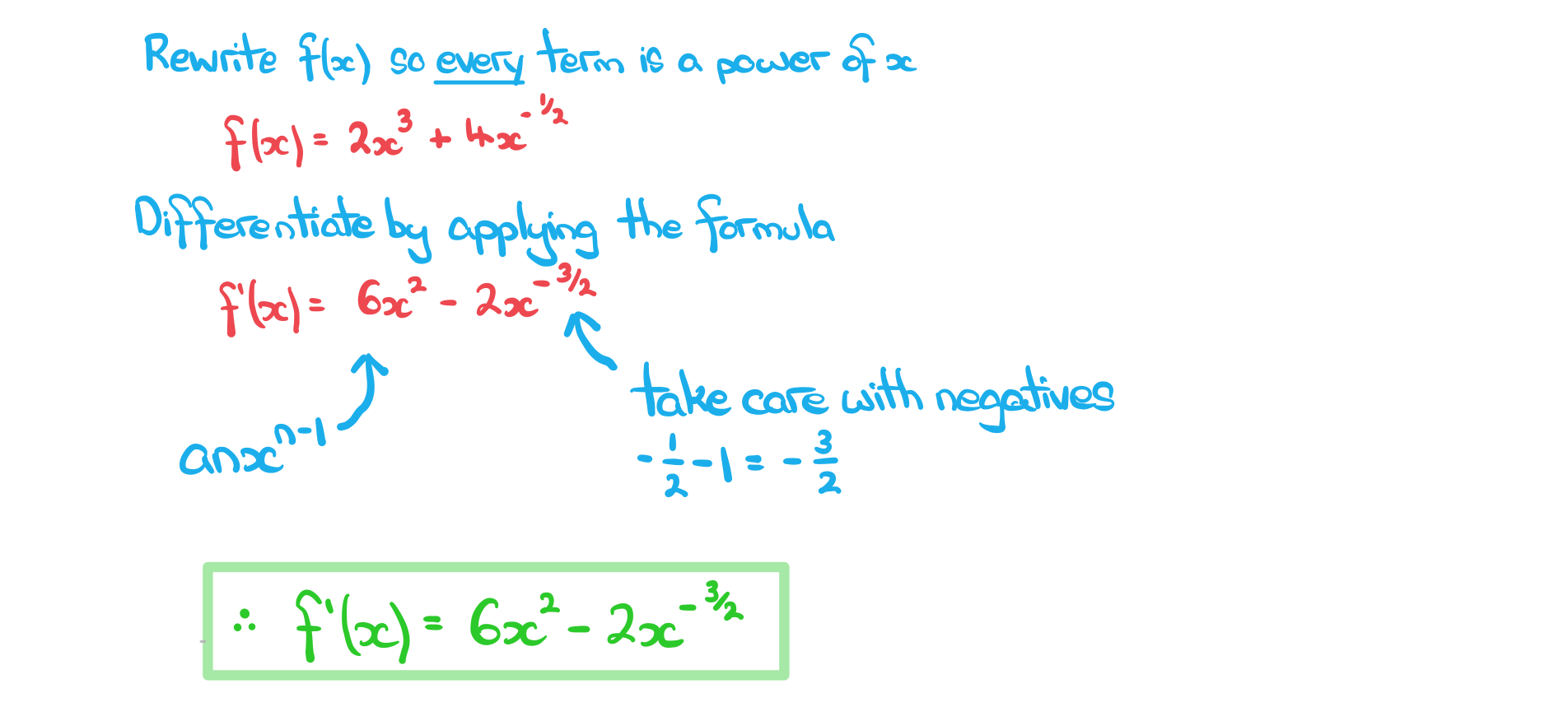
Worked Example
The function is given by
, where
Find the derivative of
Answer:

Unlock more, it's free!
Join the 100,000+ Students that ❤️ Save My Exams
the (exam) results speak for themselves:

Was this revision note helpful?
Build on this topic
