Differentiating Special Functions (DP IB Analysis & Approaches (AA): SL): Revision Note

Differentiating Trig Functions
How do I differentiate sin and cos?
The derivative of is
The derivative of is
For the linear function, where and are constants,
the derivative of is
the derivative of is
For the general function ,
the derivative of is
the derivative of is
These last two sets of results can be derived using the chain rule
For calculus with trigonometric functions angles must be measured in radians
Ensure you know how to change the angle mode on your GDC
Examiner Tips and Tricks
As soon as you see a question involving differentiation of trigonometric functions, put your GDC into radians mode.
Worked Example
a) Find for the functions
Answer:

b) Find the gradient of the tangent to the curve at the point where .
Give your answer as an exact value.
Answer:

Differentiating e^x & lnx
How do I differentiate exponentials and logarithms?
The derivative of is where
The derivative of is where
For the linear function , where and are constants,
the derivative of is
the derivative of is
in the special case , ('s cancel)
Examiner Tips and Tricks
Remember to avoid these two common mistakes:
the derivative of with respect to is, NOT
the derivative of with respect to is , NOT
For the general function ,
the derivative of is
the derivative of is
The last two sets of results can be derived using the chain rule
Worked Example
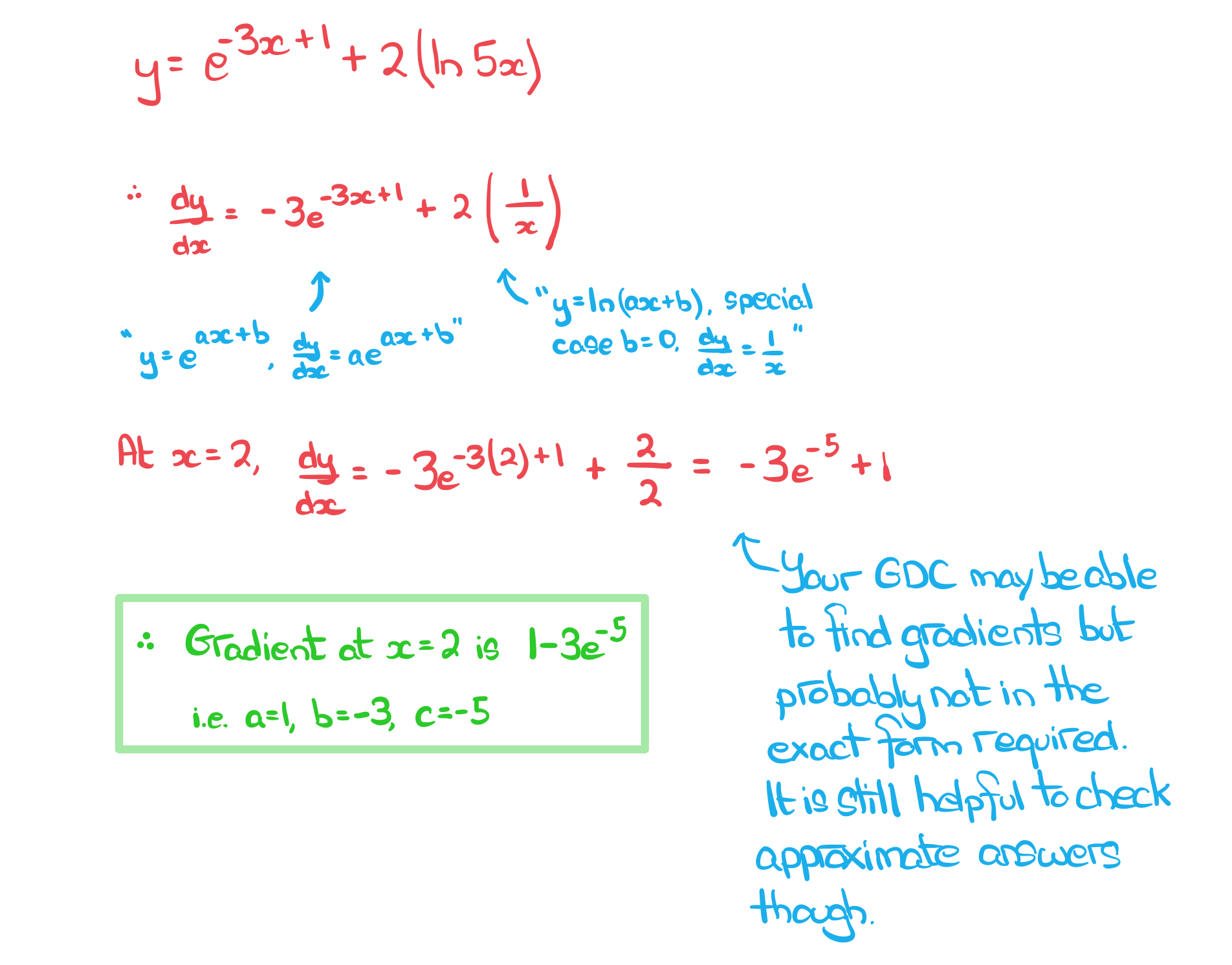
A curve has the equation .
Find the gradient of the curve at the point where giving your answer in the form , where and are integers to be found.
Answer:

Unlock more, it's free!
Join the 100,000+ Students that ❤️ Save My Exams
the (exam) results speak for themselves:

Was this revision note helpful?
Build on this topic