Exponential & Logarithmic Functions (DP IB Analysis & Approaches (AA): SL): Revision Note

Dan Finlay

Written by: Dan Finlay

Reviewed by: Lucy Kirkham

Updated on

Exponential functions & graphs

What is an exponential function?

  • An exponential function is defined by  f(x)=ax, a>0

  • Its domain is the set of all real values

  • Its range is the set of all positive real values

  • An important exponential function is  f(x)=ex

    • Where e is Euler's constant 2.718…

  • Any exponential function can be written using e

    • ax=exlna

      • This is given in the formula booklet

What are the key features of exponential graphs?

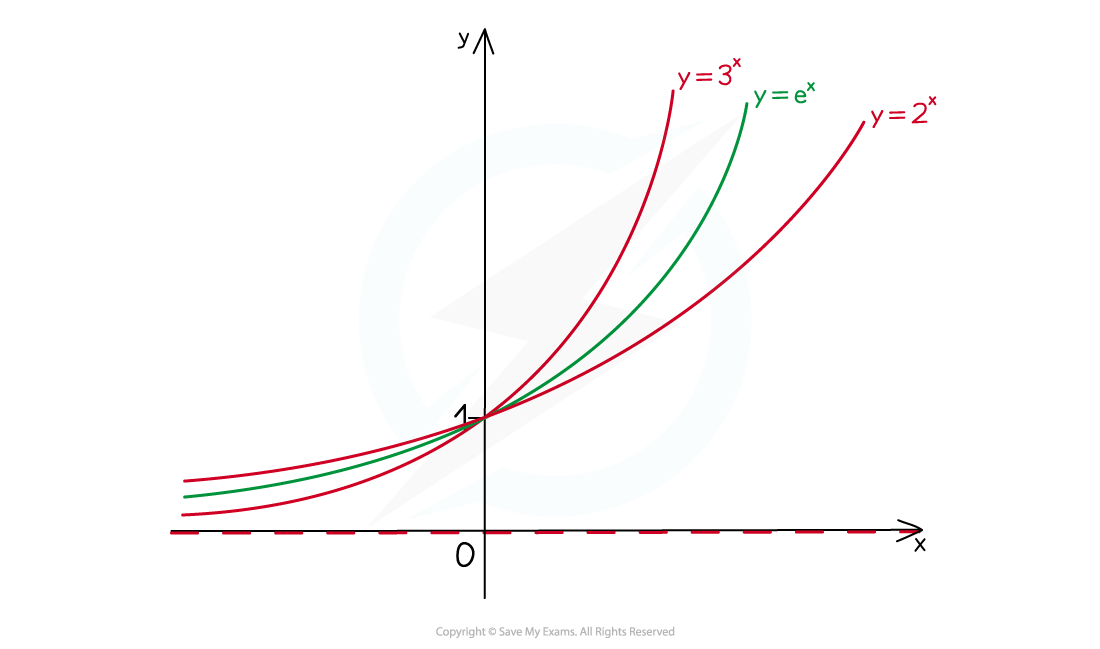
  • The graphs have a y-intercept at (0, 1)

  • The graph will always pass through the point (1, a)

  • The graphs do not have any roots

  • The graphs have a horizontal asymptote at the x-axis:  y=0

    • For a > 1 this is the limiting value when x tends to negative infinity

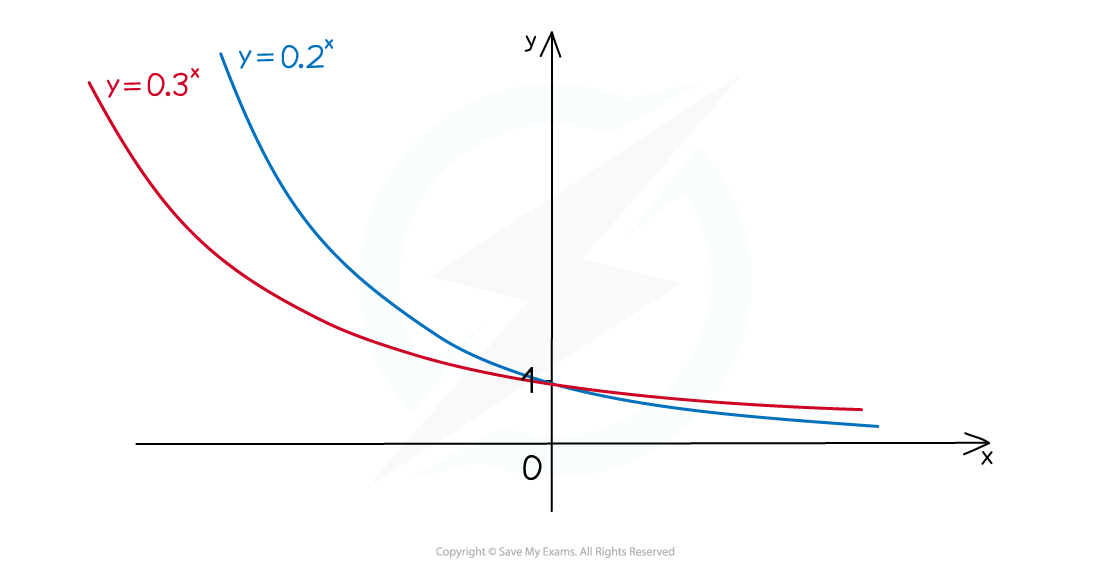
    • For 0 < a < 1 this is the limiting value when x tends to positive infinity

  • The graphs do not have any minimum or maximum points
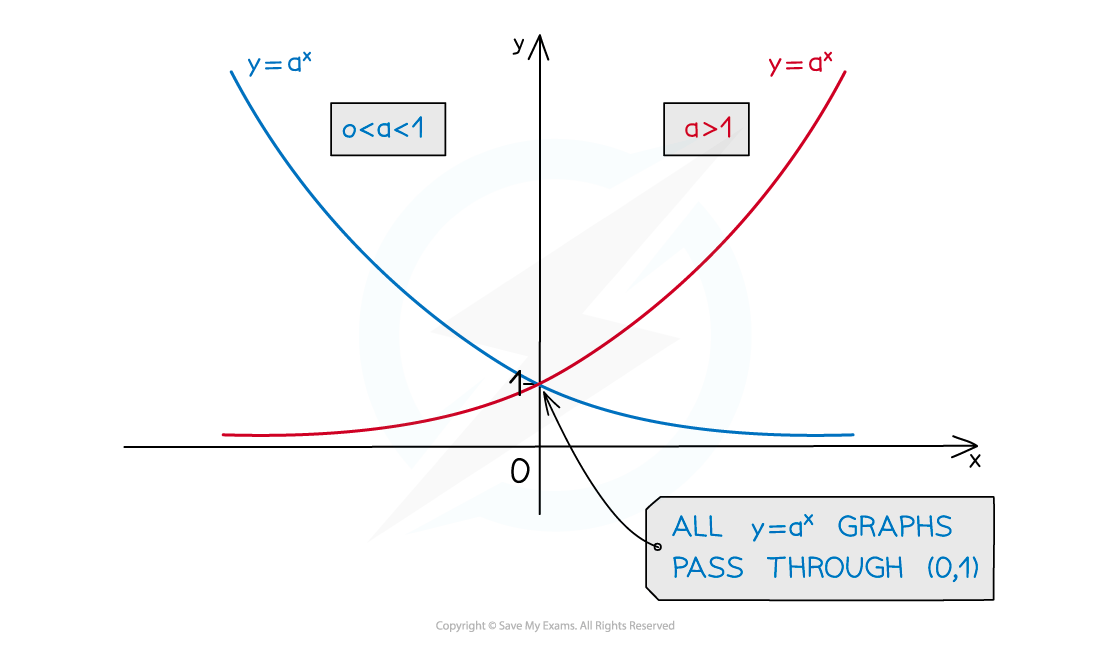
Graph showing exponential functions y = a^x. Blue curve for 0<a<1, red curve for a>1, both passing through point (0,1) on x and y axes.
Examples of graphs of exponential functions
Graph showing exponential curves: y=3^x (red), y=e^x (green), y=2^x (red) on an x-y axis, all intersecting at (0,1) and diverging.
Examples for a>1


Graph showing two exponential decay curves: y=0.3^x in red, and y=0.2^x in blue, with axes labelled x and y, and the origin marked.
Examples for 0<a<1

Logarithmic functions & graphs

What is a logarithmic function?

  • A logarithmic function is of the form  f(x)=logax, x>0

  • Its domain is the set of all positive real values

    • You can't take a log of zero or a negative number

  • Its range is set of all real values

  • logax and ax are inverse functions

  • An important logarithmic function is  f(x)=ln x

    • This is the natural logarithmic function ln xlogex

    • This is the inverse of ex

      • ln ex=xand eln x=x

  • Any logarithmic function can be written using ln

    • logax=ln xln ausing the change of base formula

What are the key features of logarithmic graphs?

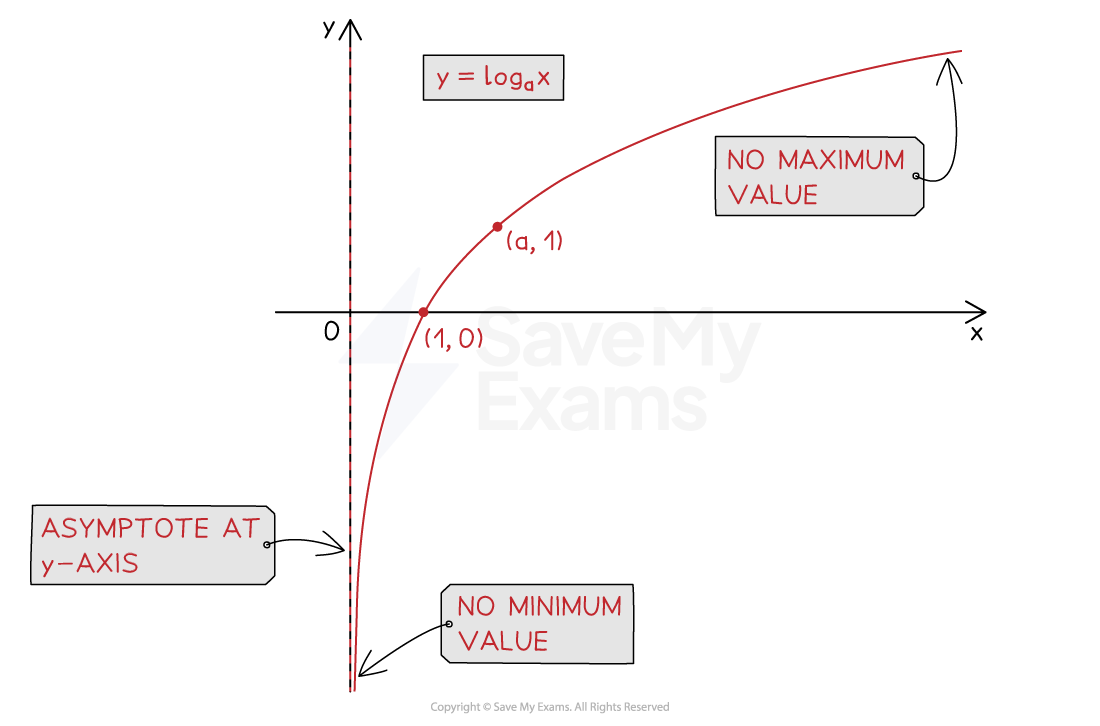
  • The graphs do not have a y-intercept

  • The graphs have one root at (1, 0)

  • The graphs will always pass through the point (a, 1)

  • The graphs have a vertical asymptote at the y-axis: x=0

  • The graphs do not have any minimum or maximum points
Graph of y = log_a x with points (1,0) and (a,1). Asymptote at y-axis. No min or max value noted. Curves up to the right.
Example of the graph of a logarithmic function

Worked Example

The function  f is defined by  f(x)=log5x for x>0.

a) Write down the inverse of  f. Give your answer in the form eg(x).

Answer:

2-4-2-ib-aa-sl-log-function-a-we-solution

b) Sketch the graphs of  f and its inverse on the same set of axes.

Answer:

2-4-2-ib-aa-sl-log-function-b-we-solution

Unlock more, it's free!

Join the 100,000+ Students that ❤️ Save My Exams

the (exam) results speak for themselves:

Build on this topic

Dan Finlay

Author: Dan Finlay

Expertise: Portfolio Lead

Dan graduated from the University of Oxford with a First class degree in mathematics. As well as teaching maths for over 8 years, Dan has marked a range of exams for Edexcel, tutored students and taught A Level Accounting. Dan has a keen interest in statistics and probability and their real-life applications.

Lucy Kirkham

Reviewer: Lucy Kirkham

Expertise: Content Creator

Lucy has been a passionate Maths teacher for over 12 years, teaching maths across the UK and abroad helping to engage, interest and develop confidence in the subject at all levels.Working as a Head of Department and then Director of Maths, Lucy has advised schools and academy trusts in both Scotland and the East Midlands, where her role was to support and coach teachers to improve Maths teaching for all.