Exact Values (DP IB Analysis & Approaches (AA): SL): Revision Note

Amber

Written by: Amber

Reviewed by: Dan Finlay

Updated on

Trigonometry exact values

What are exact values in trigonometry?

  • For certain angles the values of sin θ, cos θ and tan θ can be written exactly

    • This means using fractions and surds

    • You should be familiar with these values and be able to derive the values using geometry

  • You are expected to know the exact values of sin, cos and tan for angles of 0°, 30°, 45°, 60°, 90°, 180° and their multiples

    • In radians this is 0, π6, π4, π3, π2, π and their multiples

  • The exact values you are expected to know are:

A table showing trigonometric values for angles 0° to 360° in degrees and radians, with sine, cosine, and tangent values for each angle.
Table of exact values

How do I find the exact values of other angles?

  • Use the symmetries of the unit circle

sin

cos

tan

(θ)

sin(θ)=sinθ

cos(θ)=cosθ

tan(θ)=tanθ

(180θ)

sin(180θ)=sinθ

cos(180θ)=cosθ

tan(180θ)=tanθ

(180+θ)

sin(180+θ)=sinθ

cos(180+θ)=cosθ

tan(180+θ)=tanθ

(360θ)

sin(360θ)=sinθ

cos(360θ)=cosθ

tan(360θ)=tanθ

(360+θ)

sin(360+θ)=sinθ

cos(360+θ)=cosθ

tan(360+θ)=tanθ

  • You can use this to find the exact trig values for any multiple of 30° or 45°

    • For example:

      • sin315=sin(36045)=sin45=22

      • cos210=cos(180+30)=cos30=32

      • tan420=tan(360+60)=tan60=3

Unit circle diagram with angles in degrees and radians, showing cosine and sine values at key points, with coordinates for each angle marked.
Exact values of angles which are multiples of 30° and 45°

How do I derive the exact values in trigonometry?

  • There are two special right-triangles that can be used to derive the exact values

30° - 60° - 90°

  • Draw an equilateral triangle where each side has length 2

  • Split the triangle into two identical triangles

  • Looking at one triangle:

    • One side has length 1

    • The hypotenuse has length 2

    • The other side has length √3

Diagram of an equilateral triangle with side 2, split into 30°, 60° right triangle. Text explains side lengths and trigonometric ratios for these angles.

45° - 45° - 90°

  • Draw a right-angled isosceles triangle where two sides have length 1

  • The third side has length √2

Diagram of an isosceles right triangle with sides 1, hypotenuse √2. Includes 45° angle, trigonometric values, and question on rationalising denominators.

Examiner Tips and Tricks

  • You will be expected to be comfortable using exact trig values for certain angles but it can be easy to muddle them up if you just try to remember them from a list, sketch the triangles and trig graphs on your paper so that you can use them as many times as you need to during the exam!

    • sketch the triangles for the key angles 45°/π430°/π660°/π3

    • sketch the trig graphs for the key angles 0°, 90°/π2, 180°/π, 270°/3π2, 360°/2π

Worked Example

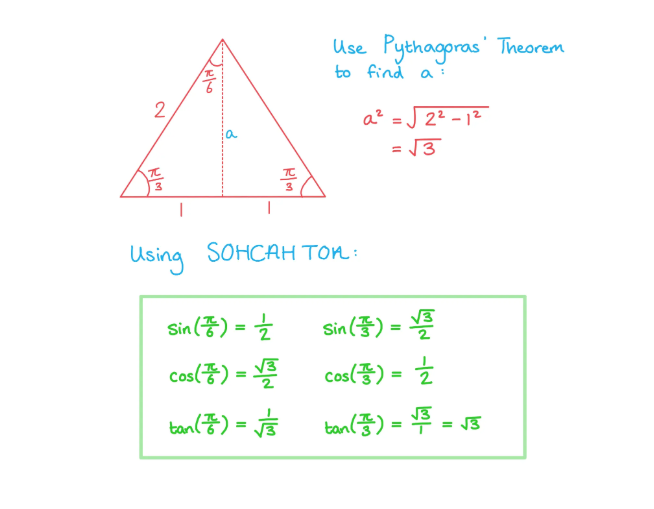
Using an equilateral triangle of side length 2 units, derive the exact values for the sine, cosine and tangent of π6 and π3.

Answer:

Diagram of a 30-60-90 triangle showing side lengths and angles, with calculations using Pythagoras' Theorem and trigonometric ratios.

Unlock more, it's free!

Join the 100,000+ Students that ❤️ Save My Exams

the (exam) results speak for themselves:

Build on this topic

Amber

Author: Amber

Expertise: Maths Content Creator

Amber gained a first class degree in Mathematics & Meteorology from the University of Reading before training to become a teacher. She is passionate about teaching, having spent 8 years teaching GCSE and A Level Mathematics both in the UK and internationally. Amber loves creating bright and informative resources to help students reach their potential.

Dan Finlay

Reviewer: Dan Finlay

Expertise: Portfolio Lead

Dan graduated from the University of Oxford with a First class degree in mathematics. As well as teaching maths for over 8 years, Dan has marked a range of exams for Edexcel, tutored students and taught A Level Accounting. Dan has a keen interest in statistics and probability and their real-life applications.