11 mark
Scientists investigated the genome of cabbage and the genome of cauliflower.
What does genome mean?
A mutation in the DNA
All of the DNA in an organism
The DNA in one gene
Was this exam question helpful?
Exam code: 8465
Scientists investigated the genome of cabbage and the genome of cauliflower.
What does genome mean?
A mutation in the DNA
All of the DNA in an organism
The DNA in one gene
Was this exam question helpful?
Figure 8 shows a human sperm cell.
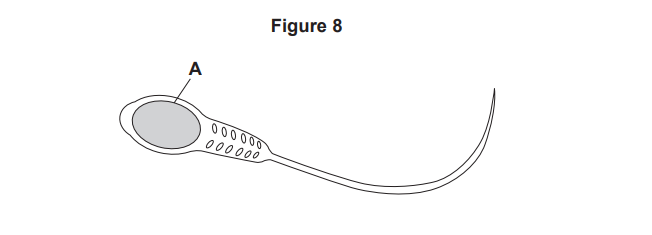
Cell part A contains DNA.
Name part A.
Describe the structure of DNA.
Sperm cells are male gametes.
What are female gametes called?
Figure 9 shows the chromosomes in a sperm cell.
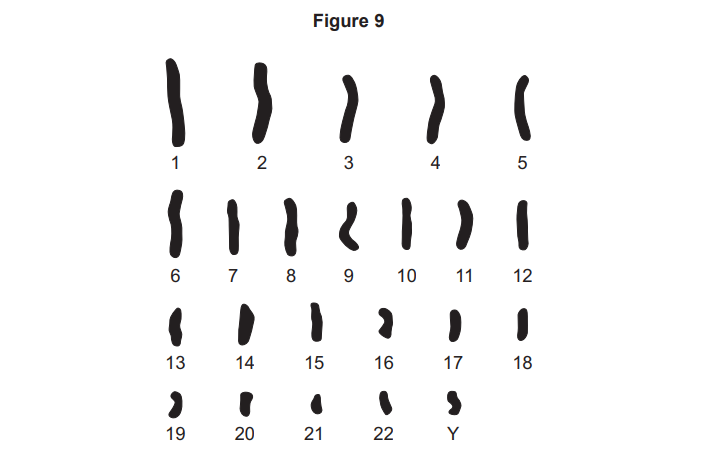
Describe one difference between the chromosomes in a sperm cell and the chromosomes in a liver cell.
A sperm with the same chromosomes as those in Figure 9 fertilises a female gamete.
Explain what sex the offspring would be.
Use information from Figure 9 in your answer.
Was this exam question helpful?
The tawny owl is one species of bird.
The tawny owl can have grey feathers or brown feathers.
The colour of the feathers is determined by one gene.
The allele for brown feathers is dominant (B).
The allele for grey feathers is recessive (b).
What is the genotype of a tawny owl with grey feathers?
BB
Bb
bb
Was this exam question helpful?
Scientists investigated the genomes of three varieties of Brassica oleracea.
What is meant by 'genome'?
Calculate the percentage of the total number of genes in cauliflower that are in kale, but not in cabbage.
Was this exam question helpful?
Earwax is produced by specialised cells in the ear.
Earwax can trap and kill bacteria.
People either have wet earwax or dry earwax.
The type of earwax people have is controlled by one gene.
Name the part of a human cell where genes are found.
Name the chemical that genes are made of.
Each person has two alleles for earwax.
Why does a person have two alleles for earwax?
The allele for wet earwax is dominant.
E = allele for wet earwax
e = allele for dry earwax
Which word describes a person with the alleles Ee?
Tick (✓) one box.
Heterozygous
Phenotype
Recessive
A person with the genotype Ee and a person with the genotype ee plan to have a child.
Complete Figure 9 to determine the probability that the child will have dry earwax.
You should identify any offspring genotype that would have dry earwax.
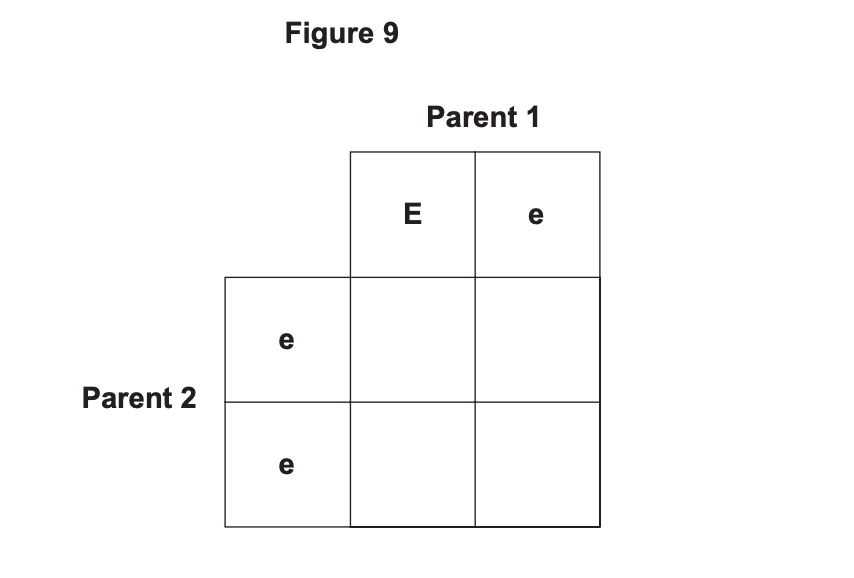
Probability that the child will have dry earwax = _________
Type of earwax is only affected by a gene.
Height is a characteristic that is affected by genes and environmental factors.
Give one other human characteristic that is affected by genes and the environment.
Do not refer to height in your answer.
Give one environmental cause for the variation in the characteristic you named in Question 6(f).
Was this exam question helpful?
The genetic material in a cell is made of DNA.
A DNA molecule is made from two strands twisted around each other.
What scientific term describes the structure of DNA?
Was this exam question helpful?
People produce either wet earwax or dry earwax.
The type of earwax people have is determined by one gene.
Define the term ‘gene’.
Scientists studied the type of earwax produced by a large number of parents and their offspring.
Table 1 shows the type of earwax of the parents and the number of offspring with each type of earwax.
Table 1
Parent 1 phenotype | Parent 2 phenotype | Offspring with wet earwax | Offspring with dry earwax |
|---|---|---|---|
dry earwax | dry earwax | 0 | 634 |
wet earwax | dry earwax | 205 | 195 |
wet earwax | wet earwax | 35 | 12 |
The allele for wet earwax is dominant.
Give the evidence from Table 1 that shows the allele for wet earwax is dominant.
Consider the offspring born when one parent has wet earwax and one parent has dry earwax.
Explain the number of offspring with each type of earwax born to these parents.
Assume the parent with wet earwax is heterozygous.
Use Table 1.
You should:
draw a Punnett square diagram
identify each offspring phenotype
explain the number of each type of offspring shown in Table 1
Use the symbols:
E = allele for wet earwax
e = allele for dry earwax
Explanation
Was this exam question helpful?
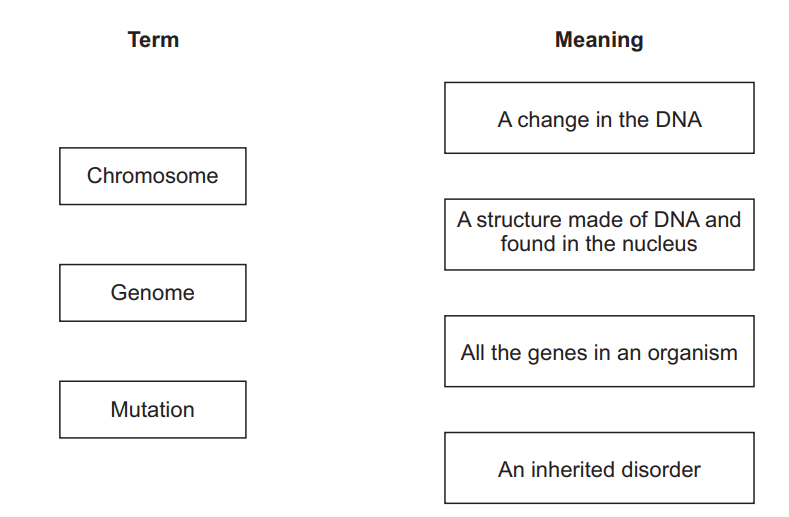
This question is about genetics.
Draw one line from each term to the meaning of the term.
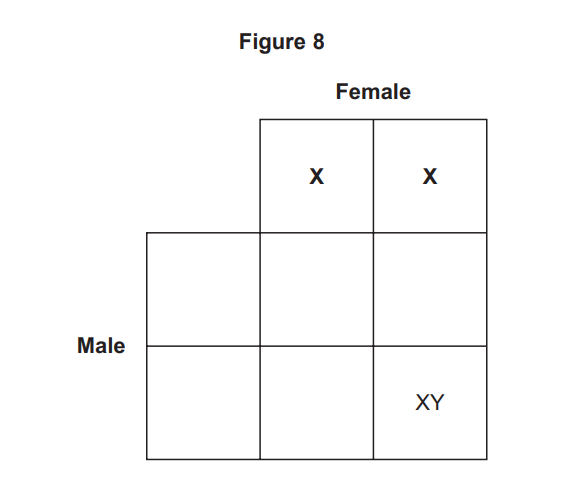
The inheritance of sex in humans is controlled by two chromosomes, X and Y.
Complete Figure 8 to show how sex is inherited.
Was this exam question helpful?
This question is about genetics.
Explain why different genes are made from different lengths of DNA.
Describe why the human population produces approximately 50% female and 50% male babies.
Was this exam question helpful?
Draw one line from each type of cell to the number of chromosomes in the cell.
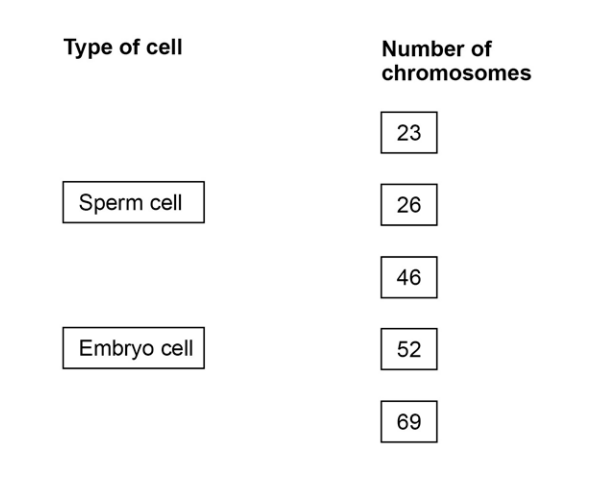
A man and a woman decide to have a child.
Complete the genetic diagram in Figure 5.
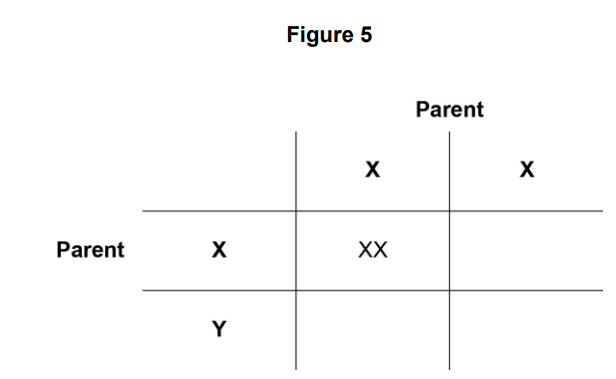
On Figure 5 (the completed Punnett square), circle a male child.
What is the chance of the man and woman having a boy?
Tick one box.
1 in 2
1 in 3
1 in 4
1 in 8
Was this exam question helpful?
Huntington's disease is an inherited disorder that affects the nervous system.
It is caused by a dominant allele.
A man is heterozygous for Huntington's disease.
His partner is healthy and does not have the allele that causes Huntington's disease.
What are the genotypes of the man and the woman?
Use:
H for the allele that causes Huntington's disease
h for the healthy allele.
Man's genotype:
Woman's genotype:
The couple want to have a child.
Use a Punnett square to determine the probability of the child having Huntington's disease.
Circle the genotypes of any children that will have Huntington's disease.
Probability of child having Huntington's disease = __________________
The couple visit a genetic counsellor, who gives them the following options.
Adopt a child.
Gamete donation — uses sperm from another man to fertilise the woman's eggs by in vitro fertilisation (IVF).
Conceive naturally.
Use pre-implantation genetic diagnosis (PGD).
Many embryos are produced by IVF using gametes from the man and woman.
Embryos are tested for Huntington's disease and a healthy embryo is implanted into the woman's uterus.
The risk of implanting an embryo with the allele for Huntington's disease is 0.2%.
Costs the NHS about £11 000.
Conceive naturally and use prenatal diagnosis (PND) once the woman becomes pregnant.
A sample of the placenta is taken at 10 weeks of pregnancy or a sample of fluid is taken from around the developing baby at 16 weeks of pregnancy.
The sample is tested for the Huntington's allele.
A 0.5–1.0% risk of miscarriage.
About 1% of samples collected are unsuitable for testing.
Costs the NHS about £600.
The couple decide they want to have a healthy baby that is their own biological offspring.
Evaluate the options.
Suggest which option would be best for the couple.
Was this exam question helpful?
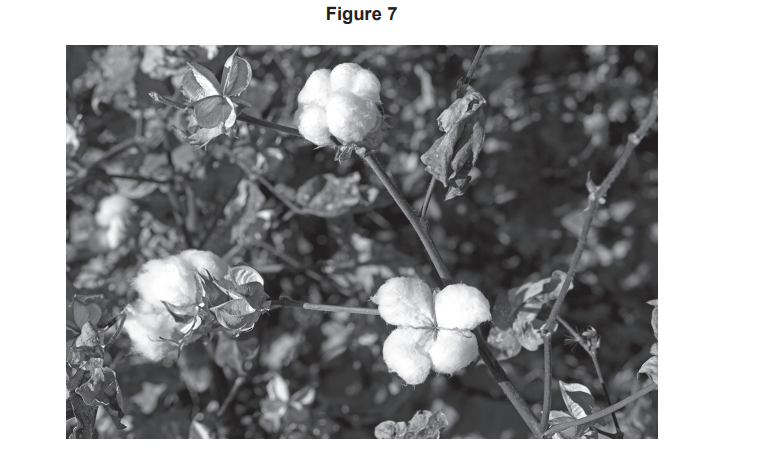
Farmers produce cotton from cotton plants.
Figure 7 shows a cotton plant.
Insects feed on cotton plants.
Cotton plants have been genetically modified to produce a pesticide that kills insects.
Give one advantage to a farmer of growing cotton plants that are able to kill insects.
Bollworms are insects that eat cotton plants.
Most bollworms are killed if they eat the GM cotton.
Some bollworms have a gene that allows the bollworm to eat GM cotton and survive.
The allele for being killed by eating GM cotton is dominant.
The allele for being able to eat GM cotton and survive is recessive.
Two bollworms mate. Both bollworms would be killed by eating GM cotton.
80 offspring are produced.
Some offspring are able to eat GM cotton and survive.
Predict how many of the 80 offspring are likely to be able to eat GM cotton and survive.
You should:
draw a Punnett square diagram
identify the genotypes of the two parent bollworms
identify the phenotype of each offspring genotype
use the symbols: B = dominant allele, b = recessive allele
The allele in bollworms for being able to eat GM cotton and survive is recessive.
A bollworm may evolve that has a new dominant allele that allows the bollworm to eat GM cotton and survive.
Explain how a new dominant allele emerging would cause a greater problem than the recessive allele that already exists.
Was this exam question helpful?