Variation & Evolution (AQA GCSE Combined Science: Synergy: Life & Environmental Sciences): Exam Questions

Exam code: 8465

1 hour13 questions
1a
2 marks

Classification of living organisms has changed over time.

Complete the sentences about classification.

Choose answers from the box.

age

appearance

DNA

mass

Traditional classification placed organisms in groups based on _ .

Modern classification places organisms in groups based on _.

1b
1 mark

Cabbage and cauliflower plants are both the same species, Brassica oleracea.

What is the genus name of cabbage and cauliflower?

  • Brassica

  • Brassica oleracea

  • Oleracea

1c
1 mark

Figure 5 shows the evolution of some plants.
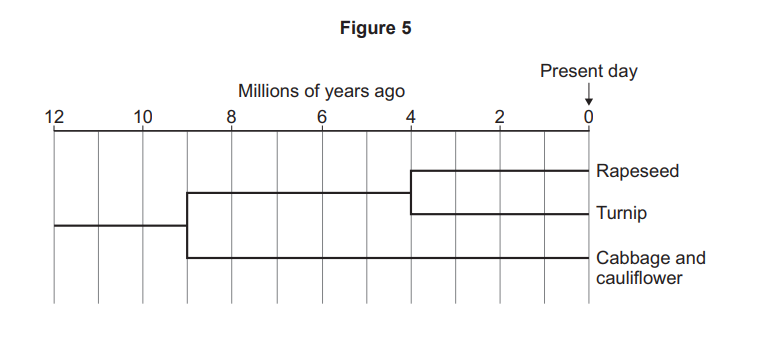
Timeline diagram from 12 million years ago to present, showing evolutionary branches for cabbage and cauliflower, turnip, and rapeseed appearing most recently.

Cabbage and cauliflower evolved into a new species 9 million years ago.

Rapeseed and turnip evolved more recently.

How many million years ago did rapeseed and turnip evolve into two species?

1d
1 mark

Farmers have gradually changed Brassica oleracea over thousands of years to produce different varieties.

Which process produced the different varieties of Brassica oleracea?

  • Active transport

  • Selective breeding

  • Transpiration

1e
Sme Calculator
3 marks

Cabbage and cauliflower have some of the same genes.

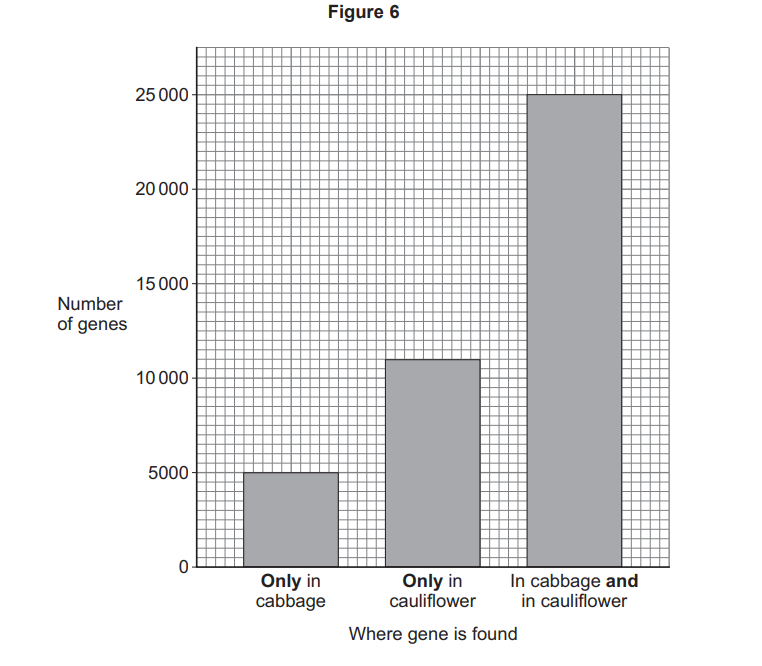
Figure 6 shows the number of genes found:

  • only in cabbage

  • only in cauliflower

  • in cabbage and in cauliflower.

Bar chart showing gene counts: about 5,000 only in cabbage, 11,000 only in cauliflower, and 25,000 shared in both cabbage and cauliflower.

Cabbage contains a total of 30000 genes.

Calculate the percentage of genes in cabbage that are found in both cabbage and cauliflower.

Use the equation:

percentage=number of genes found in cabbage and in cauliflowertotal number of genes in cabbage×100

1f
1 mark

How does Figure 6 provide evidence that cabbage and cauliflower are closely related?

  • Cabbage and cauliflower contain the same number of genes.

  • More genes are only found in cauliflower than only in cabbage.

  • Most genes are the same in cabbage and in cauliflower.

2a
1 mark

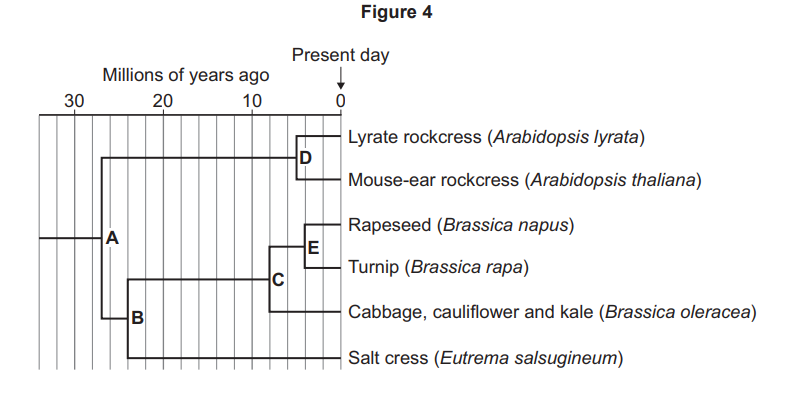
Figure 4 shows the evolution of some plants.

Cladogram showing evolutionary relationships over 30 million years among rockcresses, salt cress, and Brassica crops including rapeseed, turnip and cabbage.

A, B, C, D and E show when one species evolved into two species.

Use Figure 4 to answer this question and the following parts.

Give the genus name of salt cress.

2b
1 mark

Cabbage, cauliflower and kale are all varieties of one species, Brassica oleracea.

How many years ago did rapeseed evolve to become a different species from cabbage, cauliflower and kale?

2c
1 mark

Give the binomial names of two species that evolved 5 million years ago.

2d
3 marks

It has taken thousands of years for farmers to produce the different varieties of Brassica oleracea.

Describe how farmers have been able to produce the different varieties of Brassica oleracea.

2e
2 marks

Describe how scientists can prove that cabbage and cauliflower plants are the same species.

Do not refer to DNA analysis in your answer.

2f
1 mark

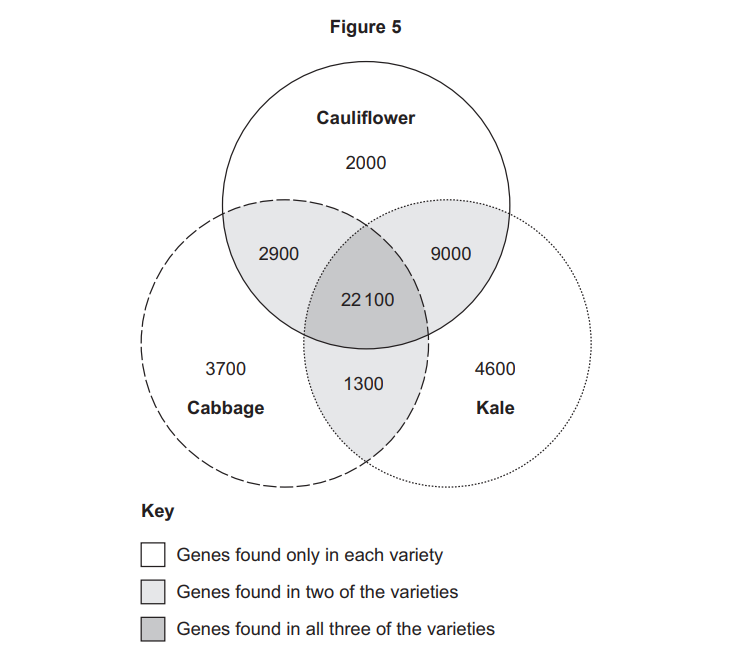
Figure 5 shows the number of genes in Brassica oleracea that are :

  • found only in each variety

  • found in two of the varieties, and

  • found in all three of the varieties.

Venn diagram of genes in cauliflower, cabbage and kale showing numbers unique, shared between two, and 22 100 genes common to all three varieties

How does Figure 5 show that cauliflower and kale are more closely related than cauliflower and cabbage?

3a
1 mark

Scientists discovered a population of mosquitos living in the tunnels of the London Underground train system.

The mosquito 'C. pipiens' entered the tunnels when the London Underground was being built in the 1800s.

Some mosquitos were trapped in the tunnels.

Table 6 gives information about C. pipiens mosquitos.

Table 6

C. pipiens that live above ground

C. pipiens that live in the tunnels

Feed on the blood of birds during the spring and summer

Feed on the blood of rats throughout the year

Need to feed on blood before laying eggs

Do not need to feed on blood before laying eggs

Are not active in the autumn and winter

Stay active all year round

Suggest one reason why the mosquitos living in the tunnels stay active all year round.

3b
1 mark

Some scientists believe that the mosquitos living in the tunnels have evolved into a new species.

Name the process that causes evolution.

3c
6 marks

Explain how the mosquitos living in the tunnels could have evolved into a different species from those living above ground.

3d
3 marks

Most female mosquitos feed on the blood of animals before laying their eggs.

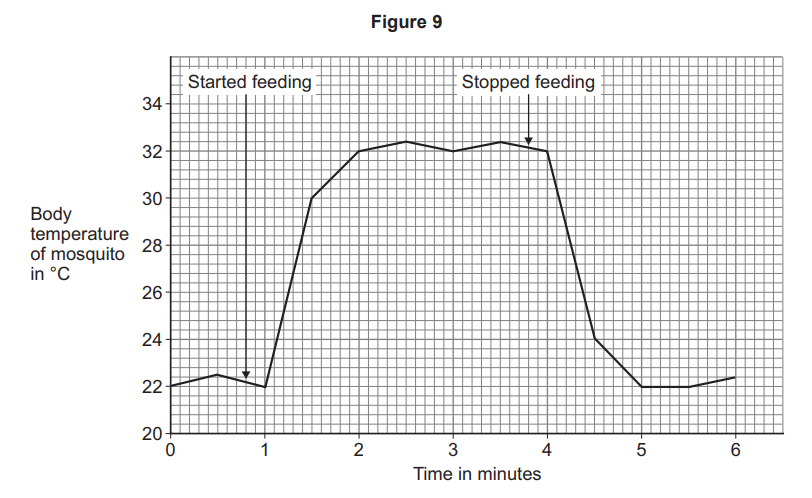
Figure 9 shows the change in the body temperature of a female mosquito while feeding on blood.

Line graph of mosquito body temperature rising from 22°C to 33°C during feeding, then dropping back to about 22°C after feeding stops at 4 minutes

Mosquitos control their internal body temperature by homeostasis.

The optimum internal body temperature of mosquitos is 22 °C.

Explain why mosquitos can only feed on blood for a short time.

4
1 mark

Patients with HPV infections are at increased risk of cancer.

Suggest what effect HPV has on human DNA.

5a
1 mark

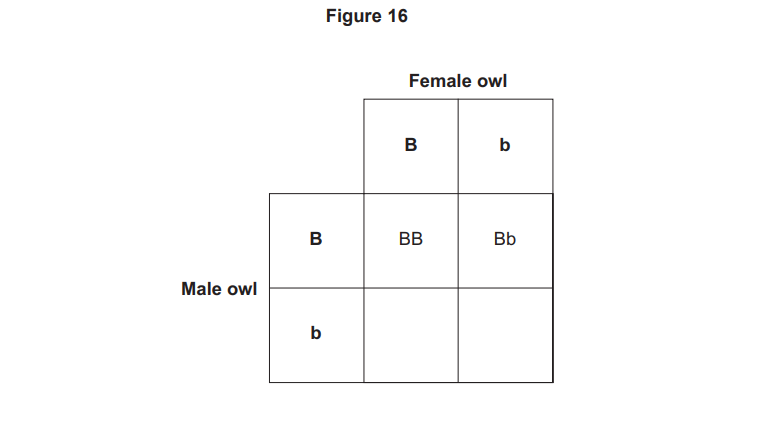
Two tawny owls mate.

Complete Figure 16 to show the possible genotypes of the offspring.

Punnett square labelled Figure 16 showing male and female owl alleles B and b, with offspring genotypes BB, Bb and two blank cells
5b
1 mark

What is the probability of the offspring having brown feathers?

Use Figure 16.

  • 25%

  • 50%

  • 75%

  • 100%

5c
2 marks

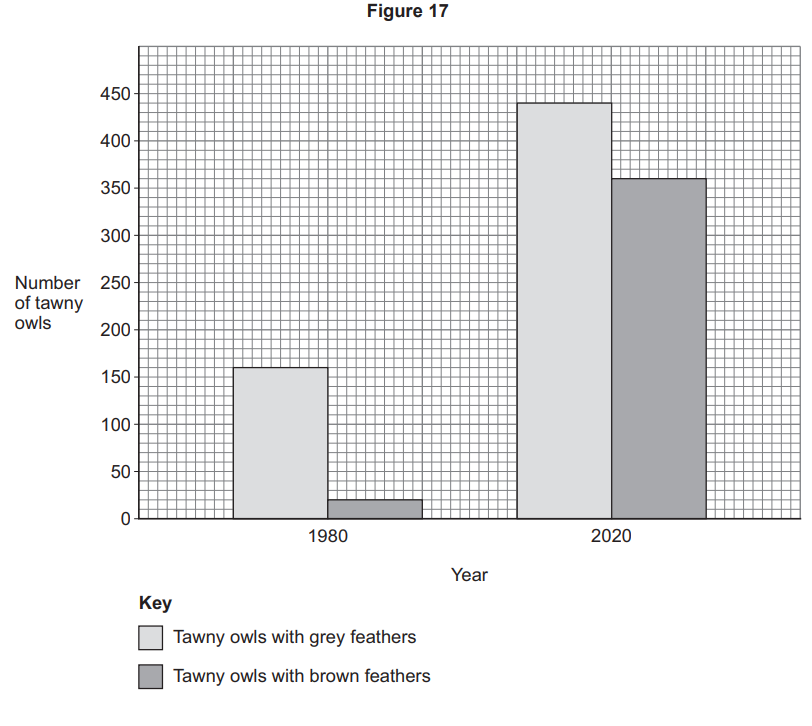
Scientists investigated the effect of climate change on the number of tawny owls with grey feathers and with brown feathers.

The investigation took place between 1980 and 2020.

Figure 17 shows the results.

Bar chart showing tawny owls: grey‐feathered rise from about 150 in 1980 to 440 in 2020; brown‐feathered from about 20 in 1980 to 360 in 2020.

The number of tawny owls with brown feathers in the population has increased since 1980.

Give two other conclusions from the data in Figure 17.

5d
4 marks

Between 1980 and 2020 there was a decrease in the time the area was covered with snow.

The tawny owls with brown feathers are better camouflaged from their prey when there is no snow.

Explain how the increase in the number of tawny owls with brown feathers occurred through the process of natural selection.

6a
1 mark

In 2018 a scientist claimed to have genetically modified two human embryos.

Why is genetic modification of human embryos illegal in most countries?

Tick (✓) one box.

  • Genetic modification technology is too expensive.

  • Specialist equipment is needed for genetic modification.

  • The side effects of genetic modification are not known.

6b
1 mark

The scientist claimed the genetic modification was made to embryos immediately after fertilisation.

Why is genetic modification of embryos more of a concern than genetic modification of body tissues in an adult?

Tick (✓) one box.

  • Genetically modified body tissues are much larger than an embryo.

  • The genetic modification of an embryo would not affect all the body tissues.

  • The modified gene in an embryo could be passed on to future offspring.

6c
1 mark

The scientist claimed that the embryos were genetically modified to be resistant to HIV infection.

Why do some scientists think this use of genetic modification is not necessary?

Tick (✓) one box.

  • HIV infection can be treated with antiretroviral drugs.

  • Only adults are at risk of HIV infection.

  • Oral contraceptives reduce the risk of HIV infection.

7
4 marks

Plant species Q is not resistant to one type of virus.

Explain how the process of natural selection could result in all plants of species Q having resistance to the virus.

8a
1 mark

Other species of tree are in the same genus as Quercus robur.

What does it mean if two species of tree are in the same genus?

  • The two species are always found in the same place.

  • The two species are closely related to each other.

  • The two species look exactly the same.

8b
1 mark

The insects have changed over time and caused a gall to grow on acorns.

The gall increases the chance of survival of the insects inside the gall.

What name is given to the process of the insects changing over time?

  • Clone production

  • Evolution

  • Inbreeding

9
1 mark

A species of grass has the binomial name Lolium perenne.

What is the genus of the grass?

10a
1 mark

In 2018, a scientist claimed to have genetically modified two human embryos.

Suggest why genetic modification of human embryos is illegal in most countries.

10b
1 mark

The scientist claimed that the embryos were genetically modified to have a faulty CCR5 gene.

The CCR5 gene codes for a protein that allows HIV to enter cells.

The genetic modification may have caused the embryos to be protected against AIDS.

Suggest how the embryos were genetically modified to make the CCR5 gene faulty.

11
3 marks

Many years ago, a mutation of an insect embryo led to the embryo causing lignin production in an acorn.

Explain how the mutation could have produced a population of insects that all cause lignin production.

12a
2 marks

Humans can use different methods to produce animals and plants with desired characteristics.

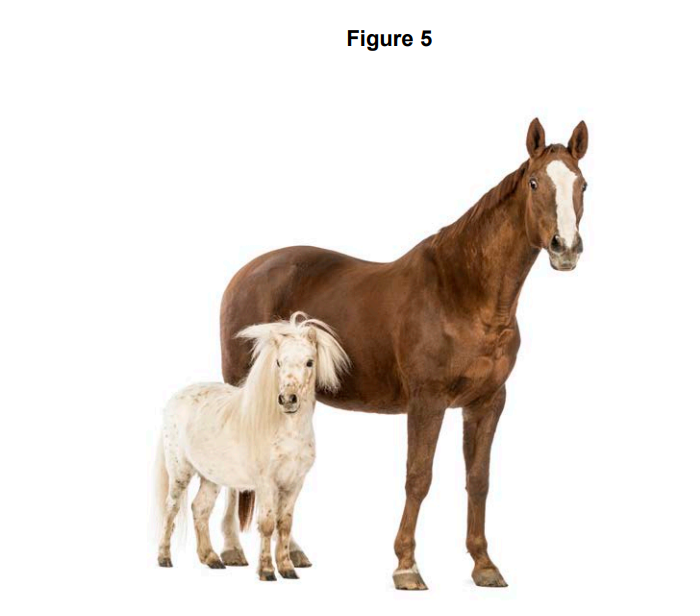
Figure 5 shows some different breeds of horse.

Brown horse standing beside a much smaller white pony on a plain white background, illustrating the size difference between the two animals

All breeds of horse are of the same species.

Suggest what you could do to show this.

12b
3 marks

Horse racing is an ancient sport.

Selective breeding has been used for centuries to produce racehorses.

Describe the steps involved in selective breeding to produce a racehorse.

12c
3 marks

Another way of producing organisms with desired characteristics is genetic engineering.

Bt cotton is a variety of cotton that has been genetically engineered to produce a poison.

The poison kills several different species of insect that feed on cotton plants.

The poison is naturally produced by a soil bacterium called Bacillus thuringiensis.

Describe how cotton plants can be genetically engineered to produce the Bt poison.

12d
4 marks

Describe the advantages and disadvantages of growing Bt cotton.

13a
3 marks

A person's characteristics can be due to:

  • environmental causes

  • genetic causes

  • both environmental and genetic causes.

Complete Table 5.

Put a tick to show what each characteristic is due to.

Table 5

Characteristic

Characteristic due to

Environmental

Genetic

Both

Eye colour

A scar

Weight

13b
2 marks

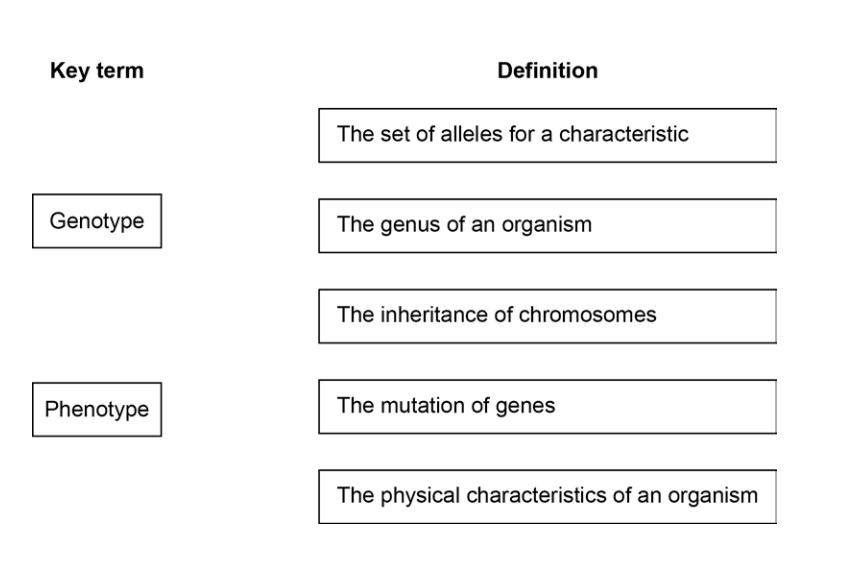
Draw one line from each key term to the correct definition.

Diagram showing the key terms genotype and phenotype with five boxed definitions to be matched, about alleles, genus, chromosomes, gene mutation and physical traits
13c
2 marks

Farmers use selective breeding to control the characteristics in cows.

Table 6 shows the stages of selective breeding in cows.

Complete Table 6 to show the correct order of the stages.

The first stage has been numbered for you.

Table 6

Stage in selective breeding

Order of stage

Cows are bred over many generations

Parents are bred together

Cows with the desired characteristics are chosen

1

Calves with the most desired characteristics are bred together

13d
2 marks

Farmers selectively breed cows for many different reasons.

Suggest two characteristics that cows may be bred for. Do not suggest coat colour.

  1. _

  2. _

13e
2 marks

Selective breeding can lead to problems.

Suggest how problems caused by selective breeding in cows can have negative financial effects for the farmer.