Evidence For Evolution (AQA GCSE Combined Science: Synergy: Life & Environmental Sciences): Revision Note
Exam code: 8465

Fossil Evidence
Evidence for early life forms on Earth can be found in the fossil record
We can learn from fossils how much or how little different organisms have changed as life developed on Earth
Fossils are the ‘remains’ of organisms from millions of years ago, which are found in rocks
Fossils may be formed in several ways:

Evolutionary trees
Evolutionary trees are diagrams that show the relationship between species over evolutionary time
A new branch in the tree shows where speciation has occurred (when a new species has evolved)
In the evolutionary tree below, for example:
Chimpanzees and bonobos share a recent common ancestor. Chimpanzees are therefore most similar to bonobos (more similar than they are to any other primate species)
Humans share a more recent common ancestor with gorillas than they do with orangutans – this means we are more closely related to gorillas than we are to orangutans
All five primate species shown here share a common ancestor (from the distant past)

An evolutionary tree for five species of primate
Evolution in Bacteria
The theory of evolution by natural selection is now widely accepted and many sources of data are now available to support the theory of evolution
One very clear piece of evidence for evolution is antibiotic resistance in bacteria
An antibiotic is a chemical that can kill or inhibit the growth and reproduction of bacteria
Antibiotics are extremely useful to humans as some bacteria are pathogenic and can cause life-threatening disease
Bacteria reproduce, on average, every 20 minutes and therefore evolution occurs in a much shorter time span
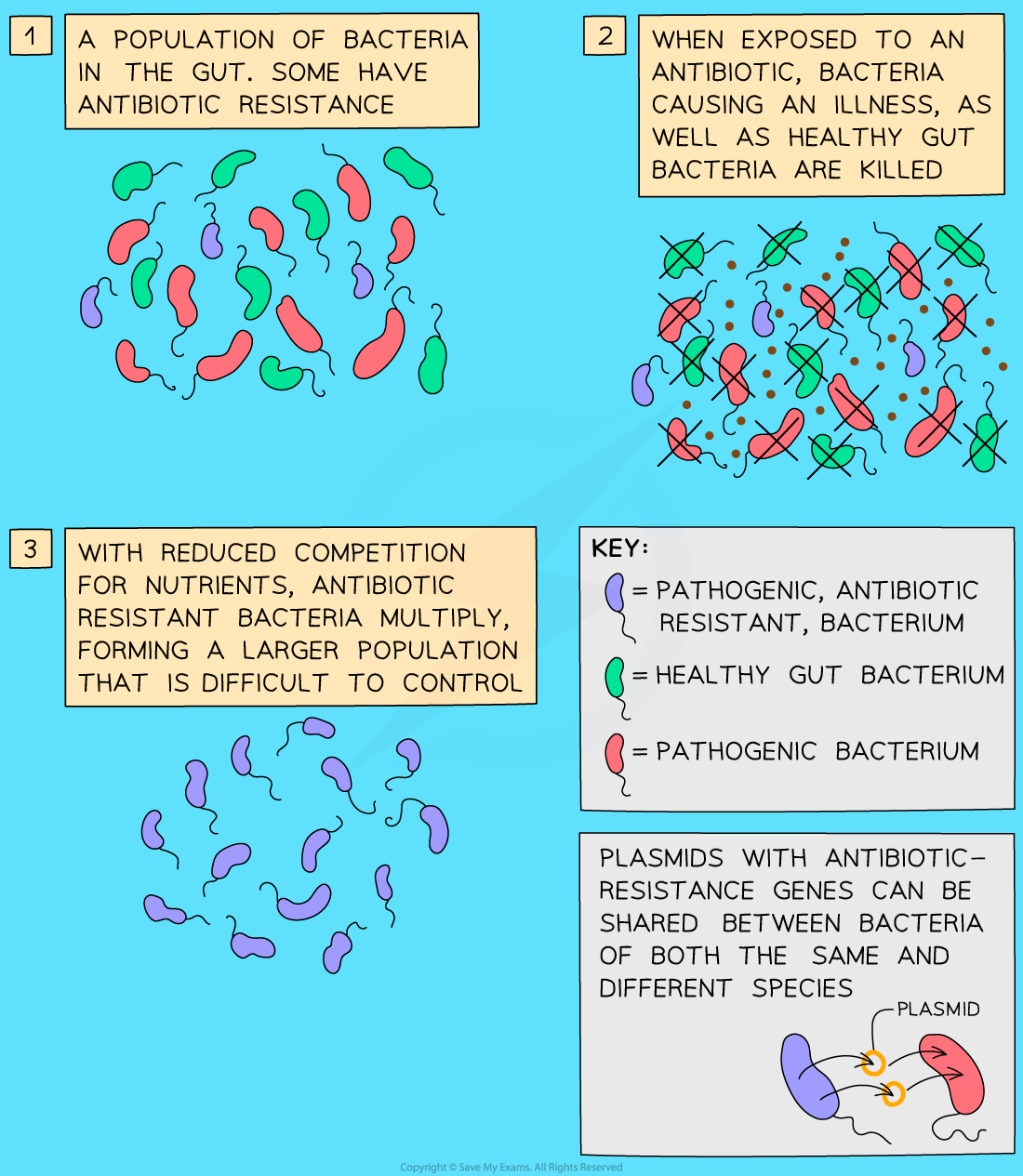
Antibiotic resistant strains of bacteria develop by the following mechanism:
Like all other organisms, within a population, there will be variation caused by mutations
A chance mutation might cause some bacteria to become resistant to an antibiotic (eg penicillin)
When the population is treated with this antibiotic, the resistant bacteria do not die
This means they can continue to reproduce with less competition from non-resistant bacteria, which are now dead
Therefore the genes for antibiotic resistance are passed on with a much greater frequency to the next generation
Over time the whole population of bacteria becomes antibiotic-resistant because the bacteria are best suited to their environment

Unlock more, it's free!
Join the 100,000+ Students that ❤️ Save My Exams
the (exam) results speak for themselves:

Was this revision note helpful?
Build on this topic