Refraction (HT Only) (AQA GCSE Combined Science: Synergy: Life & Environmental Sciences): Revision Note
Exam code: 8465

Written by: Katie M
Updated on
Refraction
Refraction is defined as:
The change in direction of a wave caused by a change in the speed of the wave
Refraction can occur when a wave crosses a boundary between two materials with different densities or when water passes over a boundary of different depths
If the incident wave hits the boundary:
At an angle, the wave will change direction
Perpendicularly (at 90°) the wave will not change direction
Refraction ray diagrams
Refraction occurs when light passes a boundary between two different transparent media
At the boundary, the rays of light undergo a change in direction
The direction is taken as the angle from a hypothetical line called the normal
This line is perpendicular to the surface of the boundaries and is usually represented by a straight dashed or dotted line
The change in direction depends on which media the light rays pass between:
Change in medium | Example | Effect on light |
|---|---|---|
From less dense to more dense | air to glass | bends towards the normal |
From more dense to less dense | glass to air | bends away from the normal |
When passing along the normal (perpendicular) the light does not bend at all
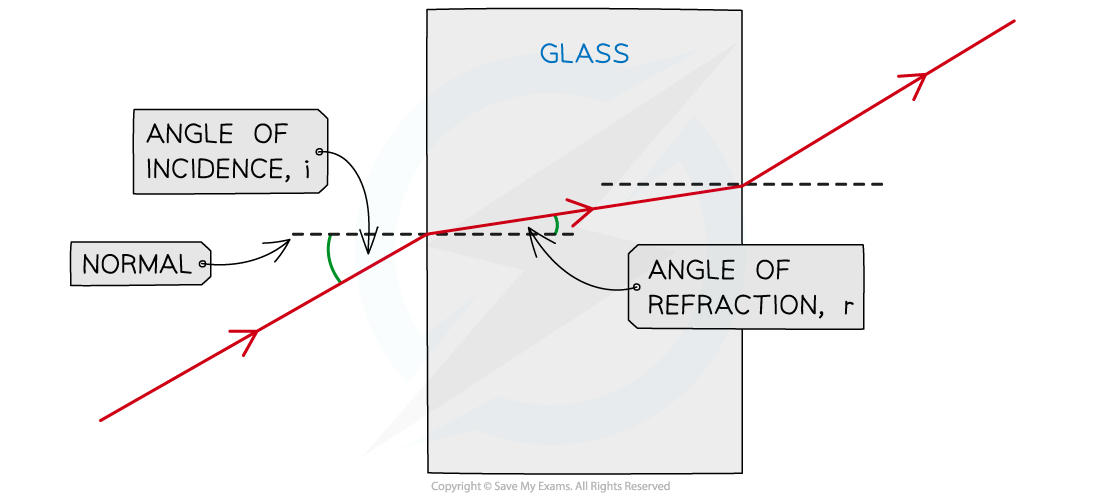
How to construct a ray diagram showing the refraction of light as it passes through a rectangular block
The change in direction occurs due to the change in speed when travelling in different substances
When light passes into a denser substance the rays will slow down, hence they bend towards the normal
The only properties that change during refraction are speed and wavelength – the frequency of waves does not change
Different frequencies account for different colours of light (red has a low frequency, whilst blue has a high frequency)
When light refracts, it does not change colour (think of a pencil in a glass of water), therefore, the frequency does not change
Worked Example
The diagram below shows two parallel rays of light entering and passing through prism A and prism C.

Draw a third parallel ray entering and passing through prism B.
Answer:
Step 1: Draw a parallel ray on the left

Step 2: Draw the refracted ray at the first surface

As the ray enters the block it bends towards the normal since it is going into a denser material
In this case, the angle of refraction is smaller than the angle of incidence
Step 3: Draw the refracted ray at the second surface

As the ray leaves the block it bends away from the normal
In this case, the angle of refraction is larger than the angle of incidence
Examiner Tips and Tricks
Practice drawing refraction diagrams as much as you can! It's very important to remember which way the light bends when it crosses a boundary:
As the light enters the block it bends towards the normal line
Remember: Enters Towards
When it leaves the block it bends away from the normal line
Remember: Leaves Away
Wavefront Diagrams
When an incident wave hits a boundary at an angle, one end of the wavefront changes speed before the other end of the wavefront
This causes the wavefront to change direction
This can be seen most easily on a wavefront diagram
Refraction of a wave at a boundary

When waves pass from a less dense medium to a denser medium:
The wave speed decreases
The wavelength decreases
The frequency remains the same
When a wave hits a boundary perpendicularly, the entire wavefront changes speed at the same time
In this case, the wave does not change direction
Refraction of water waves
Refraction can occur when water waves travel between deep water and shallow water
This effect can also be observed using water waves in a ripple tank
Water waves refracting in a ripple tank

When water waves pass from deep water to shallow water:
The wave speed decreases
The wavelength decreases
The frequency remains the same
Examiner Tips and Tricks
In wavefront questions, the key explanation is:
One end of the wavefront enters the new medium and changes speed before the other
This is why the direction changes
Always link the speed change to the direction change explicitly, as marks are awarded for the explanation not just the diagram

Unlock more, it's free!
Join the 100,000+ Students that ❤️ Save My Exams
the (exam) results speak for themselves:

Was this revision note helpful?
Build on this topic