Electron Microscopy (AQA GCSE Combined Science: Synergy: Life & Environmental Sciences): Revision Note
Exam code: 8465

Electron microscopes
Why are electron microscopes better?
An electron microscope has much higher magnification and resolving power than a light microscope
The magnification of an electron microscope is up to a million times (x 1 000 000) or more
The magnification of a light microscope is only about a thousand times (x 1000)
Electron microscopes can therefore be used to study cells in much finer detail, enabling biologists to see and understand many more subcellular structures such as the mitochondrion
They have also helped biologists develop a better understanding of structures such as the nucleus and cell membrane
Magnification calculations
Magnification equation
Magnification is calculated using the following equation:
Magnification = Drawing size ÷ Actual sizeMagnification equation triangle
An equation triangle can help with rearranging simple equations

An equation triangle for calculating magnification
Rearranging the equation to find things other than the magnification becomes easy when you remember the triangle – whatever you are trying to find, place your finger over it and whatever is left is what you do, so:
Magnification = image size / actual size
Actual size = image size / magnification
Image size = magnification x actual size
Remember magnification does not have any units and is just written as ‘X 10’ or ‘X 5000’
Worked example
An image of an animal cell is 30 mm in size and it has been magnified by a factor of X 3000. What is the actual size of the cell?
To find the actual size of the cell:

Worked example using the equation triangle for magnification
Examiner Tips and Tricks
It is easy to make silly mistakes with magnification calculations. To ensure you do not lose marks in the exam:
Always look at the units that have been given in the question – if you are asked to measure something, most often you will be expected to measure it in millimetres NOT in centimetres – double-check the question to see!
Learn the equation triangle for magnification and always write it down when you are doing a calculation – examiners like to see this!
Converting Units
Converting units in Biology
Cells are very small and require a microscope to be seen
Scientists measure the size of cells in micrometers (µm)
You may be given a question in your Biology exam where the measurements for a magnification calculation have different units
The following units may be used:
centimetre (cm): 1cm = 10mm
milimetre (mm): 1mm = 1000 µm
micrometre (µm): 1µm = 1000 nm OR 0.001 mm
nanometre (nm)
You need to be able to convert between different units of measurement, particularly mm and µm

You need to ensure that you convert them both into the same unit before proceeding with the calculation (usually to calculate the magnification)
For example:

Example of an extended magnification question
Step 1: convert into mm
1mm = 1000µm
2000 / 1000 = 2 mm
Step 2: Substitute the numbers into the formula
The actual thickness of the leaf is 2 mm
The thickness of the leaf in the image is 50 mm
Magnification = image size / actual size
Magnification = 50 / 2 = 25
So the magnification is X 25
Examiner Tips and Tricks
If you are given a question with 2 different units in it, make sure you make a conversion so that both measurements have the same unit before doing your calculation. Also, watch out for the units you are given in the answer-prompt space.Remember the following to help you convert between mm and µm:
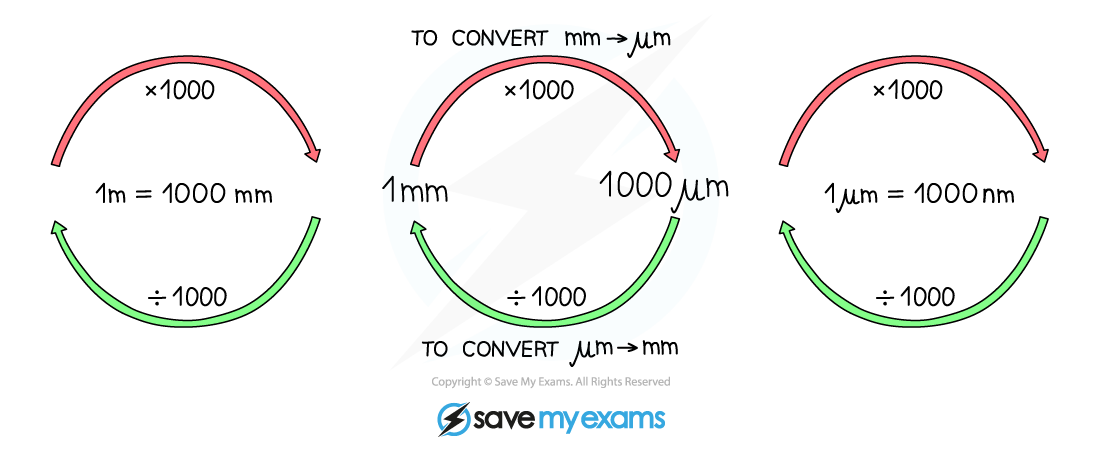
How to Use Standard Form
When biologists talk about the size of cells and the structures within them, they are dealing with very small numbers. Very small (or very big) numbers are represented using standard form – this helps to avoid confusion
Let’s say we want to represent the length of a Vibrio cholerae cell which is 1.5µm in mm
First, we need to convert the measurement in µm into mm (see image in Scale & the Size of Cells)
5 µm = 0.0015 mm
To write this in standard form:

Practise converting numbers into standard form – you may be asked to do this in the exam!
Examiner Tips and Tricks
Take care to look at the units that measurements of cells and subcellular structures are given in.
Scale & the Size of Cells
You need to show an understanding of the size and scale of cells (and the subcellular structures within them)

You need to be aware that many subcellular structures in eukaryotic cells are the same size as or bigger than prokaryotic cells!
Differences in size can be described as differences in order of magnitude, essentially the difference in size calculated by a factor of 10
Size of cells table

Examiner Tips and Tricks
A common exam question is to ask you to calculate the size of subcellular structures and then to suggest why they may or may not be present in a certain type of cell.For example:Why do bacterial cells not contain mitochondria?

Unlock more, it's free!
Join the 100,000+ Students that ❤️ Save My Exams
the (exam) results speak for themselves:

Was this revision note helpful?
Build on this topic