Field Investigations (AQA GCSE Combined Science: Synergy: Life & Environmental Sciences): Revision Note
Exam code: 8465

Investigating Ecosystems
Ecology is the branch of biology that studies the distribution and abundance of species, the interactions between species, and the interactions between species and their abiotic environment
Ecologists are biologists that study these interactions by investigating ecosystems
You need to know how ecologists determine the distribution and abundance of species in an ecosystem using quadrats and transects
You need to understand how they use quadrats and transects in order to do this
Quadrats
Quadrats are square frames made of wood or wire
They can be a variety of sizes eg. 0.25m2 or 1m2
They are placed on the ground and the organisms within them are recorded
They can be used to measure the abundance of plants or slow-moving animals
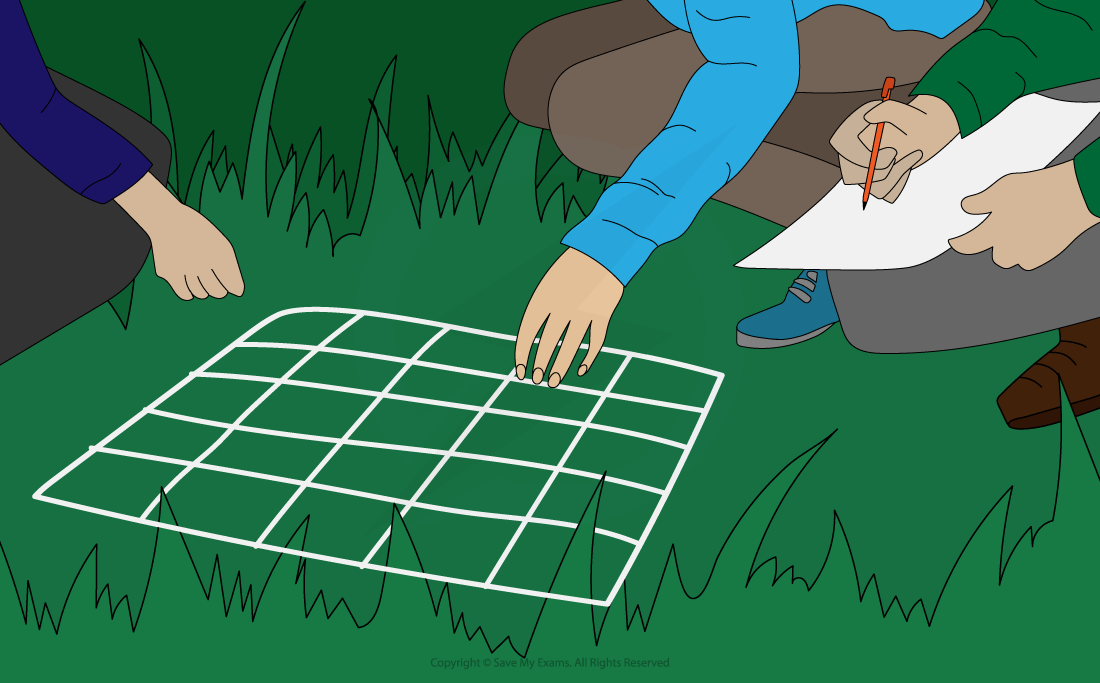
Using a quadrat to investigate population size or distribution
Quadrats can be used to measure abundance by recording:
The number of an individual species: the total number of individuals of a single species (eg. buttercups) is recorded
Species richness: the total number of different species (but not the number of individuals of each species) is recorded
Percentage cover: the approximate percentage of the quadrat area in which an individual species is found is recorded (this method is used when it is difficult to count individuals of the plant species being recorded eg. grass or moss

How to estimate percentage cover of one or more species using a quadrat
Transects
A transect is used to measure how the abundance of a species changes as you move along a changing habitat, eg. changing altitude on a hillside, or from open field to dense woodland, or along the shoreline at the coast
A line called a transect is set up through the changing habitat you want to investigate with a tape measure
A quadrat is then placed at regular intervals (eg. every 5 metres) along the transect
At each interval, the quadrat can be used to record the number of an individual species, species richness or percentage cover
Transects are useful for investigating how the abundance of a species is affected by an abiotic factor (e.g. light intensity, moisture levels, soil depth, altitude etc)

An example of a transect on a hillside. A quadrat is placed at regular intervals (every 10m of altitude gained) and counts the number of individuals (of the species being investigated eg. buttercups) in each quadrat
Examiner Tips and Tricks
When estimating percentage cover, you can count a square (and include it in your calculations) if more than half of it is covered by the species.
Abundance of Organisms
When studying the abundance of organisms, you should be able to:
Understand the terms mean, mode and median
Calculate arithmetic means
Plot and draw appropriate graphs selecting appropriate scales for the axes


Unlock more, it's free!
Join the 100,000+ Students that ❤️ Save My Exams
the (exam) results speak for themselves:

Was this revision note helpful?
Build on this topic