Required Practical 8: Human Reaction Time (AQA GCSE Combined Science: Synergy: Life & Environmental Sciences): Revision Note
Exam code: 8465

Required practical 8: Investigating the effect of a factor on human reaction time
Aim: to plan and carry out an investigation into the effect of a factor on human reaction time
You will:
Choose a factor that you wish to investigate that will have an effect on reaction time
Carry out a number of experiments to measure reaction time
Reaction time is the time taken to respond to a stimulus; reactions are usually very quick responses typically taking less than a second to occur
Reaction time can be affected by factors such as age, stress or use of drugs (such as caffeine)
You could investigate the effect of background noise or consumption of caffeine on how quickly a person catches a ruler
Reaction time can be measured in this way using the principle that the further down the length a ruler is caught, the slower an individual's reaction time
The experiment can be repeated several times to calculate a mean average distance caught and this can be equated to a reaction time
The process is then repeated after a condition is changed (the person drinks a can of caffeinated drink or has to repeat the experiment when loud background music is playing)
Remember to only change one factor (independent variable) in your investigation
There are many control variables that should be considered in this experiment such as:
The person catching the ruler using their dominant hand each time
Dropping the same ruler from the same height each time, with the ruler orientated in the same direction (0 cm facing down)
If the effect of caffeine is being investigated then none should have been consumed before the start of the experiment, or the room is silent for the first run if background noise is being altered
It is possible to carry out a reaction time investigation using a computer; this is obviously more precise as it removes human error from measurements
Reaction time can also be recorded in milliseconds which is more accurate than seconds
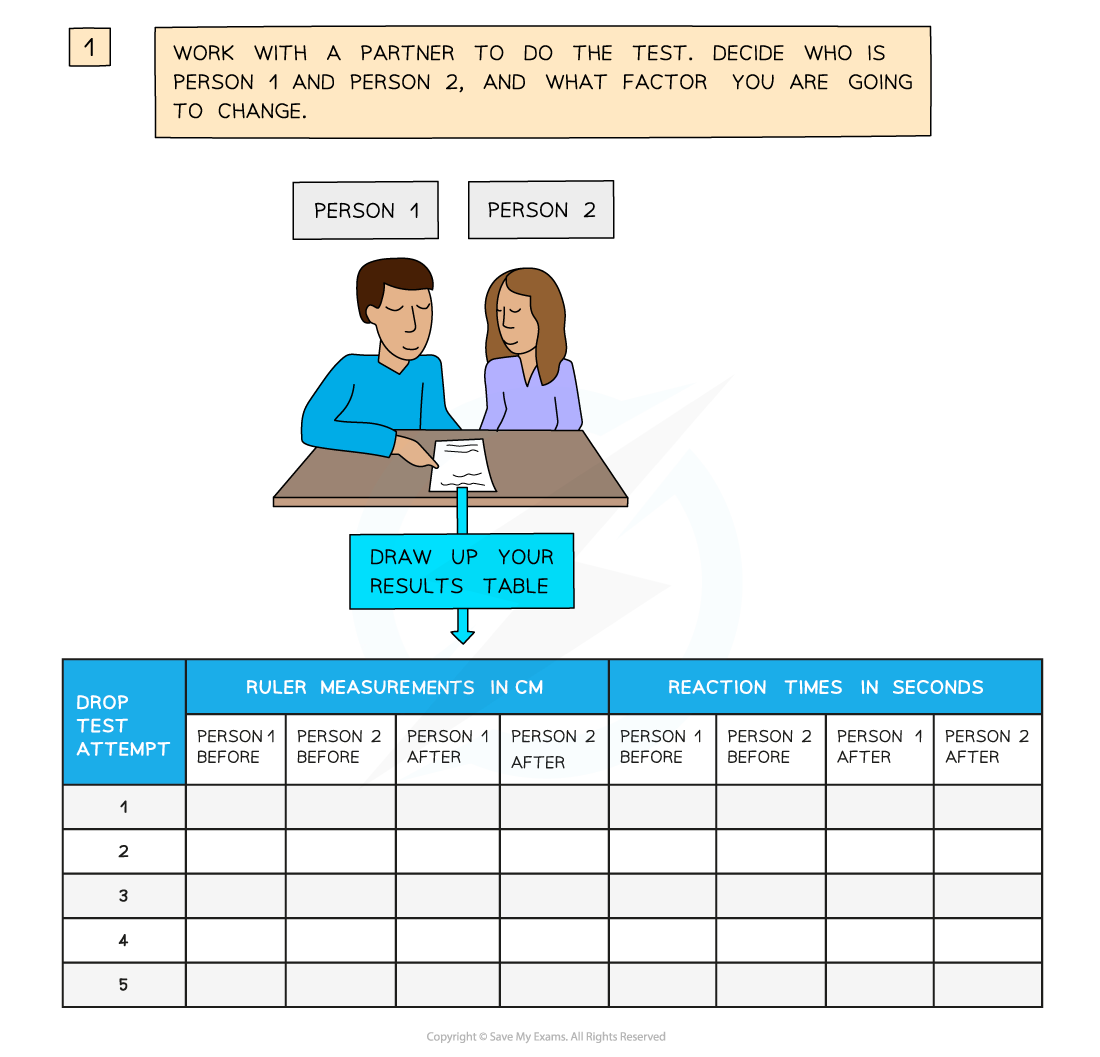


This experiment is prone to lots of errors and there are many factors that can affect the results. Repeat as many times as possible!

Unlock more, it's free!
Join the 100,000+ Students that ❤️ Save My Exams
the (exam) results speak for themselves:

Was this revision note helpful?
Build on this topic