Chlorophyll & Other Plant Pigments (AQA GCSE Combined Science: Synergy: Life & Environmental Sciences): Revision Note
Exam code: 8465

Chromatography
Separating pigments in plant leaves using chromatography
Chromatography can be used to separate and identify chloroplast pigments that have been extracted from a leaf e.g. chlorophyll
Chromatography works by separating substances with different solubilities using a solvent
It uses supporting medium - usually paper, to produce a chromatogram that can be studied to identify the substances
A pencil line is drawn on chromatography paper and spots of the sample are placed on it
Pencil is used for this as ink would run into the chromatogram along with the sample
The paper is then lowered into the solvent container, making sure that the pencil line sits above the level of the solvent so the samples don’t wash into the solvent container
The solvent travels up the paper by capillary action, taking some of the coloured substances with it
Different substances have different solubilities so will travel at different rates, causing the substances to spread apart
Those substances with higher solubility will travel further than the others

The pigments in ink can be analysed using paper chromatography
The mobile and stationary phase
All chromatography techniques use two phases called the mobile phase and the stationary phase
In paper chromatography:
The mobile phase is the solvent in which the sample molecules can move, which in paper chromatography is liquid e.g. water or ethanol
The stationary phase in paper chromatography is the actual chromatography paper itself
The substances which are more soluble in the solvent will travel further up the paper because they spend more time in the mobile phase and are thus carried further up the paper than the less soluble components
Examiner Tips and Tricks
Paper chromatography is the name given to the overall separation technique while a chromatogram is the name given to the visual output of a chromatography run. This is the piece of chromatography paper with the visibly separated components after the run has finished.
Distinguishing pure & impure substances
Pure substances will produce only one spot on the chromatogram
If two or more substances are the same, they will produce identical chromatograms
If the substance is a mixture, it will separate on the paper to show all the different components as separate spots
An impure substance therefore will produce a chromatogram with more than one spot

Diagram showing the analysis of a mixture and pure substances using chromatography
Rf value
Calculating Rf values
These values are used to identify the components of mixtures
The Rf value of a particular compound is always the same but it is dependent, however, on the solvent used
If the solvent is changed then the value changes
Calculating the Rf value allows chemists to identify unknown substances because it can be compared with Rf values of known substances under the same conditions
These values are known as reference values
Retention factor, Rf, is calculated by the equation:
The Rf value is a ratio and therefore has no units and will be less that 1
Calculating Rf value
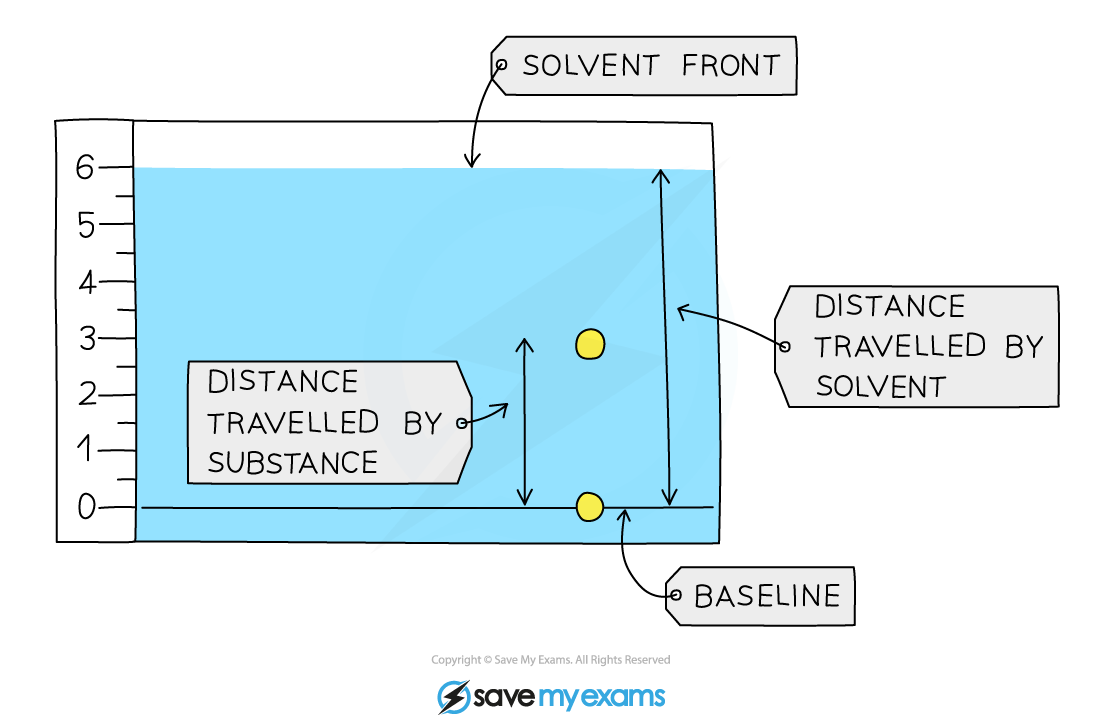
Using Rf values to identify components of a mixture
The Rf value of the substances in the chromatogram above can be calculated by:
Examiner Tips and Tricks
For the Rf calculations, both distances are measured from the baseline.

Unlock more, it's free!
Join the 100,000+ Students that ❤️ Save My Exams
the (exam) results speak for themselves:

Was this revision note helpful?
Build on this topic