Exact Trig Values (Cambridge (CIE) IGCSE Maths: Extended): Revision Note
Exam code: 0580 & 0980

Exact trig values
What are exact values in trigonometry?
For certain angles the values of sin θ, cos θ and tan θ can be written exactly
This means using fractions and surds
You are expected to know the exact values of sin, cos and tan for
0°, 30°, 45°, 60°, 90°, 180° and their multiples
0º | 30º | 45º | 60º | 90º | |
|---|---|---|---|---|---|
sin | 0 | 1 | |||
cos | 1 | 0 | |||
tan | 0 | 1 | undefined |
How can I remember these exact trig values?
Look at patterns in the table
Note the values of sin θ from 0° to 90° match cos θ in reverse, from 90° to 0°
Examiner Tips and Tricks
Some people remember sin θ using the trick which simplifies to .
Two special right-angled triangles below can help you to find the exact values for 30º, 45º and 60º
Remember that by rationalising the denominator,
Triangle for 45°

Triangle for 30° and 60°

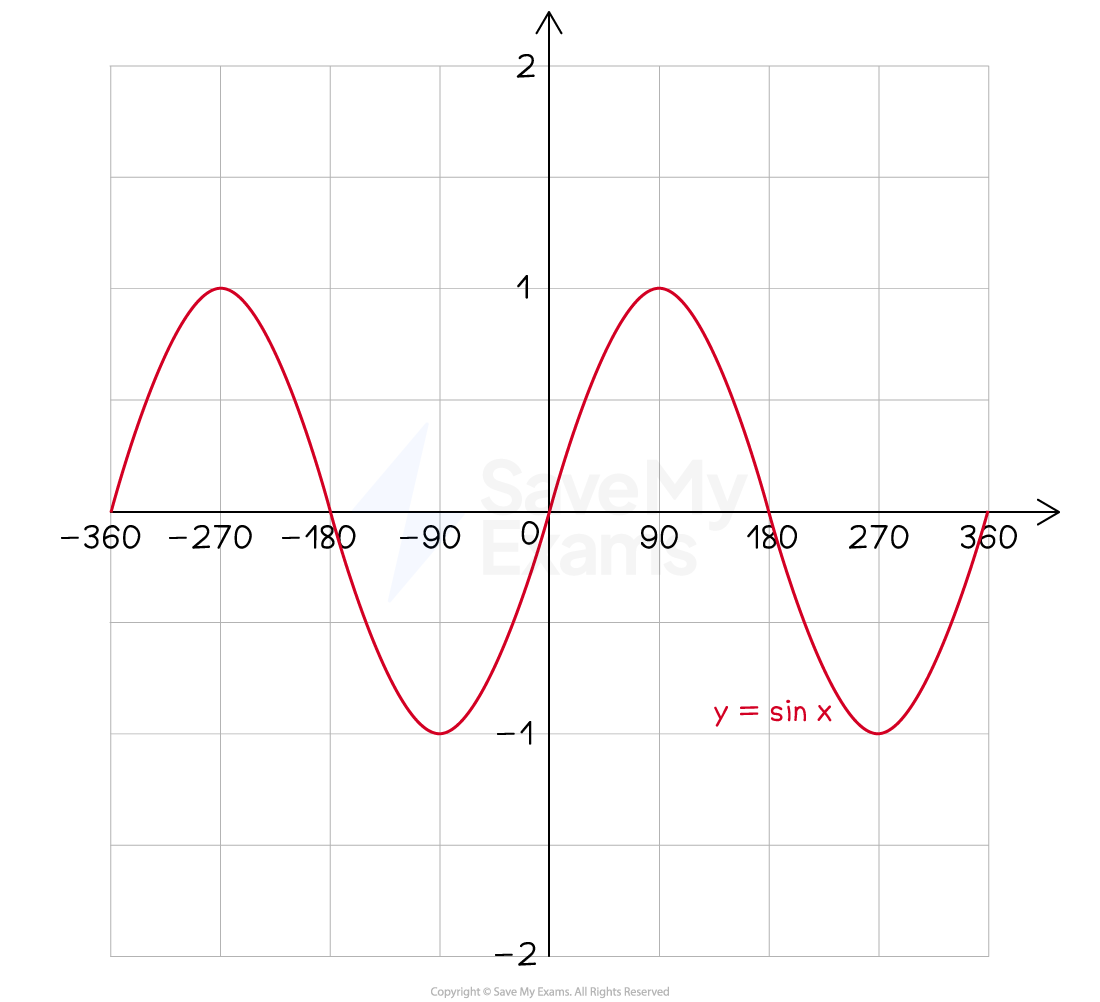
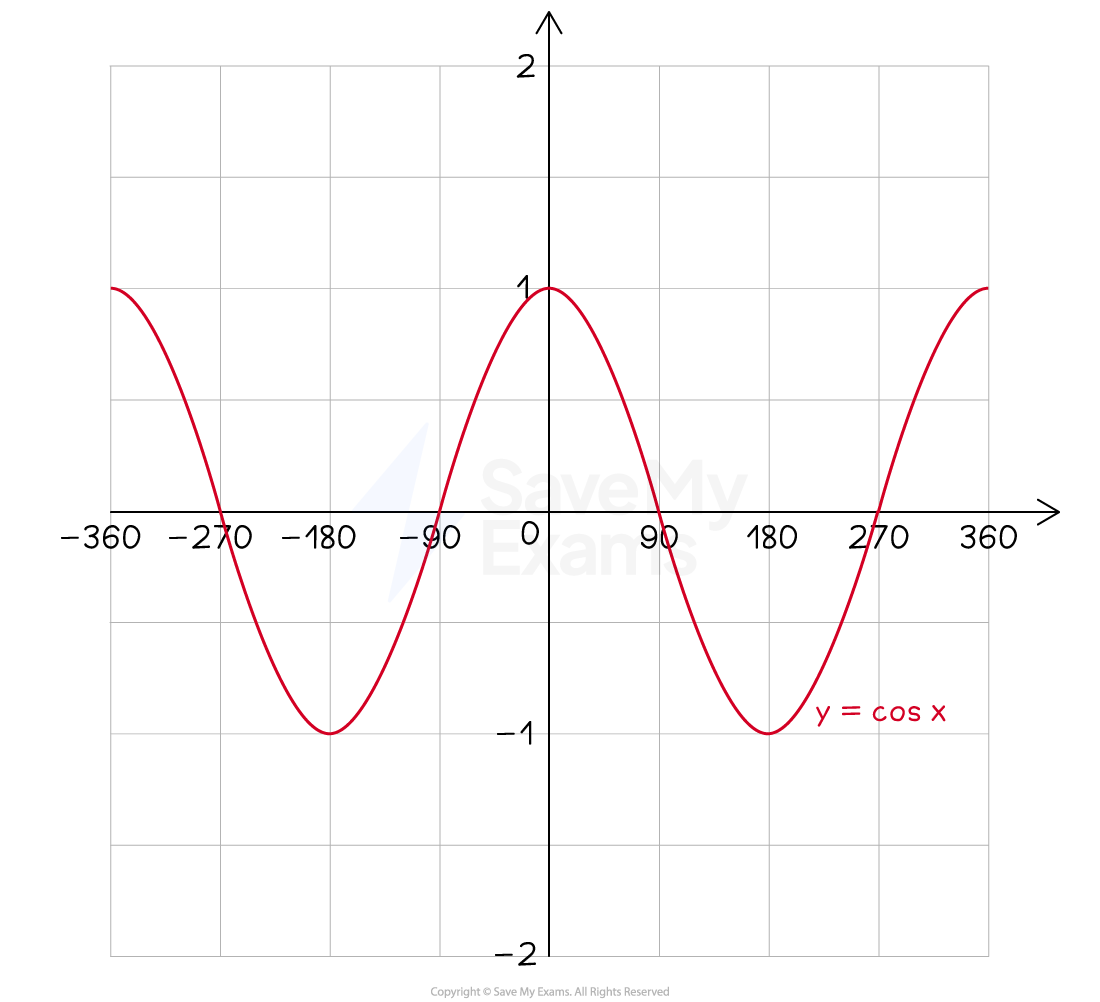
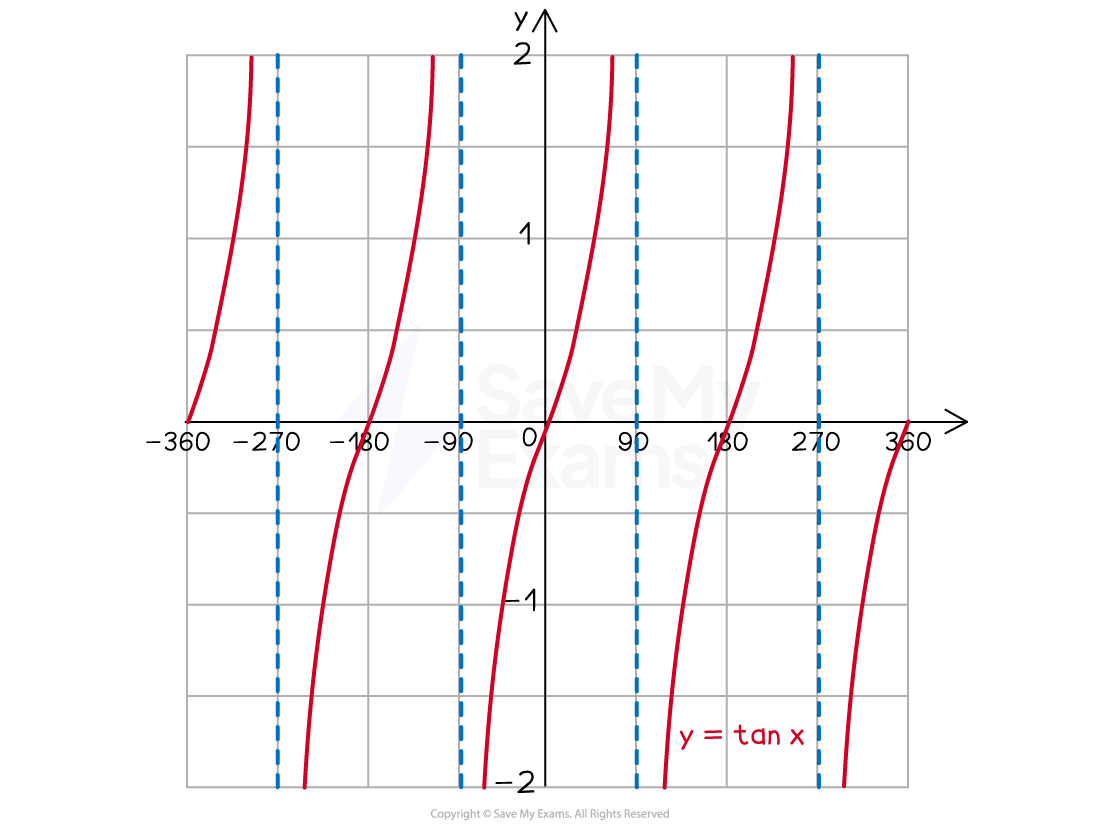
The trig graphs can help you to remember the exact values for 0º and multiples of 90º
How do I use exact trig values?
You may come across trig questions in a non-calculator question
In trig calculations, substitute in the exact trig values and solve as usual
E.g. Solve the equation
Replace with to give
Then you can solve for
On trig graphs, you may be expected to find a coordinate
E.g. The coordinates lie on the graph , find
will be equal to
The exact value of is
Therefore
Examiner Tips and Tricks
Writing these out (or sketching the triangles/graphs) on your paper at the beginning of the exam means that you can use them as many times as you need to during the exam!
Worked Example
Find the value of in the diagram below.
Give your answer as an exact value.

Answer:
Triangle ABC is a right-angled triangle, so use SOHCAHTOA
We know the hypotenuse (AC) and we want to calculate the opposite (BC), so use
Remember that
So,
Leave in exact (surd) form
cm

Unlock more, it's free!
Join the 100,000+ Students that ❤️ Save My Exams
the (exam) results speak for themselves:

Was this revision note helpful?
Build on this topic
Questions students ask about Exact Trig Values
Real questions from students revising this topic on Save My Exams
Why is tan 90° undefined?
tan 90° is undefined because working it out means dividing by zero, and dividing by zero has no answer.
From the exact values table:
- tan θ = sin θ ÷ cos θ
- sin 90° = 1 and cos 90° = 0
- So tan 90° = 1 ÷ 0, which is undefined
From a right-angled triangle:
- tan θ = opposite ÷ adjacent
- As θ gets closer to 90° the adjacent side shrinks towards 0, so the values grow without limit: tan 45° = 1, tan 60° = √3, and upwards from there
From the graph of y = tan x on the page:
- There are vertical dashed lines (asymptotes) at x = ±90° and x = ±270°
- The curve gets closer and closer to them but never reaches them, so tan x has no value there
If you type tan 90 into your calculator you get an error, for exactly this reason.
Why do we need to know exact trigonometric values if we have a calculator?
Because you can meet trig in a non-calculator question, and some questions ask for an exact answer that a rounded decimal will not give.
- The page says trig can come up in a non-calculator question, so you need values such as sin 60° = √3/2 by heart
- Exact means fractions and surds, not rounded decimals. A calculator gives sin 60° = 0.866..., which is only an approximation
Page example: triangle ABC has hypotenuse AC = 28 cm and an angle of 60° at A. Find x = BC as an exact value.
- sin 60° = x/28
- √3/2 = x/28
- x = 28 × √3/2 = 14√3 cm
On a calculator you would get 24.248..., which is not exact, so it would not answer the question as asked.
Tip from the page: write out the table, or sketch the 45° and 30°/60° triangles, at the start of the exam, then use them as often as you need.
How are exact trigonometric values tested in exam questions?
They are tested in three main ways: inside a SOHCAHTOA triangle, by substituting into an equation, and by reading a coordinate off a trig graph — usually with no calculator.
1. Exact side length (the page's worked example)
- Hypotenuse 28 cm, angle 60°, find the opposite side x
- sin 60° = x/28, and sin 60° = √3/2
- x = 28 × √3/2 = 14√3 cm — leave it in surd form
2. Solving an equation
- Solve cos 45° = x/12
- Replace cos 45° with √2/2: √2/2 = x/12, so x = 6√2
3. Coordinates on a trig graph
- (30, k) lies on y = tan x, so k = tan 30° = √3/3
What you need to know: sin, cos and tan of 0°, 30°, 45°, 60°, 90°, 180° and their multiples. Rebuild them from the 45° triangle (1, 1, √2) or the half-equilateral triangle (1, √3, 2).
Watch for "give your answer as an exact value" — it means surds and fractions, not decimals.