SOHCAHTOA (Cambridge (CIE) IGCSE Maths: Extended): Revision Note
Exam code: 0580 & 0980

SOHCAHTOA
What is trigonometry?
Trigonometry is the mathematics of angles in triangles
It looks at the relationship between side lengths and angles of triangles
What are sin, cos and tan?
The three trigonometric functions sine, cosine and tangent
They come from ratios of side lengths in right-angled triangles
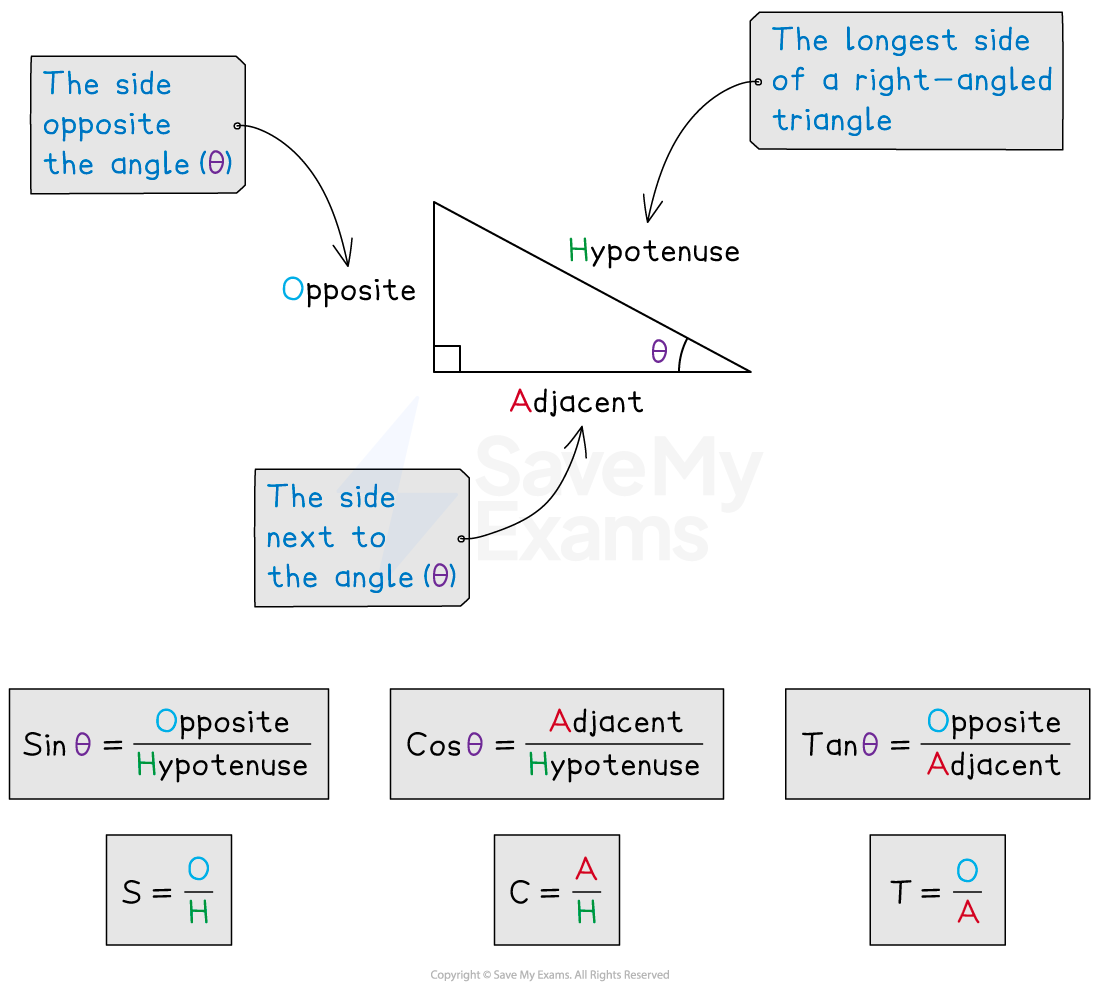
You must label the sides of a right-angled triangle in relation to a chosen angle θ
The hypotenuse, H, is the longest side in a right-angled triangle
It will always be opposite the right angle
The side opposite θ will be labelled opposite, O
The side next to θ will be labelled adjacent, A
The functions sine, cosine and tangent are the ratios of the lengths of these sides as follows


What is SOHCAHTOA?
SOHCAHTOA is a mnemonic often used to remember which ratio is which
Sin is Opposite over Hypotenuse
Cos is Adjacent over Hypotenuse
Tan is Opposite over Adjacent
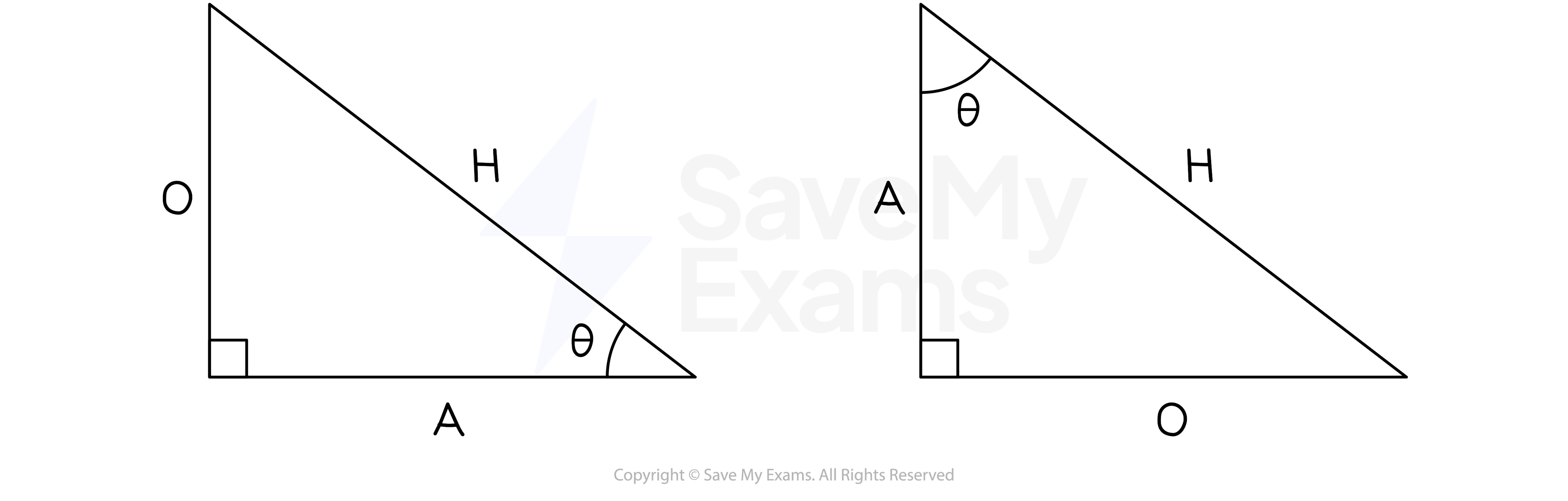
H is always the same but O and A change depending on which angle is labelled as θ
How can I use SOHCAHTOA to find missing lengths?
STEP 1
Label the sides of the triangle as H, O and ASTEP 2
Identify which trigonometric ratio to use: sin, cos or tanWrite down the letter of the length you are given
Write down the letter of the length you want to find
Find the two letters in SOHCAHTOA to identify which ratio to use
If you have A and H then use cos
STEP 3
Substitute the values into the relevant trigonometric formulaRemember to put brackets around the angle
 or

STEP 4
Rearrange and solve for the unknown letterYou will either need to multiply or divide
- leads to

- leads to

STEP 5
Type the expression into your calculatorThe question might ask you to round your answer
If not then round to three significant figures
How can I use SOHCAHTOA to find missing angles?
STEP 1
Label the sides of the triangle as H, O and ASTEP 2
Identify which trigonometric ratio to use: sin, cos or tanWrite down the letters of the lengths you are given
Find the two letters in SOHCAHTOA to identify which ratio to use
If you have O and A then use tan
STEP 3
Substitute the values into the relevant trigonometric formulaThe angle will be unknown
STEP 4
Substitute the fraction into the inverse trigonometric functionYou normally need to press SHIFT on your calculator first
 leads to

STEP 5
Type the expression into your calculatorThe question might ask you to round your answer
If not then round to one decimal place
How do I find the shortest distance from a point to a line?
The shortest distance from any point to a line will always be the perpendicular distance
Form a right-angled triangle and then use SOHCAHTOA to find the relevant distance
Examiner Tips and Tricks
SOHCAHTOA (like Pythagoras) can only be used in right-angled triangles.
Examiner Tips and Tricks
Ensure your calculator is set to measure angles in degrees.
You should see the letter D or the word Deg at the top of your screen.
Worked Example
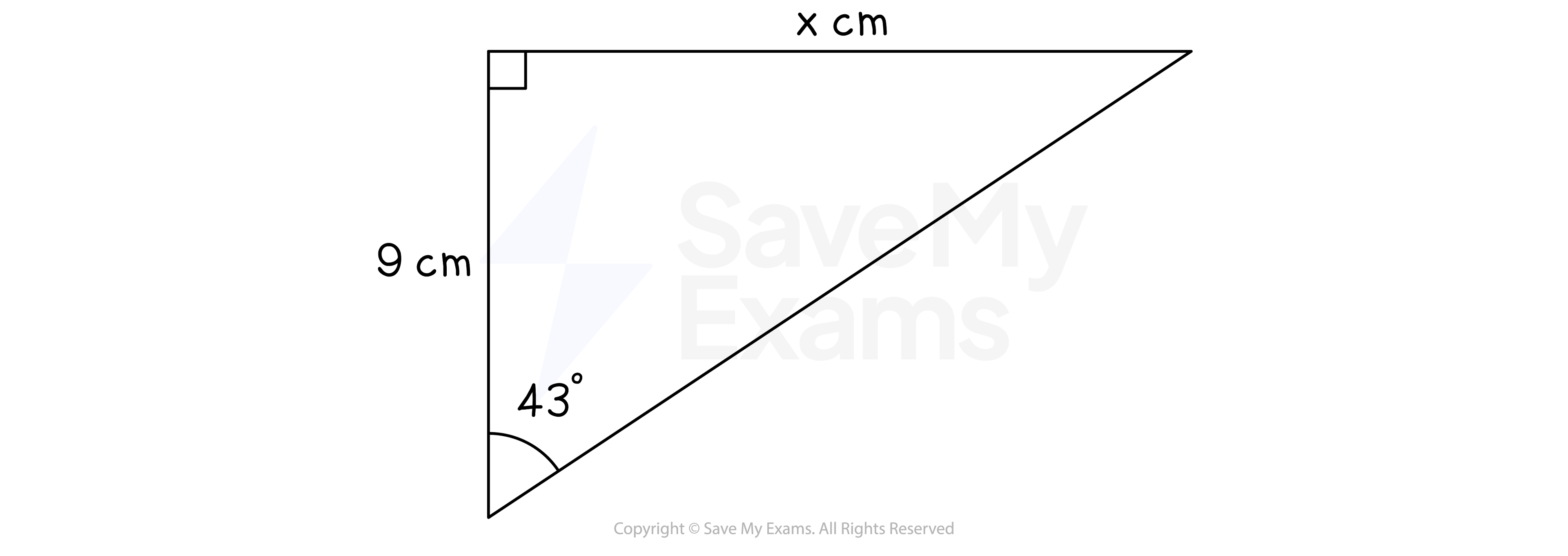
Find the length of the side  cm in the following triangle.
Give your answer to 3 significant figures.
Answer:
First label the triangle
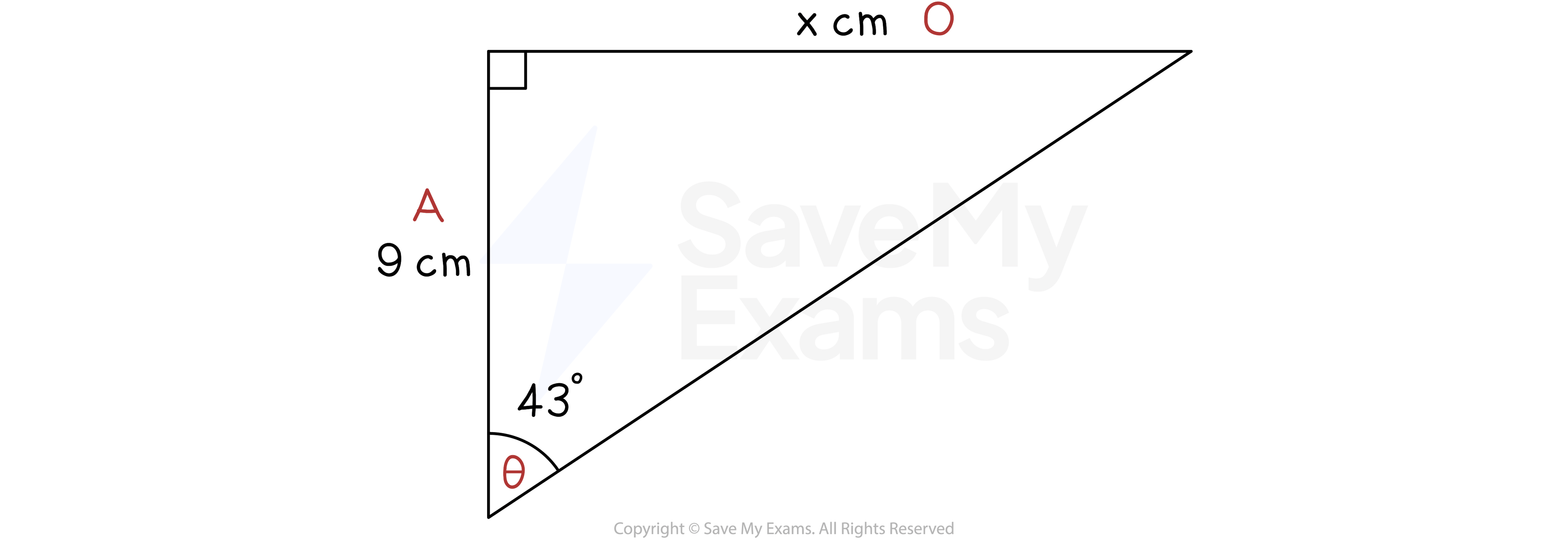
We know A and we want to know O - that's TOA or 

Multiply both sides by 9

Enter on your calculator

Round to 3 significant figures

Worked Example
Find the value of the angle  ° in the following triangle.
Give your answer to 1 decimal place.
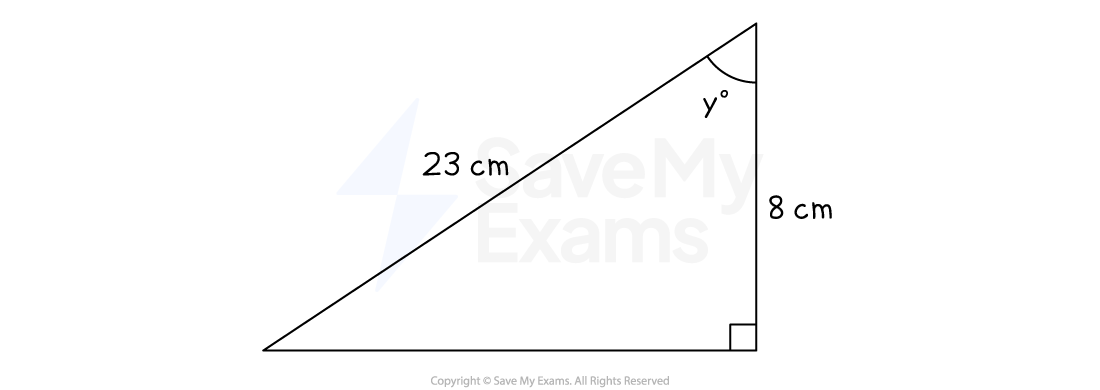
Answer:
First label the triangle
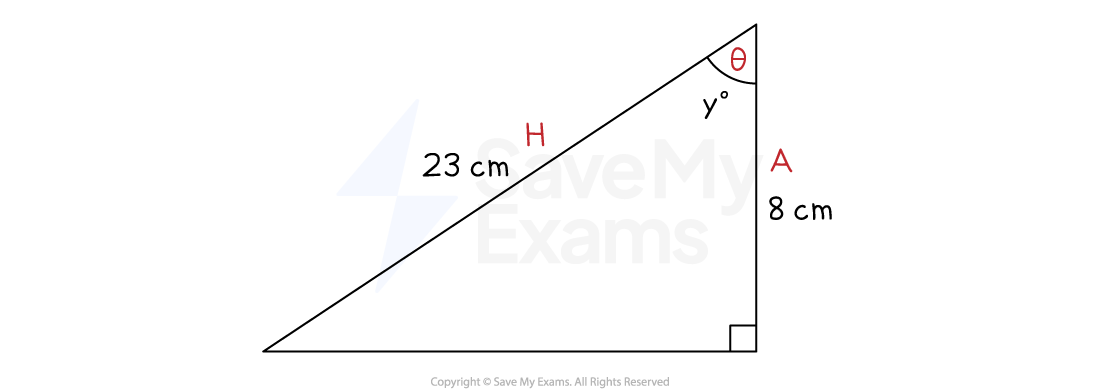
We know A and H - that's CAH or 

Use inverse cos to find 

Enter on your calculator

Round to 1 decimal place


Unlock more, it's free!
Join the 100,000+ Students that ❤️ Save My Exams
the (exam) results speak for themselves:

Was this revision note helpful?
Build on this topic
Questions students ask about SOHCAHTOA
Real questions from students revising this topic on Save My Exams
When do you use inverse sin, cos, and tan?
You use inverse sin, cos or tan (sin⁻¹, cos⁻¹, tan⁻¹) when the angle is the unknown and you already know two side lengths.
- Finding a missing side: use sin, cos or tan as normal, because the angle is given.
- Finding a missing angle: the ratio gives you a fraction, and the inverse function turns that fraction back into an angle.
- On most calculators you press SHIFT first, then sin, cos or tan.
Worked example (from this page): find y° when the hypotenuse is 23 cm and the side next to y° is 8 cm.
- Label the sides: H = 23, A = 8, so you have A and H, which is CAH
- cos(y) = 8/23
- y = cos⁻¹(8/23)
- y = 69.6455... = 69.6° (1 d.p.)
- Check your calculator is in degrees — you should see D or Deg at the top of the screen.
- If the question doesn't tell you how to round an angle, give it to 1 decimal place.
How do you know whether to use SOH, CAH, or TOA?
Pick the ratio whose two letters match the two sides you are working with: the side you know and the side you want (or, for an angle, the two sides you know).
- Label the sides H, O and A from the angle θ.
- Write down the letter of the side you are given.
- Write down the letter of the side you want to find.
- Find that pair in SOHCAHTOA:
- O and H → SOH, sin θ = O/H
- A and H → CAH, cos θ = A/H
- O and A → TOA, tan θ = O/A
The third side isn't needed, so ignore it.
Worked example (from this page): the angle is 43°, the side next to it is 9 cm and you want x cm, the side across from it.
- 9 cm is A and x is O, so you have O and A → TOA
- tan(43) = x/9
- x = 9 × tan(43) = 8.3926... = 8.39 cm (3 s.f.)
Finding an angle works the same way: know A and H, use CAH, then inverse cos.
How do you identify the opposite, adjacent, and hypotenuse sides of a right-angled triangle?
Label the sides from the angle you are using (θ): the hypotenuse is opposite the right angle, the opposite side is across from θ, and the adjacent side is next to θ.
Label them in this order:
- Hypotenuse (H) — find the right-angle box; the side across from it is H. It is the longest side and never changes.
- Opposite (O) — the side across from θ. It is the only side that doesn't touch θ.
- Adjacent (A) — the side left over, joining θ to the right angle.
H is fixed, but O and A swap if you switch to the other acute angle, so always label before you calculate.
Worked example (from this page): in the triangle with the 43° angle:
- the sloping side is across from the right angle, so it's H
- the 9 cm side runs from 43° to the right angle, so it's A
- the x cm side is across from 43°, so it's O