Completing the Square (Cambridge (CIE) IGCSE Maths: Extended): Revision Note
Exam code: 0580 & 0980

Completing the Square
How can I rewrite the first two terms of a quadratic expression as the difference of two squares?
Look at the quadratic expression x2 + bx + c
The first two terms can be written as the difference of two squares using the following rule
is the same as where is half of
Check this is true by expanding the right-hand side
Is the same as ?
Yes: (x + 1)(x + 1) - 12 = x2 + 2x + 1 - 1 = x2 + 2x
This works for negative values of b too
can be written as which is
A negative b does not change the sign at the end
How do I complete the square?
Completing the square is a way to rewrite a quadratic expression in a form containing a squared bracket
To complete the square on x2 + 10x + 9
Use the rule above to replace the first two terms, x2 + 10x, with (x + 5)2 - 52
then add 9: (x + 5)2 - 52 + 9
simplify the numbers: (x + 5)2 - 25 + 9
answer: (x + 5)2 - 16
How do I complete the square when there is a coefficient in front of the x2 term?
You first need to take out as a factor of the x2 and x terms only
Factorise the first two terms
Use square-shaped brackets here to avoid confusion with round brackets later
Then complete the square on the bit inside the brackets:
This gives
where p is half of
Finally multiply this expression through by a (from outside the square brackets) and add the c on to the end
This looks far more complicated than it is in practice!
Usually you are asked to give your final answer in the form
For example, y = 4x2 + 16x + 5
Factorise out 'a' on the right-hand side (use square brackets)
y = 4[x2 + 4x] + 5
Replace x2 + 4x with (x + 2)2 - 22 (because p = = 2)
y = 4[(x + 2)2 - 22] + 5
Simplify the terms inside the square brackets
y = 4[(x + 2)2 - 4] + 5
Multiply everything inside the square brackets by 4
y = 4(x + 2)2 - 16 + 5
Simplify to get the final answer
y = 4(x + 2)2 - 11
For quadratics like , do the above but with a = -1
How do I find the turning point by completing the square?
Completing the square helps us find the turning point on a quadratic graph
If then the turning point is at
Notice the negative sign in the x-coordinate
This links to transformations of graphs
A translation of by p to the left and q up
If then the turning point is still at
The a does not change the coordinates
The turning point is a minimum point if a > 0
or a maximum point if a < 0
This can also help you create the equation of a quadratic when given the turning point
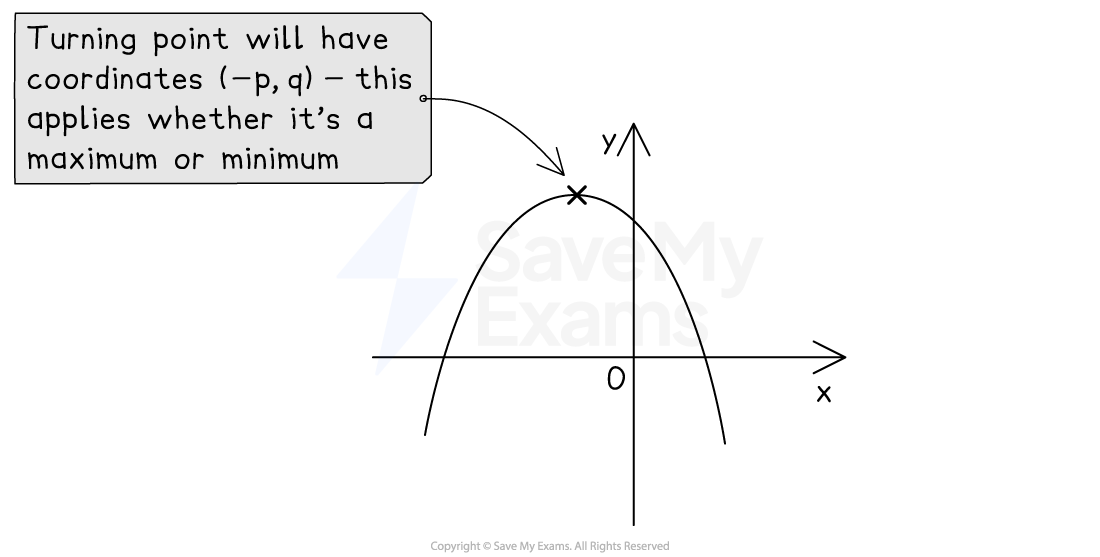
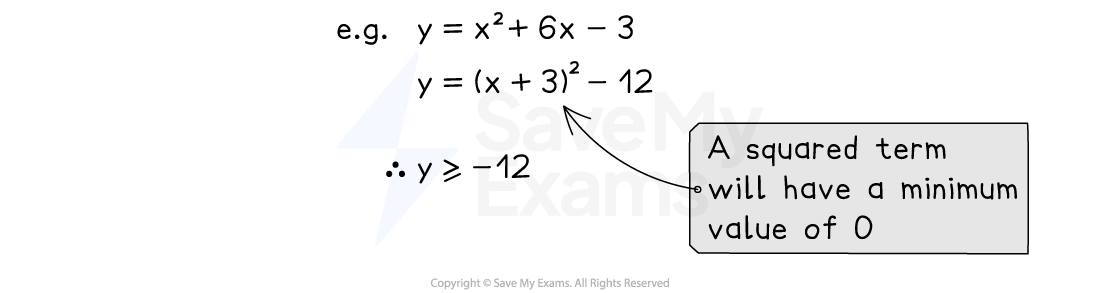
It can also be used to prove or show results using the fact that any squared term, such as the squared bracket (x ± p)2, will always be greater than or equal to 0
You cannot square a number and get a negative value
The smallest a squared term can be is 0
Examiner Tips and Tricks
To know if you have completed the square correctly, expand your answer to check
Worked Example
(a) By completing the square, find the coordinates of the turning point on the graph of .
Answer:
Find half of +6 (call this p)
Write x2 + 6x in the form (x + p)2 - p2
is the same as
Put this result into the equation of the curve
Simplify the numbers
Use the fact that the turning point of is at
Here p = 3 and q = -20
turning point at (-3, -20)
(b) Write in the form .
Answer:
Factorise -3 out of the first two terms only
Use square-shaped brackets
Complete the square on the x2 - 4x inside the brackets
Write in the form (x + p)2 - p2 where p is half of -4
Simplify the numbers inside the brackets
(-2)2 is 4
Multiply -3 by all the terms inside the square brackets
(You do not multiply -3 by the 24)
Simplify the numbers
This is now in the form a(x + p)2 + q where a = -3, p = -2 and q = 36
Solving by Completing the Square
How do I solve a quadratic equation by completing the square?
To solve x2 + bx + c = 0
replace the first two terms, x2 + bx, with (x + p)2 - p2 where p is half of b
This is completing the square
x2 + bx + c = 0 becomes (x + p)2 - p2 + c = 0
(where p is half of b)
rearrange this equation to make x the subject (using ±√)
For example, solve x2 + 10x + 9 = 0 by completing the square
x2 + 10x becomes (x + 5)2 - 52
so x2 + 10x + 9 = 0 becomes (x + 5)2 - 52 + 9 = 0
make x the subject (using ±√)
(x + 5)2 - 25 + 9 = 0
(x + 5)2 = 16
x + 5 = ±√16
x + 5 = ±4
x = -5 ±4
x = -1 or x = -9
It also works with numbers that lead to surds
The answers found will be in exact (surd) form
Examiner Tips and Tricks
When making x the subject to find the solutions, don't expand the squared bracket back out again!
Remember to use ±√ to get two solutions
How do I solve by completing the square when there is a coefficient in front of the x2 term?
If the equation is ax2 + bx + c = 0 with a number (other than 1) in front of x2
you can divide both sides by a first (before completing the square)
For example 3x2 + 12x + 9 = 0
Divide both sides by 3
x2 + 4x + 3 = 0
Complete the square on this easier equation
This trick only works when completing the square to solve a quadratic equation
i.e. it has an "=0" on the right-hand side
Don't do this when using completing the square to rewrite a quadratic expression in a new form
i.e. when there is no "=0"
For that, you must factorise out the a (but not divide by it)
and so on
How does completing the square link to the quadratic formula?
The quadratic formula actually comes from completing the square to solve ax2 + bx + c = 0
a, b and c are left as letters when completing the square
This makes it as general as possible
You can see hints of this when you solve quadratics
For example, solving x2 + 10x + 9 = 0
by completing the square, (x + 5)2 = 16 so x = -5 ± 4 (as above)
by the quadratic formula, = -5 ± 4 (the same structure)
Worked Example
Solve by completing the square.
Answer:
Divide both sides by 2 to make the quadratic start with x2
Halve the middle number, -4, to get -2
Replace the first two terms, x2 - 4x, with (x - 2)2 - (-2)2
Simplify the numbers
Add 16 to both sides
Take the square root of both sides
Include the ± sign to get two solutions
Add 2 to both sides
Work out each solution separately
x = 6 or x = -2

Unlock more, it's free!
Join the 100,000+ Students that ❤️ Save My Exams
the (exam) results speak for themselves:

Was this revision note helpful?
Build on this topic
