Direct Proportion (Cambridge (CIE) IGCSE International Maths: Extended): Revision Note
Exam code: 0607

Direct proportion
What is direct proportion?
Proportion is a way of talking about how two variables are related to each other
Direct proportion means that as one variable goes up the other goes up by the same factor
The ratio between the two amounts will always stay the same
The symbol means "proportional to"
E.g. y is directly proportional to x, yx
If x and y are directly proportional, then
x : y will always be the same
there will be some value, k, such that y = kx
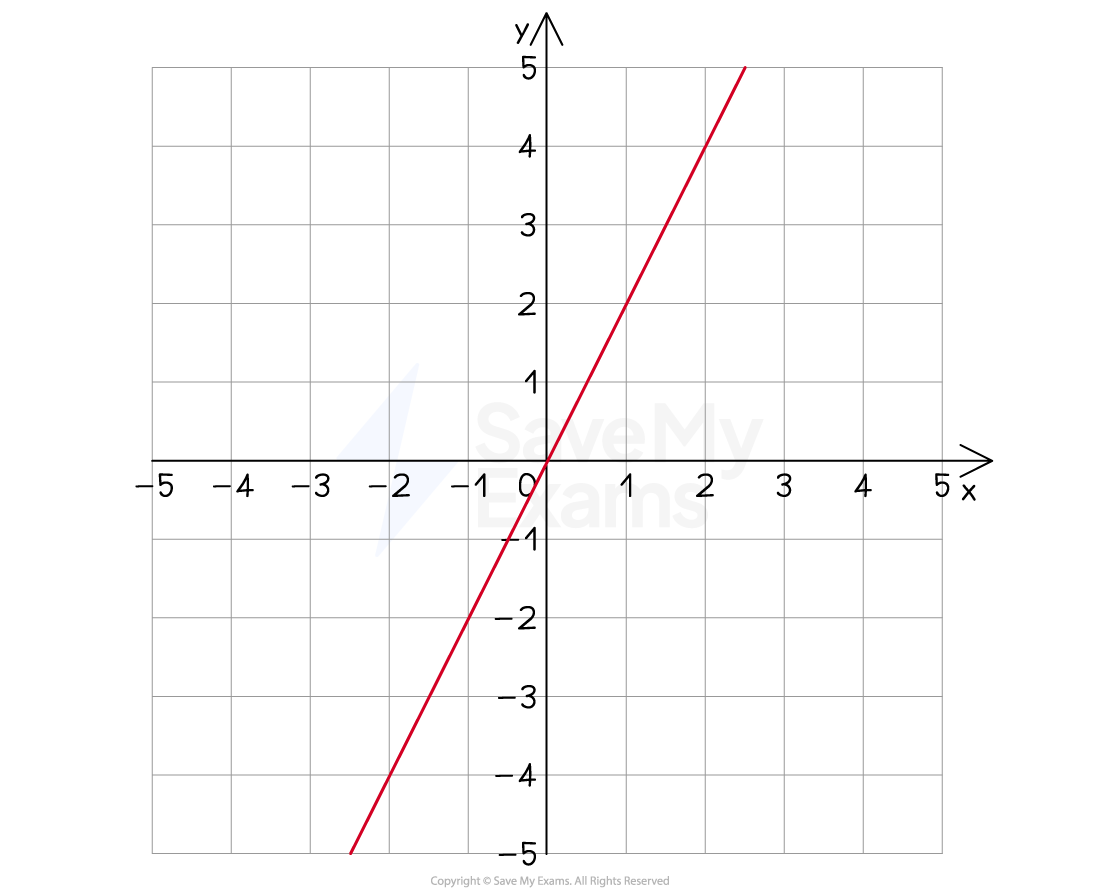
the graph relating x and y is a linear graph, with gradient k
k is called the constant of proportionality
How do I use direct proportion with powers and roots?
Problems may involve a variable being directly proportional to a power or root of another variable
For example
y is directly proportional to the square of x
means that
y is directly proportional to the square root of x
means that
y is directly proportional to the cube of x
means that
y is directly proportional to the cube root of x
means that
Each of these would have a different type of graph, depending on the power or root
How do I find the equation between two directly proportional variables?
Direct proportion questions always have the same process:
STEP 1
Identify the two variables and write down the formula in terms of kE.g. y is directly proportional to x
write down the formula
STEP 2
Find k by substituting any given values from the question into your formula, then solving to get kE.g. if you are told y = 6 when x = 2
then giving
STEP 3
Rewrite the formula with the known value of k from above (substitute it in)This is the equation relating the two variables
STEP 4
Use the equation to answer other parts of the questionE.g. find y when x = 10
gives
Examiner Tips and Tricks
Some harder exam questions do not tell you to work out the equation. You are expected to do it on your own.
Worked Example
It is known that is directly proportional to the square of .
When , .
Find the value of when .
Answer:
Identify the two variables
We are told this is direct proportion
Write down the formula involving k
Find k by substituting in y = 18 when x = 3
Then solve the equation for k
Substitute this value of k back into the formula to get the full equation
Use this formula to find y when x = 4

Unlock more, it's free!
Join the 100,000+ Students that ❤️ Save My Exams
the (exam) results speak for themselves:

Was this revision note helpful?
Build on this topic
