Exponential Growth & Decay (Cambridge (CIE) IGCSE International Maths: Extended): Revision Note
Exam code: 0607

Exponential Growth & Decay
The ideas of compound interest and depreciation can be applied to other (non-money) situations, such as increasing or decreasing populations.
What is exponential growth?
When a quantity grows exponentially it is increasing from an original amount by a scale factor (or percentage) each year for years
Some questions use a different timescale, such as each day, or each minute
Real-life examples of exponential growth include:
Population increases
Bacterial growth
The number of people infected by a virus
What is exponential decay?
When a quantity exponentially decays it is decreasing from an original amount by a scale factor (or percentage) each year for years
Some questions use a different timescale, such as each day, or each minute
Real-life examples of exponential decay include:
The temperature of hot water cooling down
The value of a car decreasing over time
Radioactive decay (the mass of a radioactive substance over time)
How do I use models for exponential growth or decay?
Scenarios which exponentially grow or decay can be modelled with an equation
A useful format for this equation is
E.g. or
If then it is exponential growth
If then it is exponential decay
cannot be negative
could model the number of flies, , in a population of flies, against the number of days,
The initial number of flies, when , is
After 2 days, the number would be
After 4 days, the number would be
From the values above, and the fact that , this is exponential growth
could model
the radius of a water droplet, , as it evaporates where is measured in minutes
The initial radius of the droplet, when , is
After 2 minutes, the radius would be
After 4 minutes, the radius would be
From the values above, and the fact that , this is exponential decay
How are exponential models related to exponential graphs?
Plotting an exponential model, , on a set of axes gives an exponential graph with the following shape
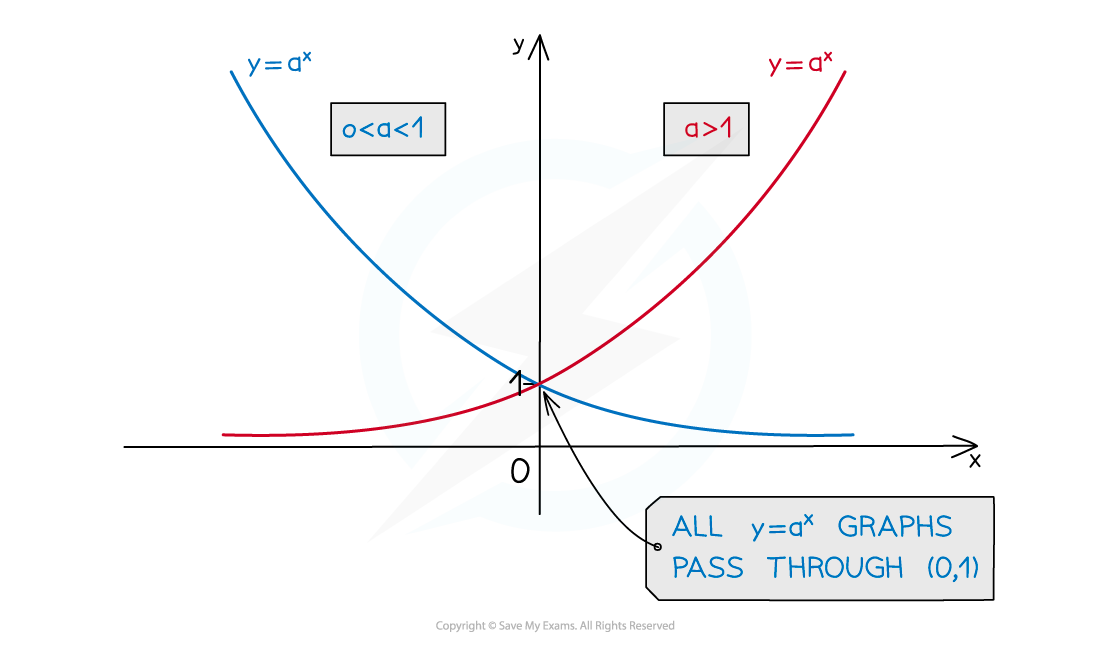
The -intercept is always 1
This is because the -intercept is where
There is an asymptote at
(the curve gets closer and closer to the x-axis without crossing it)
This is because there are no solutions to
Are there any other exponential models I may encounter?
You may see exponential models in the form
The coefficient, , scales (stretches) the graph vertically
The -intercept will be
This is because when ,
is the initial (starting) amount of the quantity being modelled
Examiner Tips and Tricks
Look out for how the question wants you to give your final answer
It may want the final amount to the nearest thousand or to the nearest integer
Worked Example
A large population of birds increases exponentially according to the model
where is the number of birds, measured in thousands, and is the number of years.
Find the population after 13 years, giving your answer to the nearest hundred.
Substitute in
The question asks for the answer to the nearest hundred
The question also states that is measured in thousands
1.665073507... × 1000 = 1665.073507... birds
Round to nearest hundred
1700
Worked Example
The percentage of tickets still available for a concert is modelled approximately by the equation
Where is the percentage of tickets still available, as a decimal, and is the number of days since the tickets have been released.
(a) After 3 days, 51.2% of the tickets are still available. Find the value of .
will be 3 (from 3 days)
will be 0.512 (as the percentage is written as a decimal in this model)
Substitute these values into the model
Find by taking the cube root of both sides
(b) What percentage of tickets remain after 2 weeks? State your answer to three significant figures.
Now that is known, the full equation of the model is
is measured in days
2 weeks = 2 × 7 = 14 days
Substitute in
Turn this into a percentage by multiplying by 100
4.398046511... %
Round to three significant figures
4.40 %
(c) State one reason why this model may not be appropriate for the scenario.
The value of y can never reach zero (there is an asymptote at ).
The model suggests that the tickets never truly run out (which is unrealistic).

Unlock more, it's free!
Join the 100,000+ Students that ❤️ Save My Exams
the (exam) results speak for themselves:

Was this revision note helpful?
Build on this topic
