Differentiation (Cambridge (CIE) IGCSE Maths: Extended): Revision Note
Exam code: 0580 & 0980

Differentiation
What is a gradient function?
Recall that the equation of a curve gives the y-coordinate of a point when you substitute in its x-coordinate
For example,
Substitute in to get
The point lies on the curve
A gradient function gives the gradient of the curve at a point when you substitute in its x-coordinate
A gradient function is written as
pronounced "dy by dx"
This refers to the change in y over change in x
For example, the gradient function
Substitute in to get
The gradient at the point where is 7
The gradient function can also be called the derivative or derived function
What is differentiation and how does it work?
Differentiation is an algebraic method that changes the equation of a curve, , into a gradient function,
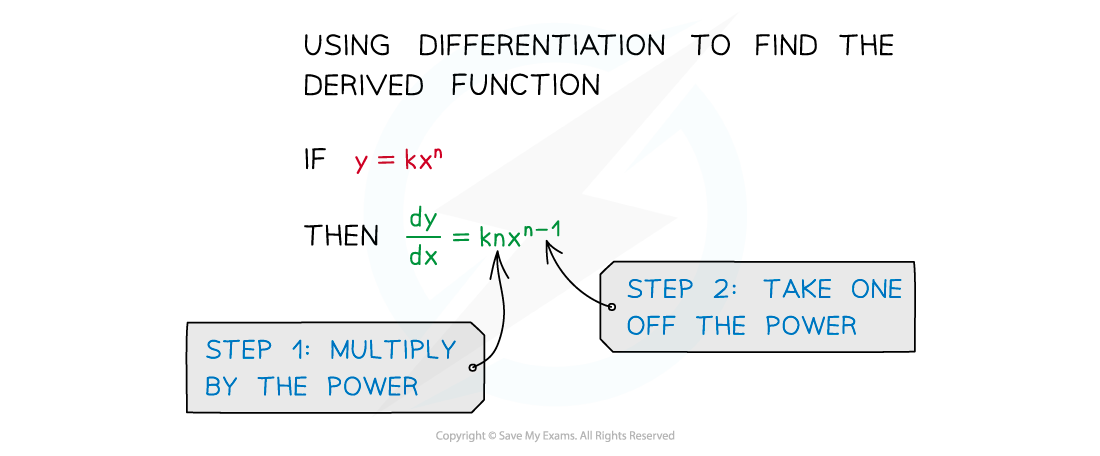
To differentiate a power of , bring down the power and reduce the power by 1
Differentiating gives
Differentiating gives
Differentiating gives
Any number that is already in front of is multiplied by the power that was brought down
Differentiating gives
Differentiating gives
Differentiating gives
Be careful with two special cases:
Differentiating gives
The disappears leaving just a number
For example, differentiates to
This makes sense, the gradient of the straight line is 2
Differentiating just a number (a constant term), , gives
Numbers disappear!
For example, differentiates to
This makes sense, the gradient of the horizontal line is zero
How do I differentiate sums and differences of terms?
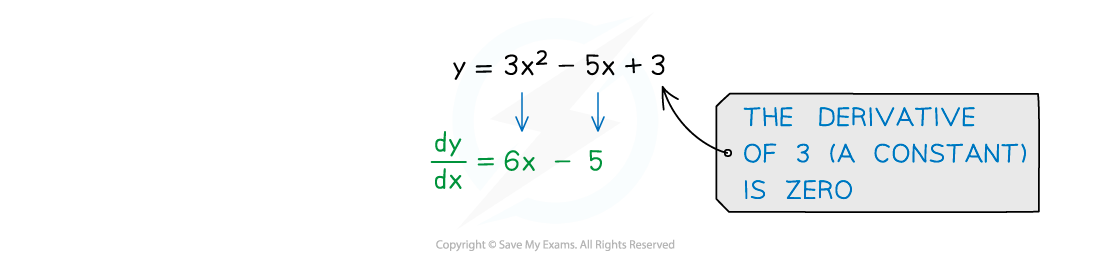
The equation of a curve may include a number of different terms
You can differentiate each term individually
Differentiating gives
Differentiating gives
Remember the two special cases of:
differentiating to just
and constant terms, , differentiating to zero
E.g. differentiating gives
How do I find the gradient of a curve using the gradient function?
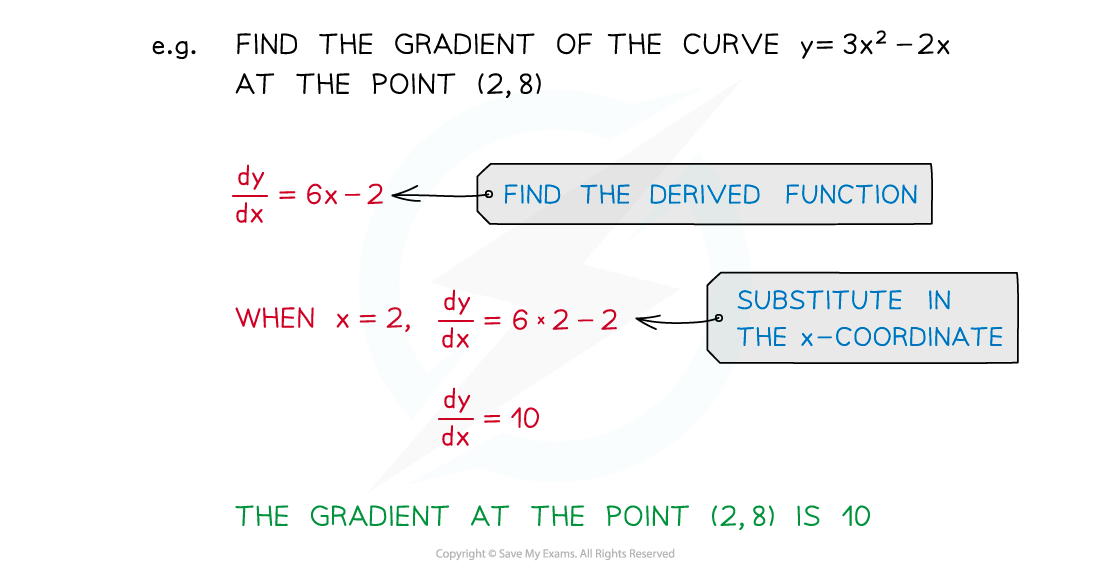
Find the x-coordinate of the point on the curve you're interested in
Use differentiation to turn the equation of the curve, , into the gradient function,
Substitute the x-coordinate into the gradient function to find the gradient
The y-coordinate is not needed
If instead you are given a gradient and asked to find the x-coordinate
set equal to that gradient and solve the equation
Examiner Tips and Tricks
Don't forget to write the left-hand sides of and to avoid mixing up the curve equation with the gradient function!
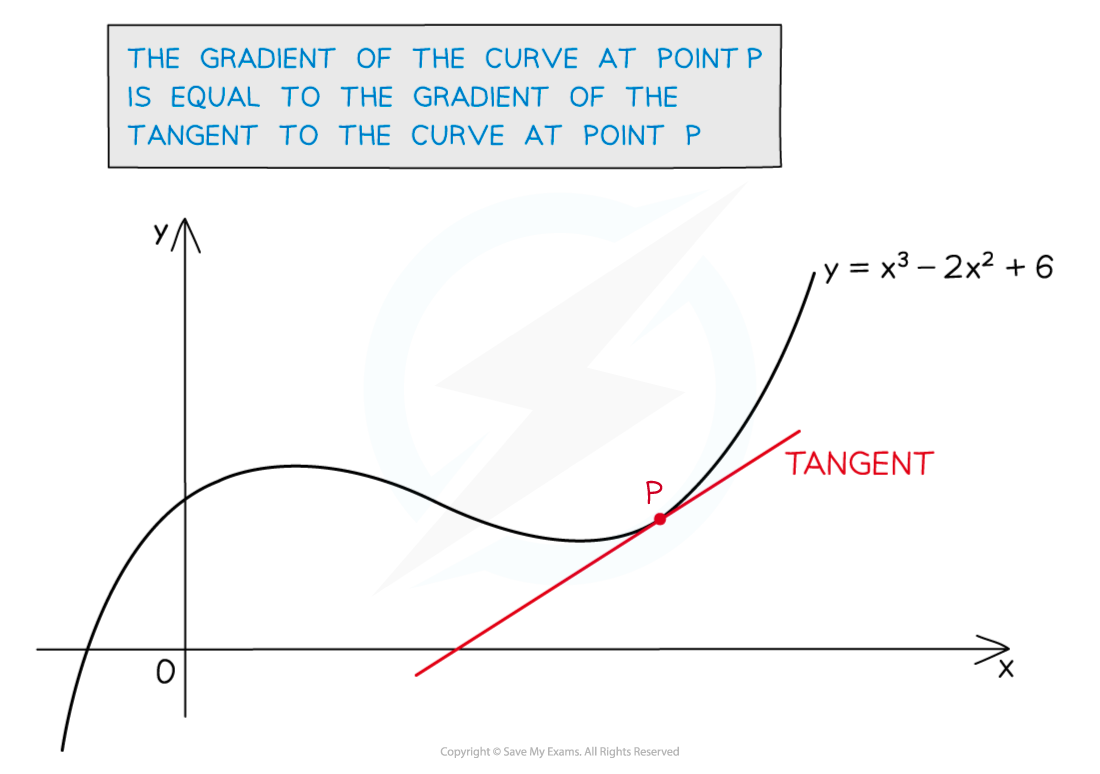
How is the gradient function related to drawing tangents?
The gradient of a curve changes as you move along the curve
To find the gradient at a particular point you can draw a tangent and find its gradient
This is a graphical method that is not accurate
It depends on how well you draw the tangent
Instead, you can use differentiation to find the gradient function, then substitute the x-coordinate of the point into the gradient function to find the gradient
This is an algebraic method that is exact
For example, to find the gradient of the curve at the point P where
either try to draw a tangent at and measure its gradient (see below)
or differentiate the equation to get
Substitute in to get
The gradient is 4
Worked Example
A curve has the equation .
(a) Find the gradient of the curve at the point .
Find the gradient function using differentiation
Substitute into the gradient function
The gradient when is -7
(The y-coordinate of the point is not needed)
The gradient at is -7
(b) Find the coordinates of the two points on the curve with a gradient of 5.
This is saying that
(This is not the same as substituting in )
Form an equation using from above
This is a quadratic equation
Bring the terms to one side and solve (for example, by factorisation)
These are the -coordinates of the two points on the curve with gradient 5
Substitute into to find the -coordinate of this point
Similarly, substitute into the equation for
Write out the two sets of coordinates
The points and have a gradient of 5

Unlock more, it's free!
Join the 100,000+ Students that ❤️ Save My Exams
the (exam) results speak for themselves:

Was this revision note helpful?
Build on this topic
Questions students ask about Differentiation
Real questions from students revising this topic on Save My Exams
What is a gradient function?
A gradient function gives you the gradient of a curve at a point: substitute the point's x-coordinate into it and out comes the gradient there.
- The equation of the curve, y = ..., gives the y-coordinate when you substitute in x
- The gradient function, written dy/dx = ... (said "dy by dx"), gives the gradient when you substitute in x
- dy/dx means the change in y over the change in x
- It is also called the derivative, or derived function
- You find it by differentiating the equation of the curve
Example from this page:
- Curve y = x² + 3x + 5: substituting x = 2 gives y = 2² + 3 × 2 + 5 = 15, so (2, 15) lies on the curve
- Gradient function dy/dx = 2x + 3: substituting x = 2 gives dy/dx = 2 × 2 + 3 = 7, so the gradient at x = 2 is 7
You need a function rather than a single number because the gradient of a curve changes as you move along it.
How do you find the gradient of a curve at a given point?
Differentiate the equation of the curve to get dy/dx, then substitute the x-coordinate of the point into dy/dx.
- Find the x-coordinate of the point (you do not need the y-coordinate)
- Differentiate y = ... to get the gradient function dy/dx = ... — multiply by the power, then take one off the power; kx becomes k, and a constant becomes 0
- Substitute the x-coordinate into dy/dx
Worked example from this page: find the gradient of y = x³ − 3x² − 4x + 1 at the point (1, −5).
- dy/dx = 3x² − 6x − 4
- Substitute x = 1: dy/dx = 3 × 1² − 6 × 1 − 4 = −7
- The gradient at (1, −5) is −7
You could instead draw a tangent at the point and measure its gradient, but that is only as accurate as your drawing — differentiation is exact. Write "y =" and "dy/dx =" on the left each time so you don't mix up the curve with its gradient function.
How do you find the coordinates of a point on a curve with a given gradient?
Set dy/dx equal to the gradient you are given, solve for x, then substitute each x back into the equation of the curve to find y.
- Differentiate to find dy/dx
- Set dy/dx = the given gradient — this is not the same as substituting x = that number
- Solve the equation for the x-coordinate(s); it is often a quadratic, so bring all terms to one side
- Substitute each x into the original curve equation y = ... to find the y-coordinate(s)
Worked example from this page: find the points on y = x³ − 3x² − 4x + 1 with gradient 5.
- dy/dx = 3x² − 6x − 4
- Set it equal to 5: 3x² − 6x − 4 = 5
- Rearrange: 3x² − 6x − 9 = 0, so x² − 2x − 3 = 0
- Factorise: (x − 3)(x + 1) = 0, so x = 3 or x = −1
- x = 3 gives y = −11; x = −1 gives y = 1
The points are (3, −11) and (−1, 1).
