Practical: Investigating Temperature Changes (Edexcel IGCSE Science (Double Award): Chemistry): Revision Note
Exam code: 4SD0

Practical: Investigating Temperature Changes
Simple calorimeter
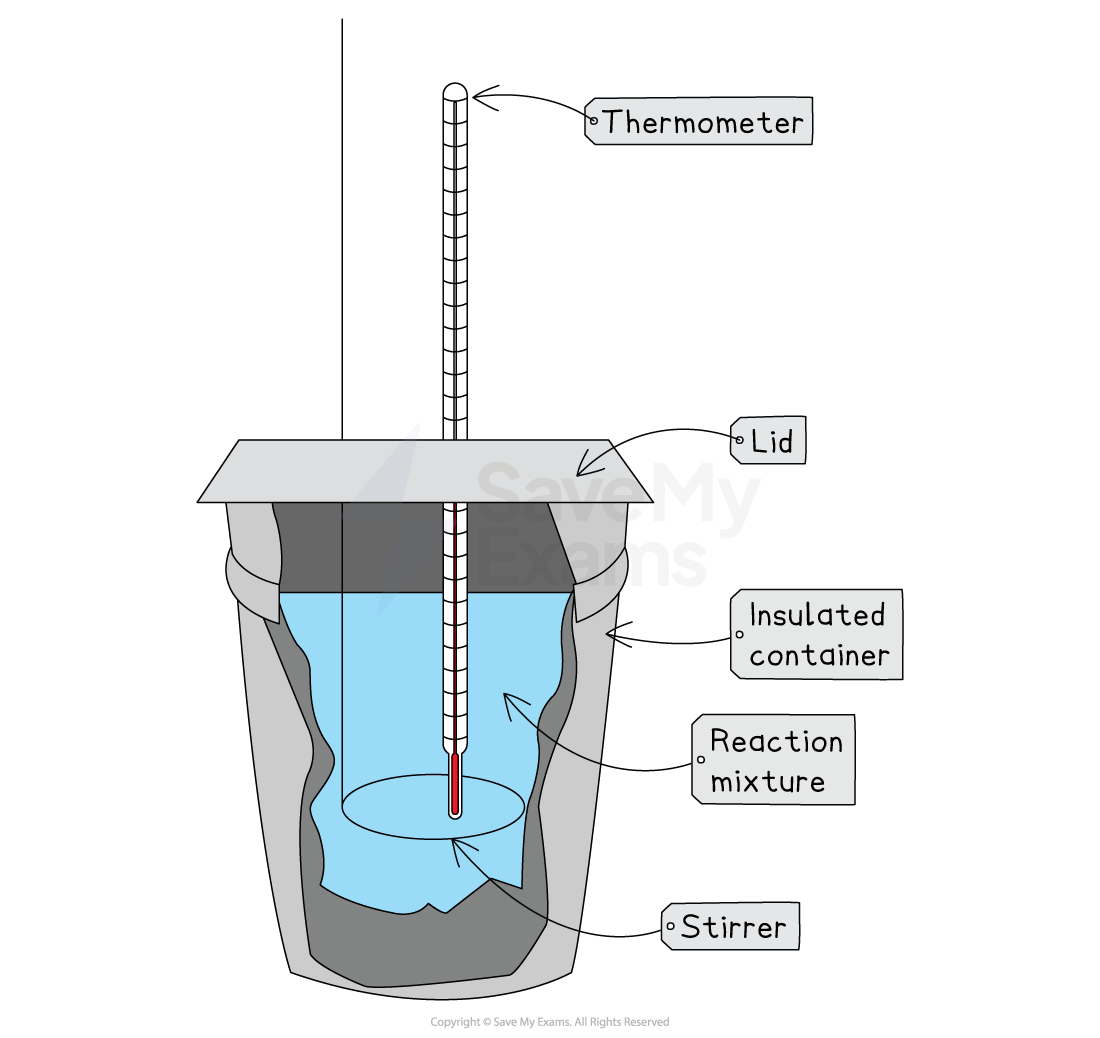
A lid is required to prevent heat loss
The same simple calorimeter can be used to investigate temperature changes in different processes
Use an insulated container with a lid to reduce heat transfer to the surroundings.
Measure the initial temperature before the substances are mixed.
Measure the highest or lowest temperature reached after mixing.
A temperature increase indicates an exothermic process.
A temperature decrease indicates an endothermic process.
Example 1: Neutralisation reactions - Hydrochloric Acid and Sodium Hydroxide
Aim:
To perform a calorimetry study of the neutralisation reaction between HCl and NaOH
Apparatus:
Dilute hydrochloric acid
Dilute sodium hydroxide solution
Simple calorimeter shown above
25 cm3 measuring cylinder
Thermometer & stirrer
Method:
Using a measuring cylinder, place 25 cm3 of the NaOH solution into the calorimeter
Measure and record the temperature of the solution
Add 5 cm3 of the dilute HCl and stir
Measure and record the highest temperature reached by the mixture
Repeat steps 1 – 4 increasing the amount of acid added by 5 cm3 each time
Results:
Record your results in a suitable table
Volume of acid (cm3) | Highest Temperature (oC) |
|---|---|
5 |
|
10 |
|
15 |
|
20 |
|
25 |
|
Plot a graph of the results
Draw a line of best fit
Use the graph to determine which volume of acid produces the greatest temperature change
Conclusion:
Compare the initial temperature with the highest temperature reached
A temperature increase shows that energy has been transferred to the surroundings
The neutralisation reaction is therefore exothermic
Example 2: Displacement reactions - Iron and Copper(II) Sulfate
The same simple calorimeter setup can also be used to investigate the temperature change during a displacement reaction
Only the chemicals being investigated are changed
Aim:
To investigate the temperature change when iron reacts with copper(II) sulfate solution
Apparatus:
Copper(II) sulfate solution
Iron powder or iron filings
Simple calorimeter shown above
25 cm3 measuring cylinder
Balance
Thermometer & stirrer
Method:
Place 25 cm3 of copper(II) sulfate solution into the insulated container
Measure and record the initial temperature of the solution
Add a measured mass of iron and stir
Measure and record the highest temperature reached
Repeat the experiment using different measured masses of iron
Results:
Record your results in a suitable table
Mass of iron (g) | Temperature change (oC) |
|---|---|
5 | |
7 | |
9 | |
11 |
Compare the temperature changes obtained
Identify which quantity of iron produces the greatest temperature change
Conclusion:
A rise in temperature shows that energy has been transferred to the surroundings
The displacement reaction between iron and copper(II) sulfate is therefore exothermic
Example 3: Salts dissolving in water — Ammonium Nitrate in Water
The same simple calorimeter setup can also be used to investigate the temperature change when a substance dissolves
Aim:
To investigate the temperature change when ammonium nitrate dissolves in water
Apparatus:
Water
Ammonium nitrate
Simple calorimeter shown above
25 cm3 measuring cylinder
Balance
Thermometer & stirrer
Method:
Place 25 cm3 of water into the insulated container
Measure and record the initial temperature of the water
Add a measured mass of ammonium nitrate
Stir until the ammonium nitrate has dissolved
Measure and record the lowest temperature reached
Repeat the experiment using different measured masses of ammonium nitrate
Results:
Record your results in a suitable table
Mass of ammonium nitrate (g) | Temperature change (oC) |
|---|---|
5 | |
7 | |
9 | |
11 |
Identify which mass of ammonium nitrate produces the greatest temperature change
Conclusion:
A fall in temperature shows that energy has been absorbed from the surroundings
Dissolving ammonium nitrate in water is therefore endothermic
Examiner Tips and Tricks
If the temperature increases, energy has been transferred to the surroundings → exothermic
If the temperature decreases, energy has been transferred from the surroundings → endothermic
The size of the temperature change can be used to compare the energy changes under similar experimental conditions

Unlock more, it's free!
Join the 100,000+ Students that ❤️ Save My Exams
the (exam) results speak for themselves:

Was this revision note helpful?
Build on this topic