11 mark
Butanoic acid may be prepared by the acid hydrolysis of
butyl ethanoate
1-chlorobutane
ethyl butanoate
propanenitrile
Was this exam question helpful?
Exam code: YCH11
Butanoic acid may be prepared by the acid hydrolysis of
butyl ethanoate
1-chlorobutane
ethyl butanoate
propanenitrile
Was this exam question helpful?
Compound X, C4H10O, is oxidised to form compound Y.
Compound Y reacts with ethanol in the presence of concentrated sulfuric acid to give an ester, Z.
Which of these could be the formula of Z?
CH3COOC(CH3)3
CH3CH2COO(CH2)3CH3
(CH3)2CHCOOCH2CH3
CH3CH2COOCH2CH(CH3)2
Was this exam question helpful?
Terylene is a polyester derived from ethane-1,2-diol and terephthalic acid.

What is the structure of the repeat unit of terylene?

Was this exam question helpful?
Propyl ethanoate, CH3COOCH2CH2CH3, is hydrolysed with aqueous sodium hydroxide.
Which products are formed?
CH3COOH and CH3CH2CH2OH
CH3COOH and CH3CH2CH2ONa
CH3COONa and CH3CH2CH2OH
CH3COONa and CH3CH2CH2ONa
Was this exam question helpful?
Which of these compounds is a product of the hydrolysis of CH3COOC3H7 by refluxing with aqueous sodium hydroxide?
CH3OH
C3H7OH
C3H7COOH
C3H7COO–Na+
Was this exam question helpful?
The formation of esters and the hydrolysis of esters are reactions that are slow under normal laboratory conditions.
What speeds up these reactions?
|
| Esterification | Hydrolysis |
☐ | A | acids only | acids only |
☐ | B | acids only | acids and bases |
☐ | C | bases only | bases only |
☐ | D | bases only | acids and bases |
Was this exam question helpful?
2.95 g of ethanoic acid is produced from 2.50 g of ethanol.
What is the percentage yield of ethanoic acid?
[Molar masses in g mol−1: ethanoic acid = 60 ethanol = 46]
65.0 %
84.7 %
90.5 %
118 %
Was this exam question helpful?
Ethanoyl chloride (CH3COCl) reacts with ethanol at room temperature.
What is the organic product of this reaction?
ethanoic acid
ethanol
ethoxyethane
ethyl ethanoate
Was this exam question helpful?
The concentration of reactant A was monitored against time during a reaction. The results are shown below.
![Graph showing a linear decrease in concentration [A] in mol dm⁻³ over time t in seconds, from 1.0 at 0s to 0.0 at 100s.](https://cdn.savemyexams.com/cdn-cgi/image/f=auto,width=3840/https://cdn.savemyexams.com/uploads/2026/05/31190-linear-decrease-in-concentration-a-in-mol-dm-cubed-over-time.png)
What is the order of the reaction with respect to A?
First order
Second order
Third order
Zero order
Was this exam question helpful?
The Arrhenius plot of ln k against 1/T for a reaction is shown.
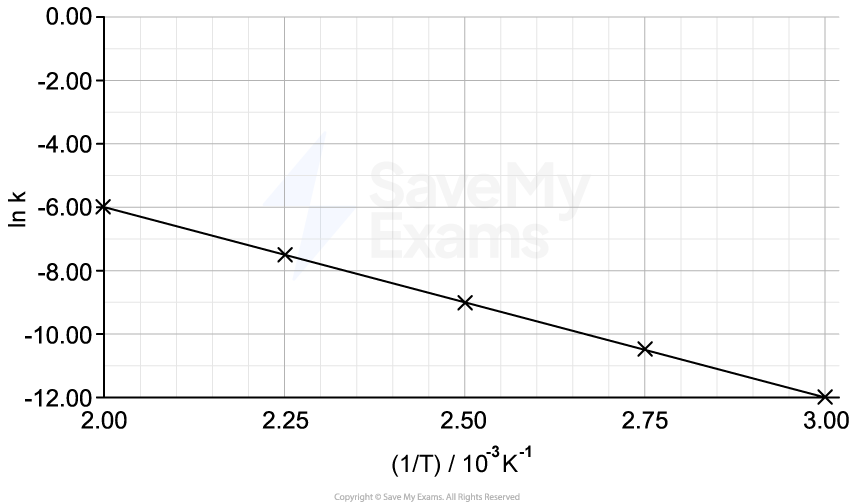
The gradient of the line is −6005 K.
[Gas constant R = 8.31 J K⁻¹ mol⁻¹]
Calculate the activation energy of this reaction.
−49.9 kJ mol⁻¹
49.9 kJ mol⁻¹
722 kJ mol⁻¹
4.99 × 10⁴ kJ mol⁻¹
Was this exam question helpful?
The substance known as PHBV is a biodegradable polymer formed from 3-hydroxybutanoic acid and 3-hydroxypentanoic acid.

Which of these is the repeat unit of the polymer?

What reaction occurs when PHBV biodegrades to its monomers?
condensation
hydrolysis
hydration
hydrogenation
Was this exam question helpful?