Elements, Compounds & Mixtures (Cambridge (CIE) O Level Chemistry): Theory Questions

Exam code: 5070

26 mins5 questions
1a
5 marks

Substances can be classified as:

elements    mixtures     compounds 

Elements can be divided into:

metals       non-metals

Define each of the following terms.

i) element

[2] 

ii) compound

  [2] 

iii)  mixture 

[1] 

1b
3 marks

Classify each of the following as either an element, compound or mixture.

i) brass .................................................................................................................... 

[1] 

ii) carbon dioxide ..................................................................................................... 

[1] 

iii) copper .................................................................................................................. 

[1] 

1c
1 mark

Which physical property is used to distinguish between metals and non-metals?

It is possessed by all metals but by only one non-metal.

2a
1 mark

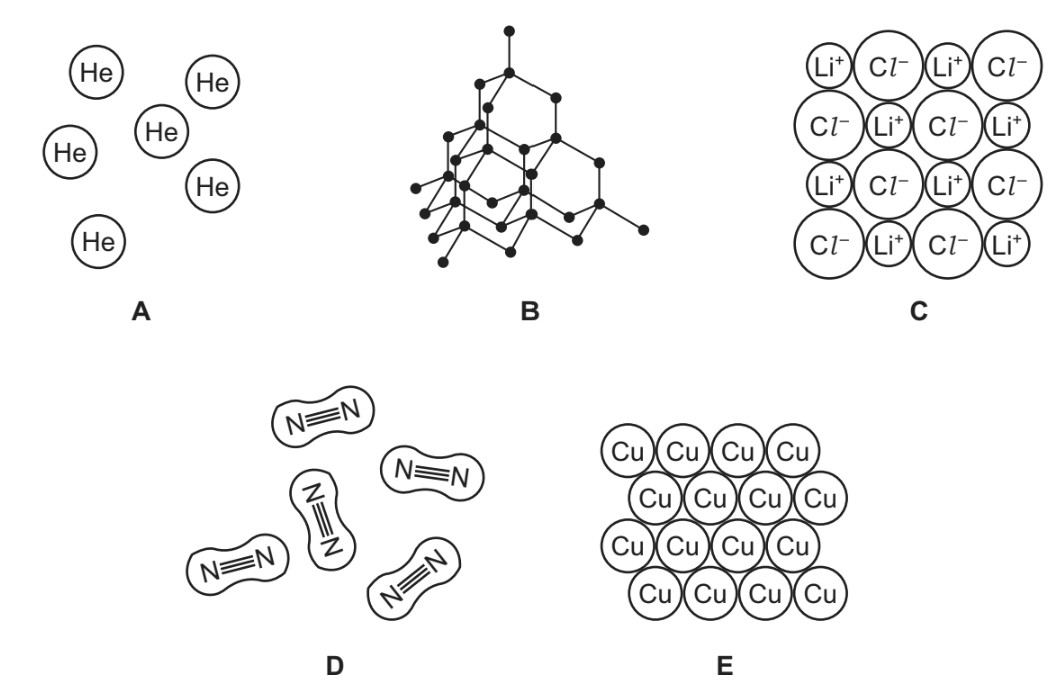
The diagrams show part of the structures of five substances, A, B, C, D and E.

Five labelled diagrams, A to E. A shows six separate circles, each labelled He. B shows a three-dimensional network of filled dots joined by straight lines, with some lines projecting outwards from the network. C shows a four by four block of touching circles labelled alternately Li with a plus sign and Cl with a minus sign. D shows five separate rounded outlines, each containing two N labels joined by a triple line. E shows a block of touching circles all labelled Cu.

Answer the following questions about these structures.

Each structure may be used once, more than once or not at all.

Which one of these structures, A, B, C, D or E, is a compound?

2b
1 mark

Substance B is an element.

What is meant by the term element ?

2c
1 mark

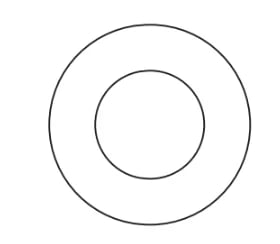
Complete the diagram to show the electron arrangement in an oxygen atom.

Two concentric circles, drawn empty. No nucleus is marked and no electrons are shown.
2d
4 marks

Complete the table to show the number of electrons, protons and neutrons in the sulfur atom and copper ion shown.


number of
electrons

number of
neutrons

number of
protons

S1634


Cu2+2963


29

1a
2 marks

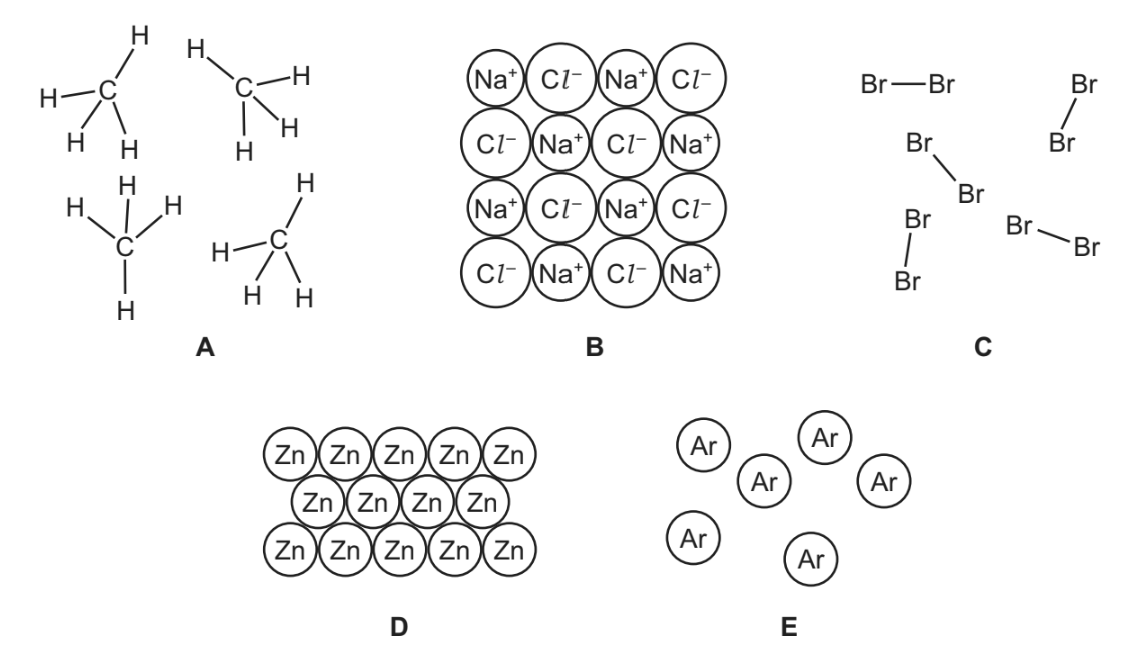
The diagram shows part of the structures of five substances, A, B, C, D and E.

Five labelled diagrams, A to E. A shows four separate displayed structures, each a central C joined by single lines to four H. B shows a four by four block of touching circles labelled alternately Na with a plus sign and Cl with a minus sign. C shows six separate pairs of Br labels, each pair joined by a single line. D shows a block of touching circles all labelled Zn. E shows six separate circles, each labelled Ar.

Answer the following questions about these structures.

Each structure may be used once, more than once or not at all.

Which two of these structures, A, B, C, D or E, are compounds?

1b
2 marks

Substance E is present in air.

Air is a mixture of different gases.

Describe two characteristics of a mixture.

1c
4 marks

Complete the table to show the number of electrons, protons and neutrons in the sulfur atom and zinc ion shown.


number of electrons

number of neutrons

number of protons

S1636


Zn2+3067


30