Experimental Design (Cambridge (CIE) O Level Chemistry): Theory Questions

Exam code: 5070

3 hours41 questions
1a
1 mark

The names of some pieces of equipment are shown.

stopwatch   balance    thermometer   gas syringe   burette   pipette

For each question, name the piece of apparatus that would be used in each case.

Each piece of equipment can be used once, more than once or not at all. 

Name the piece of apparatus that would be used to measure the time taken for a white precipitate to form when barium chloride is added to sodium sulfate.

1b
1 mark

Name the piece of apparatus that would be used to determine whether the reaction between magnesium and hydrochloric acid is exothermic.

1c
1 mark

Name the piece of apparatus that would be used to measure the volume of carbon dioxide produced when marble chips are added to hydrochloric acid.

1d
1 mark

Name the piece of apparatus used to add hydrochloric acid to 25 cm3 of sodium hydroxide solution during a titration.

2a
1 mark

A student investigated the effect of temperature on the mass of sodium chloride that dissolves in 100 cm3 of water.

Name the piece of apparatus that would be used to measure the mass of sodium chloride.

2b
1 mark

A control variable is one which must be kept constant each time the investigation is repeated. 

Give one control variable in this investigation. 

The temperature of the water


The volume of water


The mass of sodium chloride


The beaker used 


2c
4 marks

Complete these sentences using the word from the list.

solution

saturated

solute

solvent

residue

filtrate

liquid

The salt is the .................................. because it dissolves in water. The water is the .................................. because it has the salt dissolved in it.

The mixture of salt and water is known as a ...................................

When no more salt can dissolve in water at a specific temperature, the solution has become..................................

2d
1 mark

The student used a thermometer to measure the temperature during their investigation.

Name a different piece of apparatus that would give the student a more precise reading. 

3a
1 mark

A student made copper sulfate crystals. 

The first two steps of their method are shown below. 

q6


Why should sulfuric acid be added in excess to copper carbonate?

3b
1 mark

The contents of the beaker in step 2 are separated using filtration. 

Identify the residue. 

Draw a circle around the correct answer.

 water copper carbonate copper(II) sulfate sulfuric acid

3c
1 mark

Identify the filtrate. 

Draw a circle around the correct answer.

water copper carbonate copper(II) sulfate sulfuric acid


3d
2 marks

Describe how you would obtain dry copper(II) sulfate crystals from the solution. 

4a
2 marks

A student investigates how the temperature of dilute hydrochloric acid affects how quickly a strip of magnesium disappears.

The student measures out 25 cm3 of the acid, records its temperature, adds the magnesium and times how long the magnesium takes to disappear.

Name the apparatus the student uses to measure:

i) the time taken for the magnesium to disappear

[1]

ii) the volume of the dilute hydrochloric acid.

[1]

4b
2 marks

Name the apparatus the student uses to measure:

i) the temperature of the acid

[1]

ii) the mass of the magnesium.

[1]

4c
1 mark

The student decides to follow the reaction by measuring the volume of gas given off, instead of timing how long the magnesium takes to disappear.

Name the apparatus the student uses to measure the volume of gas.

4d
2 marks

State the unit in which each of the following is measured.

i) time

[1]

ii) the volume of a gas

[1]

5a
2 marks

A student makes a solution of potassium nitrate.

The method is shown.

step 1

Take 5.0 g of solid potassium nitrate.

step 2

Add the solid to 100 cm3 of distilled water in a beaker and stir.

step 3

Transfer 25.0 cm3 of the solution into a conical flask.

step 4

Record the temperature of the solution in the flask.

Name the most suitable apparatus to use:

i) in step 1

[1]

ii) to measure the 100 cm3 of distilled water in step 2.

[1]

5b
2 marks

Name the most suitable apparatus to use:

i) in step 3

[1]

ii) in step 4.

[1]

5c
1 mark

State why the student stirs the mixture in step 2.

5d
2 marks

The apparatus the student used to measure the water in step 2 holds at most 100 cm3.

The student now needs to make a second solution using 250 cm3 of distilled water.

i) Name a piece of apparatus that would measure 250 cm3 of distilled water in a single measurement.

[1]

ii) The student instead measures the 250 cm3 with the apparatus used to measure the water in step 2, in three portions.

Suggest why this gives a less accurate volume than a single measurement with the apparatus named in i).

[1]

1a
1 mark

A student investigated the effect of temperature on the rate of reaction between sodium thiosulfate solution and dilute hydrochloric acid:

Na2S2O3 (aq) + 2HCl (aq)  → 2NaCl (aq) + S (s) + SO2 (g) + H2O (l)

The reaction between these two substances produces a precipitate which makes the mixture turn cloudy. 

A student timed how long it took until the cross could no longer be seen through the precipitate, shown in Figure 1.

They then calculated the rate of reaction and repeated the experiment at different temperatures. 

Figure 1 

c3oYktGM_disappearing-cross-experiment

Name the product that made the mixture go cloudy.

1b
2 marks

Suggest two control variables for the investigation that would ensure valid results are obtained.

1c
3 marks

Define the terms:

i) Solution 

[1]

ii) Solvent

[1]

iii) Solute 

[1]

1d
2 marks

From the products formed in part a) identify:

i) The solute

[1]

ii) The solvent 

[1]

2a
2 marks

Rock salt is a mixture of sand and salt. Salt dissolves in water while sand does not. 

A group of students separated rock salt. 

They used the following method.

  1. Add the rock salt to a beaker.

  2. Add 250 cm3 of water.

  3. Leave without disturbing to allow the sand to settle to the bottom.

  4. After a while, filter the salt water into an evaporating dish.

  5. Heat the evaporating dish with a Bunsen burner until salt crystals begin to form.

i) Suggest one improvement to step 2 that the students could have done to make sure all the salt is dissolved. 

[1]


ii) What name is given to the solution when no more salt can dissolve at this specific temperature? 

[1]

2b
2 marks

Identify the residue and filtrate in step 4. 

2c
1 mark

Suggest one safety precaution the students should take in step 5.

2d
2 marks

Another student separated water from salty water using the apparatus in the diagram below. 

saltwater-distillation-aqa-sq-1-1m-7d

 By referring to points 1 and 2 in the diagram, describe how this technique works.

2e
1 mark

Identify the residue in the experiment being carried out in part (d).

3a
4 marks

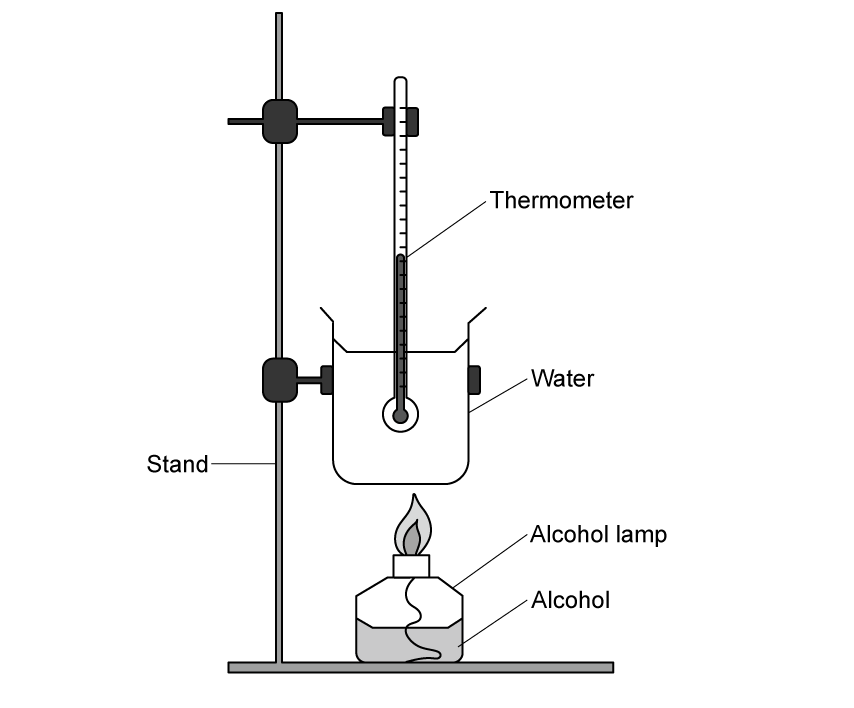
A student investigates the energy of reaction when different alcohols are burned. The alcohols belong to a homologous series.

The student uses the apparatus shown in Fig. 2.1

Clamp stand holding a thermometer vertically. The thermometer bulb is immersed in water inside a beaker. An alcohol lamp containing alcohol is placed beneath the beaker to heat the water.

Fig 2.1

The student does five experiments.

Experiment 1

  • Using a measuring cylinder, 10 cm3 of methanol, CH3OH, is placed into the spirit burner.

  • 100 cm3 of water is poured into a 250 cm3 beaker.

  • The initial temperature of the water is recorded.

  • The wick is lit and the alcohol is allowed to burn until it is all used up.

  • The final temperature of the water is recorded.

Experiment 2

  • Experiment 1 is repeated using ethanol, C2H5OH.

Experiments 3, 4 and 5

  • Experiment 1 is repeated using propanol (C3H7OH), butanol (C4H9OH) and pentanol (C5H11OH).

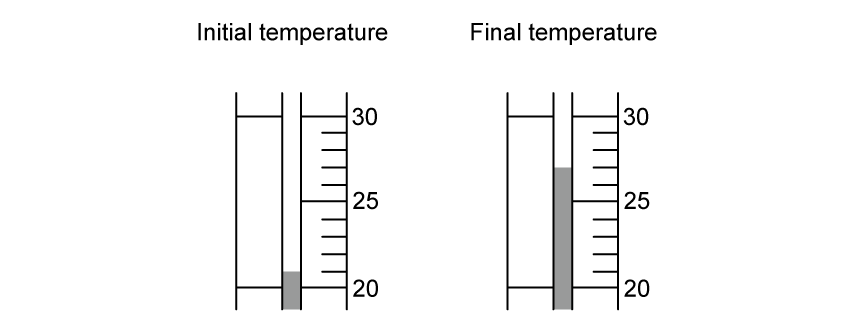
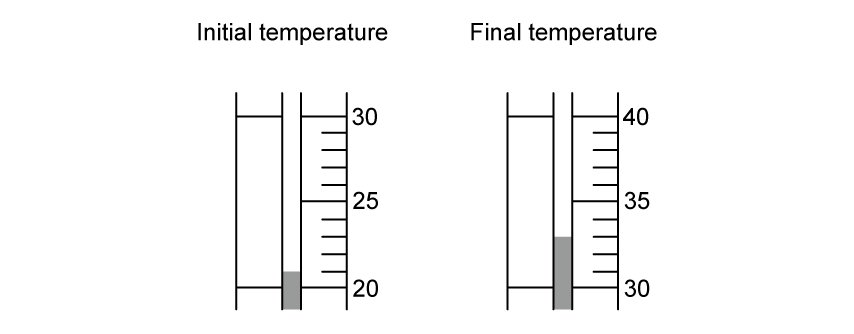
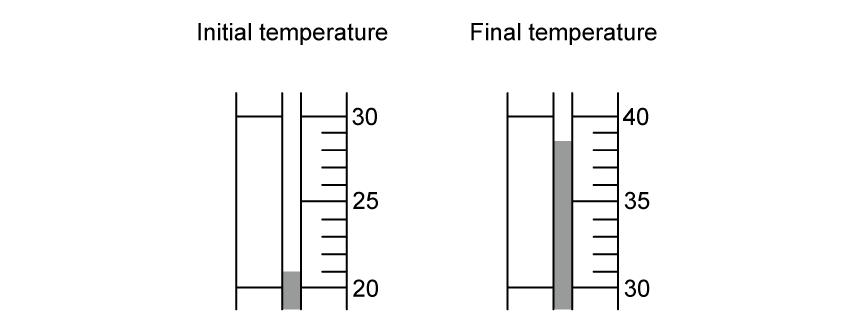
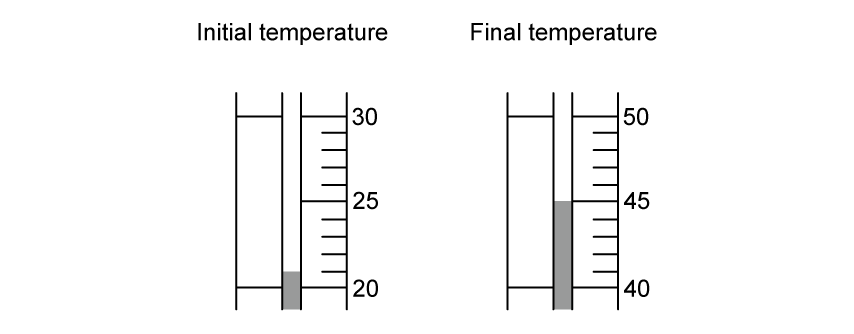
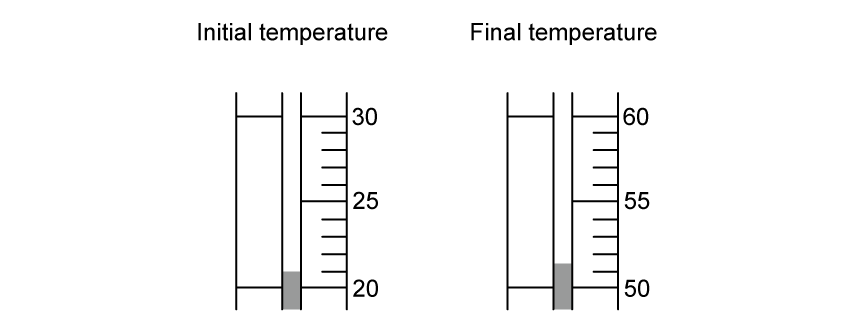
Use the thermometer diagrams for each experiment to complete Table 2.1.

Table 2.1

experiment

alcohol

number of Carbon Atoms

initial temperature / °C

final temperature / °C

temperature increase / °C

1

Methanol

1

21.0

27.0

6.0

2

Ethanol

2

3

Propanol

3

4

Butanol

4

5

Pentanol

5

Experiment 1

Two vertical thermometers show temperatures; the left reads 21°C (initial), the right reads 27°C (final), indicating a temperature increase.

Experiment 2

Two thermometers labelled "Initial temperature" at 21°C and "Final temperature" at 33°C, indicating an increase in temperature.

Experiment 3

Two thermometers showing temperatures; initial at 21 degrees, final at 38.5 degrees, indicating a temperature increase from left to right.

Experiment 4

Two thermometers showing temperature change: left at 21°C initial, right at 45°C final.

Experiment 5

Two thermometers showing temperatures; the first at 21°C labelled "Initial temperature", the second at 51.5°C labelled "Final temperature".
3b
5 marks

The student wants to study the relationship between the number of carbon atoms in the alcohol molecule and the energy released.

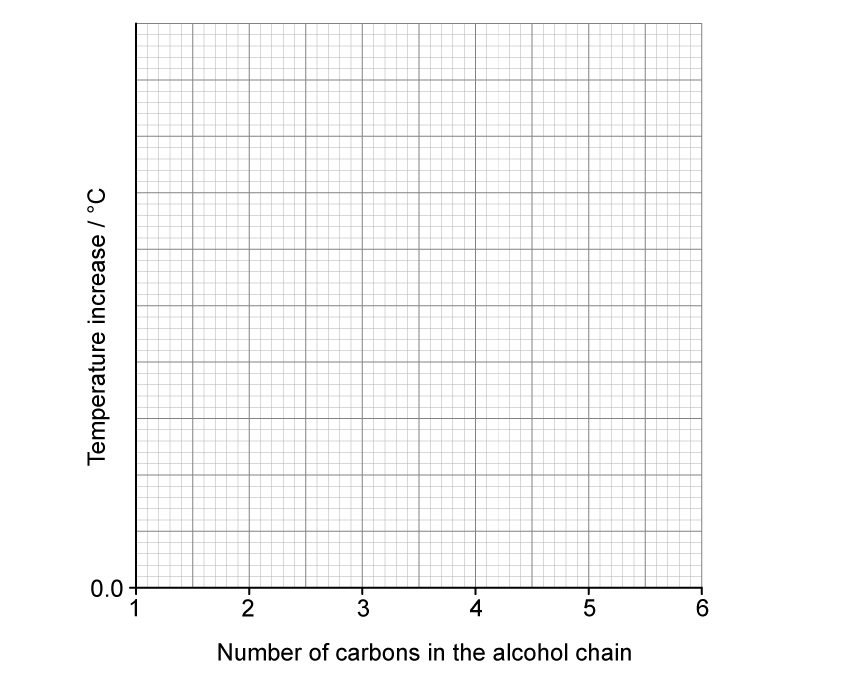
Plot the results from Experiments 1 to 5 on the grid in Fig 2.2. The x-axis is provided. Add a suitable scale for the y-axis. Draw a line of best fit that extends through all the grid.

Blank graph with labelled axes; the y-axis: "temperature increase/°C" and the x-axis: "number of carbons in the alcohol chain," numbered 1 to 6.

Fig 2.2

3c
2 marks

Use your graph to deduce the temperature increase expected if hexanol (6 carbon atoms) is used. Show clearly on the graph how you worked out your answer.

............. °C

3d
3 marks

Calculate the thermal energy, Q, absorbed by the water during the combustion of hexanol. Use your predicted temperature increase for hexanol from the graph in Fig 2.2.

Q = m c ∆T

where:

  • c = 4.2 J / g °C

  • m = 100 g (mass of water used)

  • ΔT is the temperature increase.

Include the unit for Q in your answer.

3e
1 mark

Describe the relationship between the number of carbon atoms in the alcohol molecule and the temperature change of the water.

3f
1 mark

Explain why the volume of alcohol used must be kept constant in all five experiments.

3g
2 marks

The student repeats the experiment but uses a pipette rather than a measuring cylinder to measure the volume of alcohol. Suggest how this change affects the accuracy of the results. Explain your answer.

3h
2 marks

The student’s calculated value for the energy released was much lower than the theoretical value found in a data book.

Suggest two reasons for this difference, other than student error in reading the thermometer.

4a
2 marks

A student needs to measure several different volumes of liquid during an investigation.

The student measures 100 cm3 of water by filling a beaker to the mark labelled 100 cm3 on its side.

Explain why this is not a suitable way to measure the volume.

4b
2 marks

Later in the investigation the student needs to add 25.0 cm3 of dilute acid to each of five conical flasks.

Name the most suitable piece of apparatus for this task.

Explain why it suits this task.

4c
2 marks

The student then needs to add exactly 37.5 cm3 of the dilute acid to a sixth flask, once only.

Name the most suitable piece of apparatus for this.

Explain your choice.

4d
1 mark

The beaker is still used to hold the reaction mixture during the investigation.

Suggest why a beaker is suitable for holding the mixture, even though it is not suitable for measuring a volume.

5a
2 marks

A student carries out three titrations, adding dilute acid from a burette to 25.0 cm3 of aqueous sodium hydroxide.

The burette readings are shown in Table 1.1.

Table 1.1

titration

initial reading / cm3

final reading / cm3

volume of acid added / cm3

1

0.0

23.5

2

1.4

24.9

3

0.6

24.1

Complete Table 1.1.

5b
2 marks

A second student records the volume of acid added in titration 2 as 24.9 cm3.

State the volume the second student should have recorded.

Explain the error that has been made.

5c
2 marks

When taking each burette reading, the student lowers their eye until it is level with the bottom of the curved liquid surface.

Explain why the reading is taken in this way.

5d
2 marks

Before filling the burette with the dilute acid, the student rinses the burette with a small volume of that acid.

i) Suggest why.

[1]

ii) State the effect on the recorded volume of acid if the burette were filled while still wet with distilled water.

[1]

1a
5 marks

A student investigated what happened when sodium thiosulfate dissolved in water.

Experiment 1

By using a measuring cylinder, 20 cm3 of distilled water was poured into a polystyrene cup. Use the thermometer diagram to record the temperature of the water in the table.

1 g of powdered sodium thiosulfate was added to the cup and the mixture stirred with a thermometer. Use the thermometer diagram to record the temperature of the solution.

Experiment 2

Experiment 1 was repeated using 2 g of powdered sodium thiosulfate. Record the temperature in the table.

Experiments 3, 4 and 5

Experiment 1 was repeated using 3 g, 4 g and 5 g of powdered sodium thiosulfate respectively. Record the temperatures in the table.

5-1-q2a
1b
1 mark

What type of chemical reaction occurs when sodium thiosulfate dissolves in water?

1c
2 marks

Explain how the temperature changes would differ in the experiments if 40 cm3 of water were used.

1d
1 mark

Suggest one change you could make to the apparatus used in the experiments to obtain more accurate results.

2a
3 marks

A student investigates the temperature rise when aqueous sodium hydroxide is neutralised by dilute hydrochloric acid.

The method is shown.

step 1

Measure 25.0 cm3 of aqueous sodium hydroxide into a polystyrene cup.

step 2

Record the temperature of the aqueous sodium hydroxide.

step 3

Add 25.0 cm3 of dilute hydrochloric acid, stir and record the highest temperature reached.

step 4

Rinse the cup with about 100 cm3 of distilled water before the next experiment.

Name the most suitable apparatus for:

i) step 1

[1]

ii) step 2

[1]

iii) the rinsing in step 4.

[1]

2b
2 marks

A second student suggests measuring the water for the rinsing in step 4 more closely than the apparatus named in part (a)(iii) allows.

Explain why this would not improve the investigation.

2c
2 marks

In the method, one volume is written as 25.0 cm3 and another is written as about 100 cm3.

Explain what the way each of these volumes is written tells the student about how it should be measured.

2d
1 mark

The method gives a volume of water for the rinsing in step 4.

Suggest why it does so.

3a
1 mark

A volumetric pipette is always filled to the same level, whatever liquid it is used with.

Name the feature of a volumetric pipette that fixes the volume it delivers.

3b
2 marks

Explain why a volumetric pipette can accurately deliver only one volume.

3c
2 marks

A student has a 25 cm3 volumetric pipette and a 50 cm3 burette.

The student needs to deliver 15.0 cm3 of a solution accurately.

State which piece of apparatus the student should use.

Explain your choice.

3d
2 marks

A burette has to be read twice to find the volume of liquid it has delivered.

A volumetric pipette needs no reading to find the volume it has delivered.

Explain why.

4a
1 mark

A student carries out a rough titration, which is not shown, followed by four accurate titrations.

The volumes of acid added are shown in Table 2.1.

Table 2.1

titration

1

2

3

4

volume of acid added / cm3

24.60

24.65

23.85

24.60

Results are concordant when they lie within 0.10 cm3 of each other.

State which titrations gave concordant results.

4b
2 marks

Calculate the mean volume of acid added.

Make clear which values you have used.

4c
2 marks

Another student says that titration results are concordant when they are the same.

Explain why this is not an adequate statement.

4d
2 marks

Explain why including a discordant result in the mean would make the result less reliable, rather than more reliable.

5a
2 marks

Two students investigate the same reaction.

Acidified aqueous potassium manganate(VII) is mixed with a solution that reacts with it, and the purple colour slowly disappears.

Each student uses a stop-watch to time how long the purple colour takes to disappear.

Explain why the stop-watch must be started at the moment the two solutions are mixed, rather than when the student has finished stirring them.

5b
2 marks

The two students record different times for the same reaction.

Suggest two reasons why.

5c
2 marks

The two students decide to take the mean of their two times.

Explain why taking the mean does not necessarily give a more accurate value.

5d
2 marks

One of the stop-watches displays the time to the nearest 0.01 s.

The other displays the time to the nearest 1 s.

Explain why the student using the first stop-watch does not necessarily obtain a more accurate time.