Exothermic & Endothermic Reactions (Cambridge (CIE) O Level Chemistry): Theory Questions

Exam code: 5070

4 hours41 questions
1a
2 marks

The following are two examples of substitution reactions. Only the reaction involving chlorine is a photochemical reaction.


CH4 + Cl2 → CH3Cl + HCl


CH4 + Br2 → CH3Br + HBr


i) Explain the phrase substitution reaction. 

[1]


ii) How do photochemical reactions differ from other reactions? 

[1]

1b
2 marks

Bond forming is exothermic, bond breaking is endothermic.

Explain the difference between an exothermic reaction and an endothermic reaction. 

1c
4 marks

Use the bond energies to show that the following reaction is exothermic.

Bond energy is the amount of energy (kJ / mol) which must be supplied to break one mole of the bond.

7-1-displayed-chlorination-of-methane-m5c-

Bond

Bond energy in kJ / mol

Cl-Cl

+242

C-Cl

+338

C-H

+412

H-Cl

+431

2a
3 marks

Fuel cells are used in spacecraft to produce electrical energy.

7-2-fuel-cell-m8a-

Hydrogen and oxygen react to form water.

 2H2 + O2 → 2H2O


i) Give an example of bond breaking in the above reaction. 

[1]


ii) Give an example of bond forming in the above reaction. 

[1]


iii) Is the change given in (i) exothermic or endothermic? 

[1]

2b
3 marks

i) Give two reasons why hydrogen may be considered to be the ideal fuel for the future. 

[2]


ii) Suggest a reason why hydrogen is not widely used at the moment. 

[1]

3a
4 marks

Acids have characteristic properties.

Hydrochloric acid reacts with magnesium.

Name the products of this reaction and give the observations.

3b
3 marks

Hydrogen and chlorine react to form hydrogen chloride gas, as shown in the equation.

H2 + Cl2 → 2HCl 

This equation can be represented as shown.

H−H + Cl−Cl →2H−Cl

Some bond energies are shown in the table.

bond

bond energy in kJ/mol

H–H

436

Cl–Cl

243

H–Cl

432

Calculate the energy change for the reaction between hydrogen and chlorine, using the following steps.

  • Calculate the energy needed to break the bonds.

  • Calculate the energy released when bonds are formed.

  • Calculate the energy change for the reaction.

4a
2 marks

Bromine reacts with hydrogen sulfide, H2S.

Complete the chemical equation for this reaction.

....... + H2S →  ......HBr  +  S

4b
1 mark

The energy level diagram for this reaction is shown.

q4dii-0620_s19_qp_32

Explain how this diagram shows that the reaction is exothermic.

5a
1 mark

The reaction of iron(II) carbonate with hydrochloric acid is exothermic.
What is meant by the term exothermic?

5b
2 marks

Rust contains compounds of iron.
State two conditions needed for iron to rust.

1a
4 marks

Propane reacts with chlorine to form a mixture of chloropropanes. This is a photochemical reaction.


i) What is meant by the phrase photochemical reaction?


[1]


ii) The products of this reaction include two isomers, one of which has the following structural formula.

1-chloropropane


Draw the structural formula of the other isomer.

 [1]


iii) Explain why these two different compounds are isomers. 

[2]

1b
3 marks

Bond breaking is an endothermic change and bond forming is an exothermic change.

Bond energy is the amount of energy in kJ / mol needed to break one mole of the specified bond. 

7-1-displayed-reaction-of-chlorpropane-m2b-

 Use the following bond energies to determine whether this reaction is exothermic or endothermic. You must show your reasoning.

bond

bond energies in kJ / mol

C-Cl

338

C-H

412

Cl-Cl

242

H-Cl

431

C-C

348

1c
5 marks

i) Chloropropane can be hydrolysed to propanol, CH3CH2CH2OH, by sodium hydroxide.

 Write the equation for this reaction. 

[2]


ii) Propanol can be dehydrated. It loses a water molecule to form a hydrocarbon. 

Give the name and structural formula of this hydrocarbon.


name ................................................. 

structural formula 

[2]


iii) Propanol is oxidised to a carboxylic acid by acidified potassium manganate(VII). 

Deduce the name of this acid. 

[1]

1d
5 marks

Propanol reacts with methanoic acid to form the ester propyl methanoate. 

CH3CH2CH2OH + HCOOH → HCOOCH2CH2CH3 + H2O

 4.0 g of methanoic acid was reacted with 6.0 g of propanol.

i) Calculate the Mr of methanoic acid = ........................................

 [1]

ii) Calculate the Mr of propanol = ........................................ 

[1]


iii) Determine which one is the limiting reagent. Show your reasoning. 

[2]


iv) Calculate the maximum yield in grams of propyl methanoate, Mr = 88. 

[1]

2a
2 marks

Iodine reacts with chlorine to form dark brown iodine monochloride.

I2 + Cl2 → 2ICl

This reacts with more chlorine to give yellow iodine trichloride.

An equilibrium forms between these iodine chlorides.

ICl (l) + 

Cl2 (g) ⇌ 

ICl3 (s)

dark brown


yellow

 What do you understand by the term equilibrium?

2b
1 mark

When the equilibrium mixture is heated, it becomes a darker brown colour.

Suggest if the reverse reaction is endothermic or exothermic. Give a reason for your choice.

2c
2 marks

The pressure on the equilibrium mixture is decreased.


i) How would this affect the position of equilibrium? Give a reason for your choice.

 It would move to the ................................................

 reason ................................................ 

[1]


ii) Describe what you would observe. 

[1]

2d
3 marks

Calculate the overall energy change for the reaction between iodine and chlorine using the bond energy values shown.


I2 + Cl2 → 2ICl


Bond 

Energy / kJ per mol

I–I

151

Cl–Cl

242

I–Cl

208

 Show your working.

2e
2 marks

Draw a labelled energy level diagram for the reaction between iodine and chlorine using the information in (d).

3a
3 marks

The first three elements in Period 6 of the Periodic Table of the Elements are caesium, barium and lanthanum.

How many more protons, electrons and neutrons are there in one atom of lanthanum than in one atom of caesium. Use your copy of the Periodic Table of the Elements to help you.

number of protons ................................................

number of electrons ................................................

number of neutrons ................................................

3b
4 marks

All three metals can be obtained by the electrolysis of a molten halide. The electrolysis of the aqueous halides does not produce the metal.


i) Complete the equation for the reduction of lanthanum ions at the negative electrode (cathode).


La3+ + ................ → ................


ii) Name the three products formed by the electrolysis of aqueous caesium bromide. 

3c
2 marks

All three metals react with cold water. Complete the word equation for these reactions.

 metal + water → ................................. + .............................

3d
2 marks

Barium chloride is an ionic compound. Draw a diagram that shows the formula of the compound, the charges on the ions and gives the arrangement of the valency electrons around the negative ion.

The electron distribution of a barium atom is 2.8.18.18.8.2

Use x to represent an electron from a barium atom. Use o to represent an electron from a chlorine atom.

3e
2 marks

Describe, by means of a simple diagram, the lattice structure of an ionic compound, such as caesium chloride.

3f
4 marks

The reactions of these metals with oxygen are exothermic.

 2Ba (s) + O2 (g) → 2BaO (s)

 i) Give an example of bond forming in this reaction.

[1]

 ii) Explain using the idea of bond breaking and forming why this reaction is exothermic. 

[3] 

4a
1 mark

Thermal energy is released to the surroundings when hydrogen is burnt.

State the name of the type of reaction which transfers heat to the surroundings.

4b
3 marks

The structures of the reactants and products of this reaction are shown.

q6bii-0620-s20-qp-42

Some bond energies are shown in the table.

bond

bond energy in kJ/mol

C–C

347

C=C

612

C–H

413

C–Cl

339

Cl–Cl

242

Calculate the energy change for the reaction between propene and chlorine using the following steps.

  •  Calculate the energy needed to break the bonds.

  •  Calculate the energy released when bonds are formed.

  •  Calculate the energy change for the reaction between propene and chlorine.

4c
3 marks

Ammonia, NH3, is used to produce nitric acid, HNO3. This happens in a three-stage process.

The reaction in stage 3 is exothermic.

4NO2 + 2H2O + O2 → 4HNO3

Complete the energy level diagram for this reaction. Include an arrow that clearly shows the energy change during the reaction.

4408c8cf-15a4-44cc-8a9b-a20ae8be3d12
5a
2 marks

Iodine reacts with aqueous sodium thiosulfate, Na2S2O3.

Balance the chemical equation for this reaction.

.....Na2S2O3 + I2→ Na2S4O6 + .....NaI

5b
1 mark

The energy level diagram for this reaction is shown. 

q4dii-0620_s19_qp_31

Explain how this diagram shows that the reaction is exothermic.

5c
1 mark

Heat is given out when iron reacts with sulfuric acid.

What term describes a reaction which gives out heat?

6a
1 mark

The reaction of iron(II) carbonate with hydrochloric acid is exothermic.

What is meant by the term exothermic?

6b
3 marks

The reaction between ethanoic acid and ethanol is exothermic. Draw an energy level diagram for this reaction. On your diagram label:

  • the reactants and products

  • the energy change of the reaction, ∆H.

q5b-0620_s19_qp_43
7a
4 marks

A mixture of ethanoic acid, ethene and oxygen is passed over a catalyst at 200 °C to manufacture ethenyl ethanoate, CH3COOCH=CH2.

CH3COOH + CH2=CH2 + ½O2 → CH3COOCH=CH2 + H2O

The reaction is exothermic.

Draw a reaction pathway diagram for this reaction on Fig. 7.1.

On your diagram label:

  • the axes

  • the reactants and products

  • the enthalpy change of the reaction, ∆H

  • the activation energy, Ea.

q6a-cie-o-level-chemistry-specimen-2023-paper-2

Fig. 7.1

7b
2 marks

Explain why the enthalpy change of the reaction is exothermic.

Use ideas about bond breaking and bond making.

1a
3 marks

Period 3 contains the elements sodium to argon. This question asks about the chemistry of each of the Period 3 elements or their compounds.

Sodium nitrate is a white crystalline solid. When heated it melts and the following reaction occurs.

2NaNO3 (l) → 2NaNO2 (l) + O2 (g)

A 3.40 g sample of sodium nitrate is heated.

Calculate the

• number of moles of NaNO3 used,

.................................. mol

• number of moles of O2 formed,

.................................. mol

• volume of O2 formed, in dm3 (measured at r.t.p.).

.................................. dm3

1b
3 marks

Magnesium reacts slowly with warm water to form a base, magnesium hydroxide.

 i) Explain what is meant by the term base. 

[1]

 ii) Write a chemical equation for the reaction between magnesium and warm water. 

[2]

1c
3 marks

Aluminium oxide is amphoteric. It is insoluble in water.

Describe experiments to show that aluminium oxide is amphoteric.

1d
3 marks

Silicon(IV) oxide has a giant structure.


i) Name the type of bonding in silicon(IV) oxide. 

[1]


ii) Give two physical properties of silicon(IV) oxide. 

[2]

1e
3 marks

Calcium phosphate is used in fertilisers. The bonding in calcium phosphate is ionic. Calcium phosphate contains the phosphate ion, PO43–.

 i) What is ionic bonding? 

[2]


ii) Deduce the formula of calcium phosphate. 

[1]

1f
6 marks

Sulfur tetrafluoride, SF4, can be made by combining gaseous sulfur with fluorine.

 S (g) + 2F2 (g) → SF4 (g)

 The reaction is exothermic.


i) Complete the energy level diagram for this reaction. Include an arrow which clearly shows the energy change during the reaction.


7-1-chemical-energetics-m1f-energy-profile


[3]


ii) During the reaction the amount of energy given out is 780 kJ / mol. 

The F–F bond energy is 160 kJ / mol. 

Use this information to determine the bond energy, in kJ / mol, of one S–F bond in SF4. 

7-1-chemical-energetics-m1f-bonds

.................................. kJ / mol [3]

1g
4 marks

Chlorine and compounds of chlorine are important in water treatment and in laboratory testing for water.

 i) Chlorine is added to water to make the water safe to drink.

 Explain why adding chlorine makes water safe to drink.


[1]


ii) A compound of chlorine is used in the laboratory to test for the presence of water.

 Name the compound of chlorine used in this test and describe the colour change seen in a positive result of this test.

 name of compound ..................................................

 colour change from .............................. to .............................. 

[3]

1h
1 mark

Argon is an unreactive noble gas.

Explain why argon is unreactive.

2a
5 marks

Chemical reactions are always accompanied by an energy change.

Aluminium is extracted by the electrolysis of a molten mixture which contains aluminium oxide, Al2O3. This decomposes to form aluminium at the negative electrode and oxygen at the positive electrode.


i) Write an ionic equation for the reaction at the negative electrode. 

[2]


ii) Complete the ionic equation for the reaction at the positive electrode. 

2O2– → ....... + ....... 

[2]


iii) Is the reaction exothermic or endothermic? Explain your answer. 

[1]

2b
5 marks

The cell shown below can be used to determine the order of reactivity of metals. 

mgso4-cuso4-electrochemical-cell


i) Is the reaction in the cell exothermic or endothermic? Explain your answer. 

[1]


ii) Explain why the mass of the magnesium electrode decreases and the mass of the copper electrode increases. 

[2]


iii) How could you use this cell to determine which is the more reactive metal, magnesium or manganese? 

[2] 

2c
2 marks

The combustion of propane, C3H8, is exothermic.

Give an equation for the complete combustion of propane.

2d
2 marks

Photosynthesis is an unusual endothermic reaction.

 i) Where does the energy for photosynthesis come from? 

[1]


ii) Give the word equation for photosynthesis. 

[1]

3a
3 marks

The balanced equation for the combustion of ethene is

C2H4 (g) + 3O2 (g) → 2CO2 (g) + 2H2O (l)

Bond

Bond energy (kJ / mol) 

C=C

614

C-H

414

O-H

463

C=O

804

O=O

498

Use the information in the table to calculate the following:

i) Energy required to break the bonds

[1]

ii) Energy released when bonds are made

[1]

iii) Energy change for the reaction

[1]

3b
3 marks

Complete the reaction pathway diagram for the reaction in part (a). Include an arrow which clearly shows the energy change during the reaction.

5-1-4b-h-energy-level-diagram
3c
5 marks

The forward reaction for the production of ethanol from ethene is shown below.

 C2H4 (g) + H2O (g) ⇌ CH3CH2OH (g)   ∆H = -45 kJ / mol

 In terms of temperature and pressure, explain which conditions would give an economically viable yield. 

4a
4 marks

The table below has some enthalpy data for a different chemical reaction. Hydrazine, N2H4 can react with hydrogen peroxide in an exothermic reaction, as shown below.

N2H4 + 2H2O2 → N2 + 4H2O ΔH = -789 kJ / mol

Bond

Bond Energy kJ / mol

N-N

+158

N≡N

+945

O-H

+463

O-O

+144

The structures of the reactants and products are shown.

5-1-5a-h-hydrazine-reaction-figure-5-1

Using the reaction equation and the data in the table above, calculate the value of the N-H bond in hydrazine.

4b
3 marks

Draw a dot cross diagram for hydrazine. 

Use x to represent electrons from nitrogen atoms

Use o to represent electrons from hydrogen atoms

4c
4 marks

When nitrogen and oxygen are heated to very high temperatures, they combine to form nitrogen monoxide and a lot of heat is absorbed in this reaction. 

Complete the reaction pathway diagram to show the formation of nitrogen monoxide from nitrogen and oxygen.


5-1-5ch-energy-diagram-q5c-a
5a
2 marks

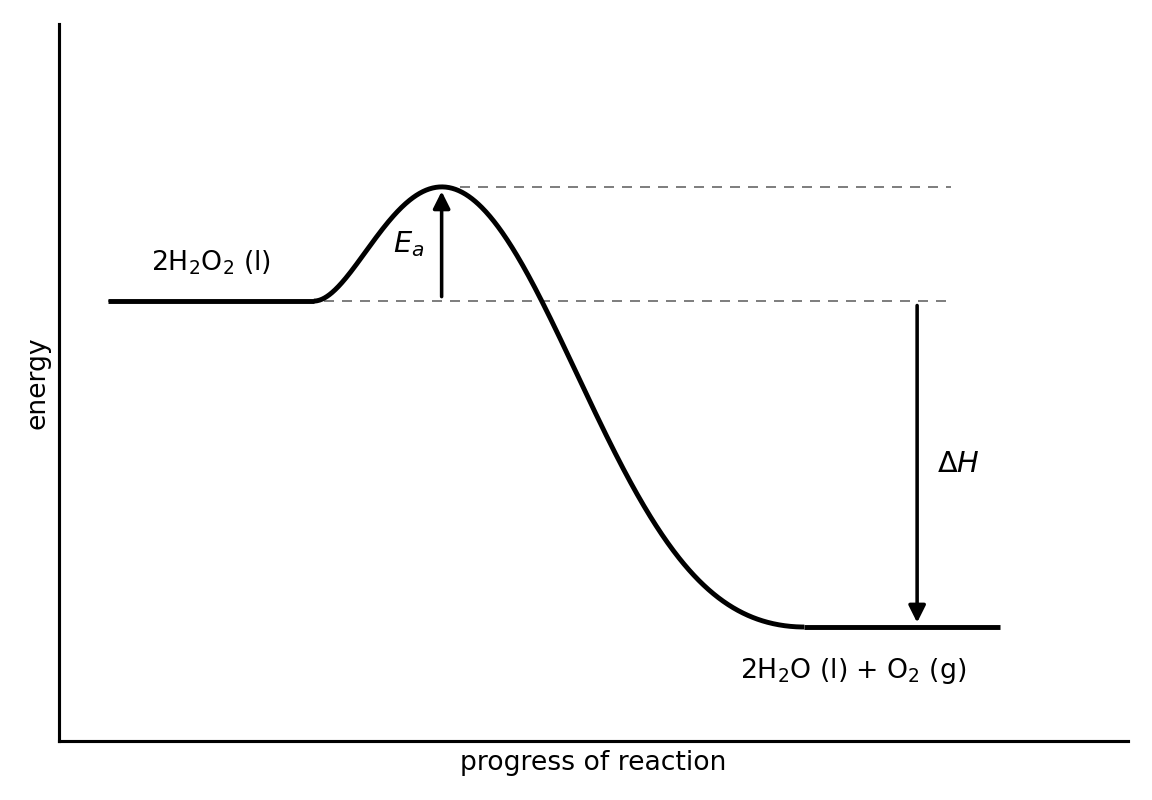
Hydrogen peroxide, H2O2, decomposes to form water and oxygen.

2H2O2 (l) → 2H2O (l) + O2 (g)

ΔH = -196 kJ / mol

The reaction pathway diagram for this reaction is shown in Fig. 5.1.

Energy on the vertical axis against progress of reaction on the horizontal axis. A horizontal line on the left is joined by a curve that rises to a rounded peak and then falls to a second horizontal line on the right, which lies below the first. The left-hand line is labelled 2H2O2 (l) and the right-hand line is labelled 2H2O (l) + O2 (g). An upward arrow labelled E a runs from the level of the left-hand line to the peak. A downward arrow labelled delta H runs from the level of the left-hand line down to the right-hand line.

Fig. 5.1

A student is asked why the enthalpy change for this reaction is negative. The student writes:

"The reaction is exothermic because bonds are made in the products. Energy is needed to make these bonds, and this energy is then given out to the surroundings."

Identify the two errors in the student's answer and give the correct chemistry in each case.

5b
2 marks

A bottle of hydrogen peroxide solution can be stored for several months with very little decomposition, even though the reaction is exothermic.

Use Fig. 5.1 to explain why, including what is meant by the activation energy, Ea.

5c
3 marks

The decomposition is carried out in an open beaker and the temperature of the surroundings is measured.

i)

State and explain what happens to the temperature of the surroundings.

[2]

ii)

The bonds in the products are stronger overall than the bonds in the reactants.

Explain how the value of ΔH shows this.

[1]

6a
3 marks

Hydrogen is manufactured on a large scale by reacting methane with steam.

CH4 (g) + H2O (g) → CO (g) + 3H2 (g)

In carbon monoxide, CO, the carbon atom and the oxygen atom are joined by a triple bond.

Some bond energies are shown in Table 5.1.

Bond

Bond energy in kJ / mol

C-H

410

C=O

805

C≡O

1077

O-H

463

H-H

436

Table 5.1

Calculate the enthalpy change for this reaction.

6b
1 mark

State what the sign of your answer to (a) shows about this reaction.

6c
2 marks

Hydrogen and carbon monoxide can be converted back to methane and steam by the reverse reaction.

CO (g) + 3H2 (g) → CH4 (g) + H2O (g)

State the enthalpy change for this reverse reaction.

Explain your answer.