Diffusion (Cambridge (CIE) O Level Chemistry): Exam Questions

Exam code: 5070

3 hours36 questions
1
6 marks

Ammonia gas and hydrogen chloride gas diffuse at different rates.

When the two gases meet they react to form a white solid.

Plan an experiment to compare the rates of diffusion of ammonia and hydrogen chloride.

Your plan must include the use of common laboratory apparatus, concentrated aqueous ammonia and concentrated hydrochloric acid. No other chemicals should be used.

Your plan must include:

  • the apparatus needed

  • the method to use and the measurements to take

  • the variables to control

  • how the measurements are used to compare the rates of diffusion

You may draw a diagram to help answer the question.

2a
1 mark

In an experiment to compare rates of diffusion, a plug of cotton wool soaked in concentrated aqueous ammonia is placed in one end of a long glass tube. A plug of cotton wool soaked in concentrated hydrochloric acid is placed in the other end. Both ends are sealed with bungs.

After a few minutes a white ring forms inside the tube.

A student repeats the experiment three times and records the distance from the ammonia end to the white ring.

Experiment

Distance from the ammonia end / cm

Time for the ring to appear / s

1

23.4

195

2

23.8

201

3

24

198

State the value in the table that the student has recorded to an incorrect degree of precision.

2b
1 mark

Explain why that value is recorded to an incorrect degree of precision.

2c
2 marks

Calculate the mean distance from the ammonia end to the white ring.

Give your answer to one decimal place.

2d
2 marks

The mean time for the white ring to appear is 198 s.

Use your answer to part (c) to calculate the mean rate of diffusion of the ammonia.

Give your answer in cm/s to three significant figures.

3a
2 marks

In an experiment to compare rates of diffusion, a plug of cotton wool soaked in concentrated aqueous ammonia is placed in one end of a long glass tube. A plug of cotton wool soaked in concentrated hydrochloric acid is placed in the other end. Both ends are sealed with bungs.

After a few minutes a white ring forms inside the tube.

A student carries out the experiment three times. The white ring forms in a slightly different position each time.

Suggest two reasons for this.

3b
1 mark

State why the student calculated a mean position rather than using the result of a single experiment.

3c
1 mark

Name a piece of apparatus the student could use to put equal volumes of the two solutions onto the cotton wool.

3d
2 marks

The student repeats the experiment using a tube that is twice as long.

Explain one advantage and one disadvantage of using the longer tube.

4a
2 marks

In an experiment to compare rates of diffusion, a plug of cotton wool soaked in concentrated aqueous ammonia is placed in one end of a long glass tube. A plug of cotton wool soaked in concentrated hydrochloric acid is placed in the other end. Both ends are sealed with bungs.

After a few minutes a white ring forms inside the tube.

The experiment is repeated in a warmer room.

Predict the effect this has on the time taken for the white ring to appear.

Explain your answer.

4b
2 marks

The white ring always forms nearer to the hydrochloric acid end of the tube than to the ammonia end.

Explain why.

Use the relative atomic masses H = 1, N = 14 and Cl = 35.5.

4c
2 marks

The experiment is repeated using a tube twice as long, with the same two solutions and at the same temperature.

Predict how the distance from the ammonia end to the white ring compares with the distance measured in the original tube.

Explain your answer.

5a
1 mark

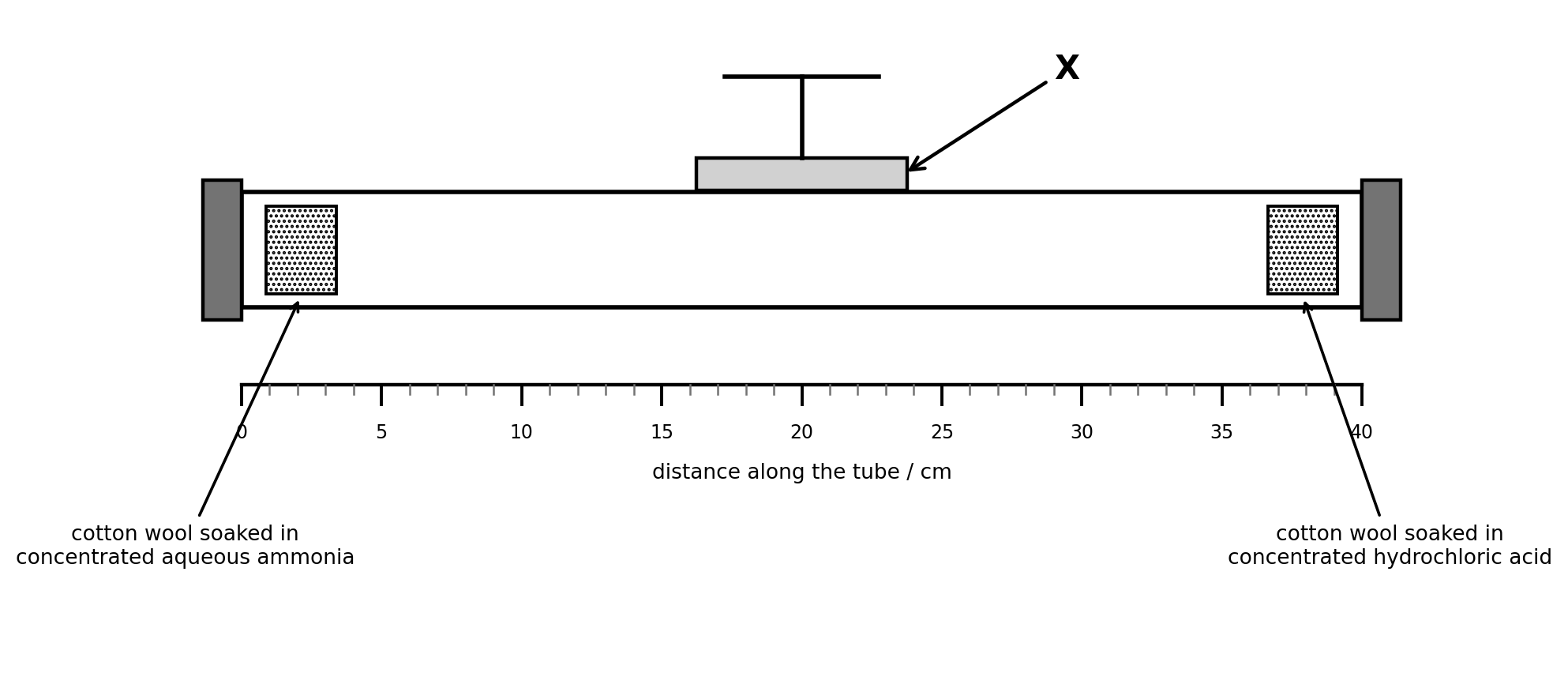
A student compares the rates of diffusion of ammonia and hydrogen chloride using the apparatus shown in Fig. 1.1.

A plug of cotton wool soaked in concentrated aqueous ammonia is placed in one end of the tube and a plug of cotton wool soaked in concentrated hydrochloric acid is placed in the other. Both ends are then sealed with bungs.

Fig. 1.1

A horizontal glass tube drawn in outline, with a shaded bung sealing each end. Just inside each end of the tube is a hatched rectangle. A leader line from the left rectangle points to a label reading cotton wool soaked in concentrated aqueous ammonia, and a leader line from the right rectangle points to a label reading cotton wool soaked in concentrated hydrochloric acid. Resting on top of the tube at its midpoint is a shaded horizontal bar, from which a vertical stem rises to a short horizontal bar above it. An arrow labelled X points to the shaded bar. Beneath the tube is a scale numbered 0 to 40 in steps of 5, with smaller divisions every unit, labelled distance along the tube in centimetres. The left hatched rectangle sits at about 2 on this scale and the right one at about 38.

Name apparatus X.

5b
1 mark

The student leaves the apparatus undisturbed.

Describe what is seen inside the tube after a few minutes.

5c
1 mark

Explain why both ends of the tube are sealed with bungs.

5d
2 marks

The student wants to compare the distance travelled by each gas.

State the two measurements the student should take, using the scale shown in Fig. 1.1.

5e
1 mark

The product forms as a broad band rather than as a sharp line.

Suggest why.