11 mark
Which of the following formulae shows an alkane?
C2H4
C4H8
C4H10
C5H10
Was this exam question helpful?
Exam code: 5070
Which of the following formulae shows an alkane?
C2H4
C4H8
C4H10
C5H10
Was this exam question helpful?
Which of the following structures shows a compound that belongs to a different homologous series to octane?

Was this exam question helpful?
The diagram shows the structure of ethene.

Which of these compounds has similar chemical properties of ethene?

Was this exam question helpful?
The structures of four organic compounds are shown.
Which one does not show the displayed formula of the compound?

Was this exam question helpful?
Which of the following is not a feature of a homologous series?
Compounds have the same functional group
Compounds have the same physical properties
Compounds have the same general formula
Compounds have similar chemical properties
Was this exam question helpful?
Butene and octene belong to the same homologous series.
What would be the same for butene and octene?
Boiling point
Number of hydrogen atoms per molecule
Relative molecular mass
Functional group
Was this exam question helpful?
The structures of six organic compounds are shown.
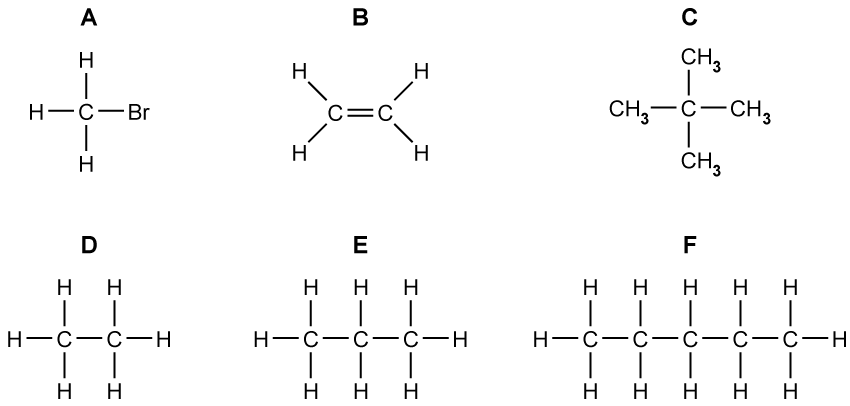
Which two compounds are isomers of one another?
B and D
A and C
C and F
C and E
Was this exam question helpful?
Which compound is an alkane?
C31H33
C31H60
C31H62
C31H64
Was this exam question helpful?
The structural formula of ethanoic acid is CH3COOH.
One of the bonds in a molecule of ethanoic acid is a C=O double bond.
Which statement about ethanoic acid is correct?
It is unsaturated, because the molecule contains a double bond.
It is unsaturated, because the molecule contains more than one type of bond.
It is saturated, because the molecule contains only single bonds.
It is saturated, because all of the carbon–carbon bonds in the molecule are single bonds.
Was this exam question helpful?
Butanoic acid, C3H7COOH, is a member of the carboxylic acid homologous series.
Which is the general formula of this homologous series?
CnH2nCOOH
CnH2n+1COOH
CnH2n+2COOH
CnH2n+1OH
Was this exam question helpful?
X and Y are consecutive members of the same homologous series. Y is the member that comes immediately after X.
The relative molecular mass, Mr, of X is 100.
What is the relative molecular mass of Y?
101
114
116
200
Was this exam question helpful?
The first three members of a homologous series are shown.

Why do these molecules represent a homologous series?
They contain carbon and hydrogen atoms.
They have saturated bonds.
They have the same functional group.
They react differently from each other.
Was this exam question helpful?
Which pair of the following structures shows a homologous series?

Was this exam question helpful?
P, Q and R are three consecutive members of the same homologous series.
P has the smallest relative molecular mass of the three and R has the largest.
P burns in excess oxygen to form carbon dioxide and water only.
Which statement about Q and R must be correct?
Q and R have the same molecular formula as P
Q and R have a different general formula from P
Q and R have lower boiling points than P
Q and R form the same products as P on complete combustion
Was this exam question helpful?
The displayed formula of an organic compound is shown.

What is the name of this compound?
butan-1-ol
butan-2-ol
butan-3-ol
butanol
Was this exam question helpful?
W, X, Y and Z are the first four members of the carboxylic acid homologous series, but not necessarily in that order.
The table shows their relative molecular masses, Mr.
substance | relative molecular mass, Mr |
W | 60 |
X | 88 |
Y | 46 |
Z | 74 |
Which sequence shows the substances in order of decreasing boiling point?
X → Z → W → Y
Y → W → Z → X
W → X → Y → Z
Z → X → W →Y
Was this exam question helpful?
The table shows three members of the alkane homologous series.
compound | molecular formula | relative molecular mass, Mr |
|---|---|---|
W | CH4 | 16 |
X | C3H8 | 44 |
Y | C4H10 | 58 |
Statements about W, X and Y are given.
1 W, X and Y have the same general formula.
2 W, X and Y have the same empirical formula.
3 Y has the highest boiling point of the three compounds.
Which statements are correct?
1, 2 and 3
1 and 2 only
1 and 3 only
2 and 3 only
Was this exam question helpful?