Ions & Ionic Bonds (Cambridge (CIE) O Level Chemistry): Alternative to Practical Questions

Exam code: 5070

4 hours54 questions
1a
1 mark

A student investigates four solids, A, B, C and D.

For each solid the student finds out whether it melts when heated in a Bunsen flame, whether the solid conducts electricity, whether it dissolves in water, and whether the solution formed conducts electricity.

The results are shown in Table 1.1.

Table 1.1

solid

melts in a Bunsen flame

solid conducts electricity

dissolves in water

solution conducts electricity

A

no

no

yes

yes

B

yes

no

yes

no

C

no

yes

no

not tested

D

no

no

no

not tested

Identify which solid is an ionic compound.

1b
2 marks

Give two results from Table 1.1 that support your answer.

1c
1 mark

The student concludes that solid C is a metal.

State the result in Table 1.1 that supports this conclusion.

1d
2 marks

The student tests the solutions using the same pair of electrodes each time, without washing them between tests.

Explain why this could affect the results.

2
6 marks

A student is given a white solid.

The solid is either an ionic compound or a simple molecular compound.

Plan an experiment to find out which of these the solid is.

Your plan must use common laboratory apparatus and the solid provided. No other chemicals should be used, apart from distilled water.

Your plan must include:

  • the apparatus needed

  • the method to use and the observations to make

  • the variables to control

  • how the observations are used to decide whether the solid is ionic

You may draw a diagram to help answer the question.

3a
1 mark

A student investigates how well solutions of ionic compounds conduct electricity.

The student places two carbon electrodes into a solution and records how brightly a lamp in the circuit glows.

The student records the brightness of the lamp as dim, bright or very bright.

Suggest one disadvantage of recording the results in this way.

3b
2 marks

When the electrodes are placed in a dilute solution of potassium chloride, the lamp glows only dimly.

The student repeats the test using a more concentrated solution of potassium chloride.

Predict and explain the effect this has on the brightness of the lamp.

3c
1 mark

The student wants to improve the way the solutions are compared.

Suggest one change to the apparatus that would allow this.

3d
2 marks

The student compares solutions of several different ionic compounds.

State two variables the student should keep the same for each solution tested.

4a
1 mark

A student heats a small sample of solid P and a small sample of solid Q in a Bunsen flame.

The student is investigating which of the two solids is an ionic compound.

In the results table, the student writes solid Q is ionic in the column headed observation.

Explain why this is not an observation.

4b
2 marks

Solid P is a simple molecular compound and solid Q is an ionic compound.

Describe what the student should see when each solid is heated strongly in the Bunsen flame.

4c
2 marks

Explain how these results show that solid Q has the higher melting point.

4d
1 mark

Suggest why this method cannot be used to find the actual melting point of solid Q.

5a
1 mark

A student tests whether different substances conduct electricity.

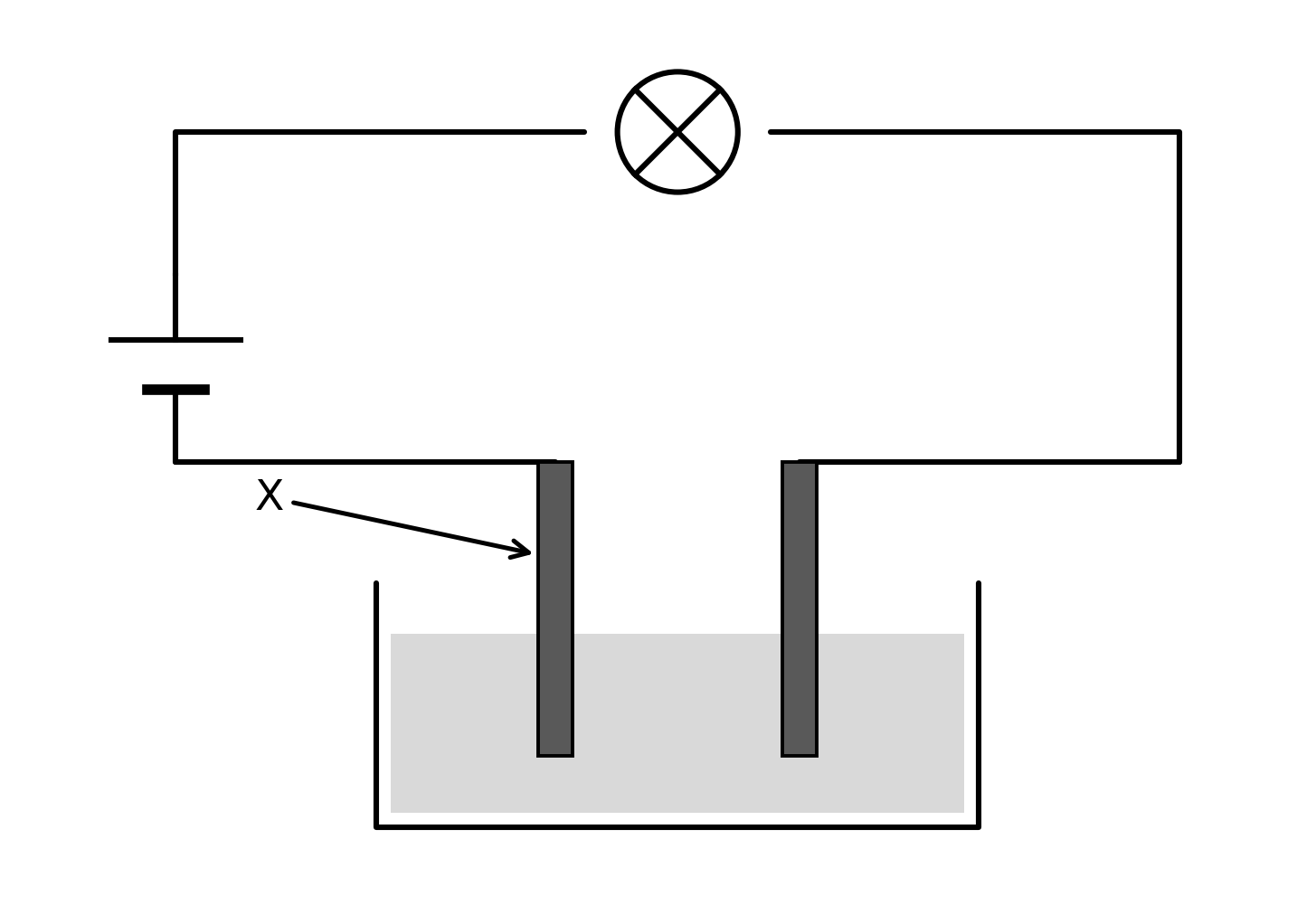
The apparatus used is shown in Fig. 1.1. The substance being tested is placed in the dish.

Fig. 1.1

A circuit drawn as a closed loop. On the top wire is a circle containing a diagonal cross. On the left wire is a pair of horizontal plates, a long thin one above a short thick one. The bottom wire runs to two identical dark grey vertical rods, which hang down side by side into an open-topped dish. The dish contains a pale shaded substance filling it to just below the rim, and the lower part of each rod is buried in the substance. An arrow labelled X points to the left-hand rod.

Name apparatus X.

5b
2 marks

The student places solid sodium chloride in the dish and switches on the power supply.

Describe and explain what is seen.

5c
1 mark

The student dissolves the sodium chloride in distilled water, pours the solution into a clean dish and repeats the test.

Describe what is seen.

5d
2 marks

The student uses distilled water to make the solution, rather than tap water.

Suggest why.